Co-Sell Frameworks for Ecosystem Teams: What to Trust

What are co-sell frameworks for ecosystem teams?
Short answer: Co-sell frameworks for ecosystem teams are documented, repeatable models that define how partners and a vendor sell together, covering who owns the customer, how deals are registered and tracked, and what each side does at every stage. A trustworthy one is judged not by how polished it looks but by whether it holds up when a real deal runs through it.
Ecosystem teams chase frameworks because they want repeatability, and that instinct is right. A motion that lives in one person’s head cannot scale across an ecosystem of partners, and a framework is how the motion becomes something any rep on any side can run.
But not every framework deserves trust. Many are abstract diagrams that describe co-sell in theory and fall apart the moment a live deal introduces a registration conflict or an ownership dispute. The trustworthy ones are built from real deals, not from a slide.
Why co-sell frameworks for ecosystem teams matter in 2026
Ecosystems have grown large enough that informal co-sell no longer scales, and in 2026 the ecosystem teams that produce are the ones running a defined framework rather than improvising each partner deal. Co-sell frameworks for ecosystem teams matter because they are the difference between a motion that works once and a motion that works across dozens of partners and hundreds of deals.
The second reason is trust between companies. A framework that clearly defines ownership, registration, and roles removes the friction and the disputes that kill joint selling, because both sides know the rules before the deal rather than fighting about them during it. Clarity is what lets two sales teams trust each other enough to share pipeline.
The third reason is onboarding speed. When a new partner joins the ecosystem, a documented framework lets them start co-selling in weeks rather than learning the motion by trial and error. The framework is the asset that makes the ecosystem scalable instead of bespoke.
How co-sell frameworks for ecosystem teams actually work
A trustworthy framework works because it answers the questions that real deals force, in writing, before the deals arrive.
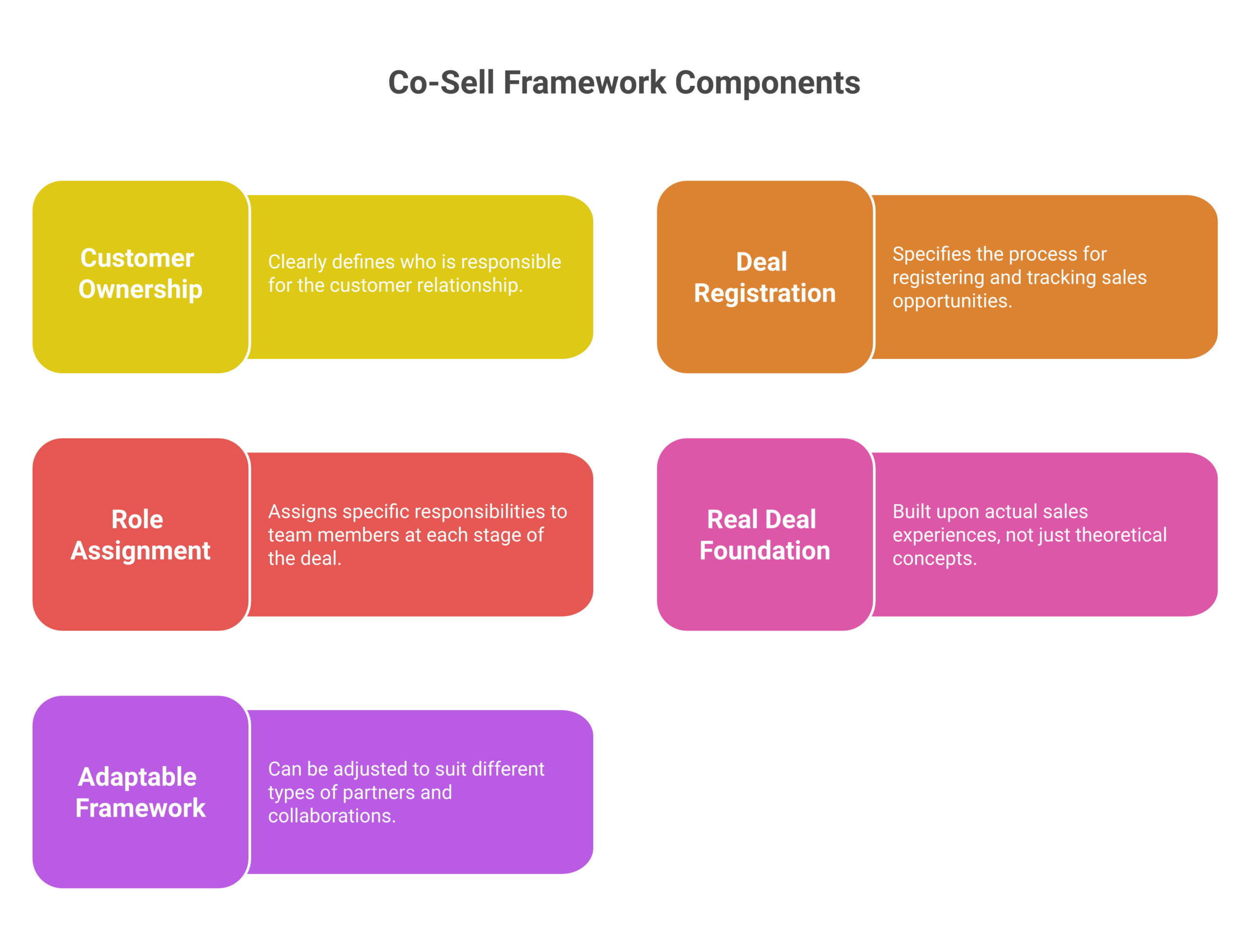
- It defines who owns the customer: The framework states clearly which side leads the customer relationship in which scenarios, so there is no ownership dispute mid-deal. Ambiguity about ownership is the single most common reason co-sell turns adversarial.
- It specifies deal registration and tracking: The framework lays out how a co-sell deal is registered, where it is tracked, and how both sides see its status, so the deal is visible to everyone who needs it. A motion no one can see is a motion no one can trust.
- It assigns roles at each stage: The framework names what each side does at discovery, pitch, and close, so reps execute a known play instead of improvising the choreography. Defined roles are what make a joint deal feel coordinated to the customer rather than confused.
- It is built from real deals, not theory: A trustworthy framework comes from motions that actually closed, refined against the conflicts and edge cases real deals produce, not from an abstract diagram. The test of a framework is whether it survives contact with a live opportunity.
- It is adaptable across partner types: An ecosystem holds different kinds of partners, and a trustworthy framework flexes to integration partners and services partners without breaking, rather than assuming every partner co-sells the same way. Rigidity is what makes a framework useless past the first partner type.
The framework is working when a new partner can run a co-sell deal correctly the first time using only the document, and it is failing when reps still have to ask how co-sell works because the framework describes a theory rather than a play.
Common pitfalls when choosing co-sell frameworks for ecosystem teams
- Trusting a framework built from theory: A polished diagram that has never been run against a real deal falls apart at the first registration conflict or ownership dispute. Trust frameworks that came from motions that actually closed, not from a whiteboard exercise.
- Adopting a framework that ignores ownership: A framework that does not clearly define who owns the customer guarantees mid-deal disputes that turn co-sell adversarial. Ownership clarity is non-negotiable in any framework worth trusting.
- Using a rigid framework across a diverse ecosystem: A model that assumes every partner co-sells identically breaks the moment you apply it to a different partner type. A trustworthy framework flexes across integration and services partners rather than forcing one motion on all.
- Treating the framework as a document, not a practice: A framework that lives in a folder no rep reads produces nothing. The value is in the framework being used on real deals, which means it has to be taught, referenced, and reinforced, not just written.
- Confusing a framework with a tool: A framework defines the motion; a tool makes it visible. Adopting software and calling it a co-sell framework leaves the actual motion undefined. The framework is the play, and the tool tracks it.
What this looks like in practice
An ecosystem team had twelve partners and twelve different co-sell experiences. Each partnership had invented its own way of working, ownership was disputed on roughly half the deals, and a new partner took a quarter to figure out how anything worked. The team went looking for a trusted framework and almost adopted a glossy one from a deck, until they tested it against three live deals and watched it fail every registration conflict. Instead they built their own from the motions that had actually closed, writing down who owned the customer in each scenario, how deals were registered, and what each side did at every stage, then refined it against the edge cases their real deals had produced. They taught it to every partner and kept it adaptable for integration versus services partners. The next partner that joined was co-selling correctly within three weeks, using only the document. The framework earned trust because it came from real deals, not because it looked impressive.
Forecastable’s POV on co-sell frameworks for ecosystem teams
The conviction we hold is that a co-sell framework is only as trustworthy as the deals it was built from. The market is full of attractive frameworks that describe co-sell in the abstract and collapse the instant a real deal introduces a conflict over ownership or registration. When an ecosystem team evaluates who provides a trusted framework, the question to ask is simple: has this survived contact with live deals, or is it a theory rendered as a diagram?
The second conviction is that ownership clarity is the load-bearing element. Most co-sell breakdowns are not about strategy, they are about two sides disagreeing on who owns the customer in the middle of a deal. A framework that resolves that question in advance prevents the disputes that turn joint selling adversarial, and a framework that ducks it is not worth adopting regardless of how complete the rest looks.
The honest caveat is that the best framework for an ecosystem team is often one built from its own closed deals rather than one bought off the shelf. External frameworks are useful starting points and faster than nothing, but the version that earns lasting trust is refined against the team’s real motions and partner types. Borrow the structure, then make it yours against actual deals.
Forecastable is a partnerships operating platform; any third-party tools or platforms referenced here are independent third-party products, and naming them is not an endorsement of one deployment over another. Evaluate each against your own motion.
Frequently asked questions
What makes a co-sell framework trustworthy for an ecosystem team? It was built from real deals that actually closed, it clearly defines who owns the customer, and it survives contact with live opportunities. A framework that exists only as an abstract diagram has not earned trust because it has never been tested where it matters.
What should a co-sell framework for ecosystem teams contain? Clear customer ownership rules, a defined deal registration and tracking process, assigned roles at each stage, and enough flexibility to work across different partner types. Those are the questions real deals force, so a framework that answers them in writing holds up.
Should an ecosystem team build or buy a co-sell framework? Often both. An external framework is a faster starting point than a blank page, but the version that earns lasting trust is refined against the team’s own closed deals and partner types. Borrow the structure, then adapt it to your reality.
Why do co-sell frameworks fail in practice? Usually because they were built from theory and never tested against a live deal, or because they ducked the ownership question. Both failures show up the same way, the framework falls apart the first time a real deal introduces a conflict it did not anticipate.
Is a co-sell tool the same as a co-sell framework? No. A framework defines the motion, who does what and who owns the customer, while a tool makes the motion visible and trackable. Adopting software without a defined framework leaves the actual motion undefined, so the two work together rather than substitute for each other.
How does a framework help onboard new ecosystem partners? A documented framework lets a new partner start co-selling correctly in weeks rather than learning the motion by trial and error. It is the asset that makes an ecosystem scalable, because each new partner runs a known play instead of inventing its own.
Next step
If every partner in your ecosystem co-sells differently, the move this quarter is to build a framework from the deals that actually closed, define ownership, registration, and roles in writing, then test it against live opportunities before you trust it across the ecosystem.
Start your growth journey now to give your ecosystem team a co-sell framework that survives real deals, or see the orientation on co-sell for how the framework fits the broader motion.
Uncover Your Growth Potential
Schedule a Discovery Call