Partner Discovery Call: Running One That Books Co-Sell
What is a partner discovery call?
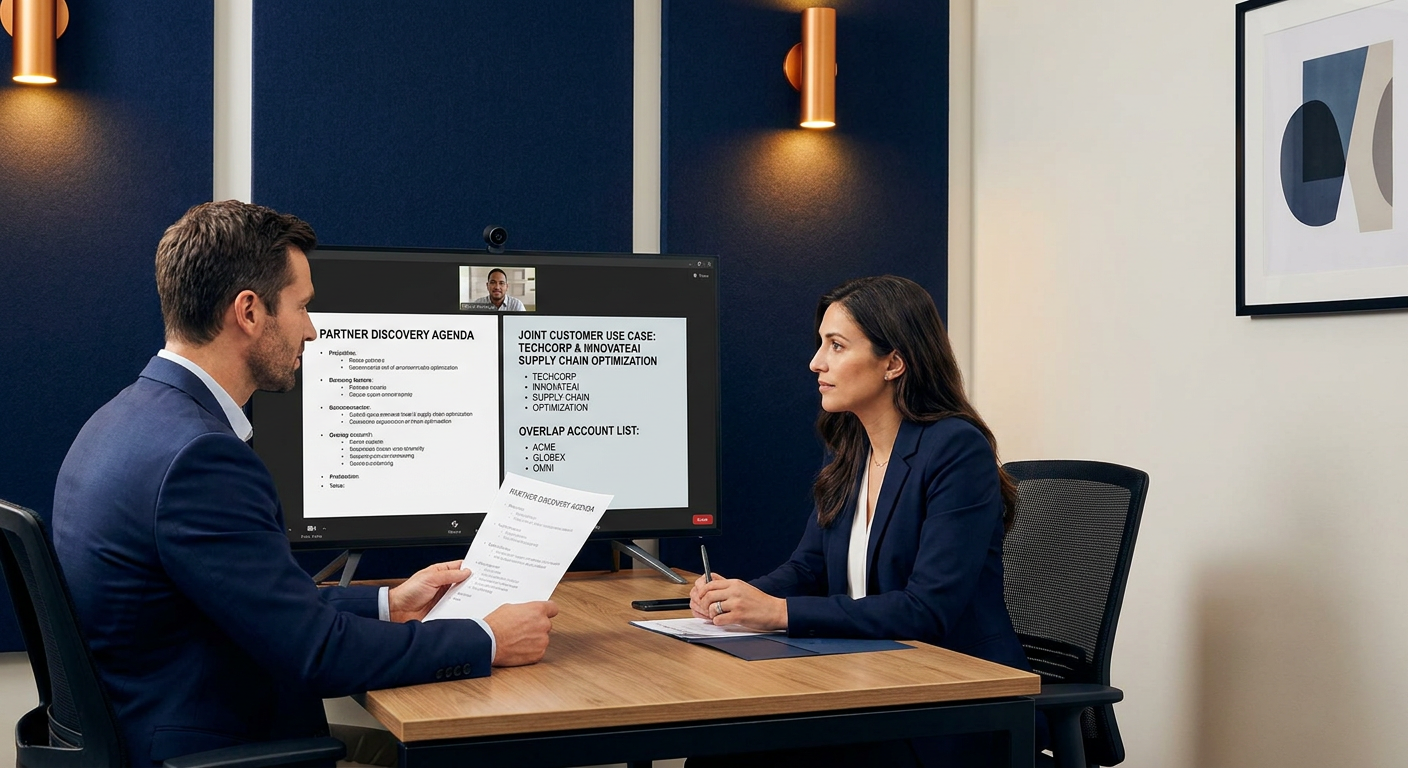
Short answer: A partner discovery call is the first thirty-to-sixty minute working session between a host partnerships team and a partner-side counterpart to determine whether a joint go-to-market motion is operationally viable, with a named joint customer use case, named overlap accounts, and a defined next move at the end of the call. It is not a relationship intro and it is not a vendor pitch; it is a working diagnostic that produces a yes-or-no on whether the partnership justifies a co-sell investment.
The shortcut is to run the call as a working session, not as a sales meeting. The host brings a hypothesis on the joint motion, an overlap account list, and a draft joint value frame; the partner side responds with their read on each. The call ends with a named next move or a clean no.
Why partner discovery calls matter in 2026
Three forces have made the partner discovery call central to partnership ROI. First, partnerships teams are running more first-call conversations than they can convert; the median program runs forty to a hundred partner discovery calls per year and converts a small share to active co-sell, and the wasted calls are a real cost. Second, the partner-side counterparts have less patience for vendor-pitch first calls; partner managers who run a working diagnostic outperform those who run an intro deck. Third, the operational signal that determines co-sell viability (overlap, customer fit, joint use case) is now structured enough to surface in the call, so the call can do real diagnostic work instead of relationship-building.
A working partner discovery call is short, structured, and ends with a named next move. The teams that produce conversion run the call as a working session; the teams that produce nothing run it as a vendor pitch.
The shortcut is to send the working agenda before the call, with the overlap account list and a draft joint value frame, so the partner counterpart shows up with their read instead of with a blank slate.
How a partner discovery call actually works
A working partner discovery call runs on six segments inside a thirty-to-sixty minute window. Each segment is named, has a working artifact, and ends with a captured decision.
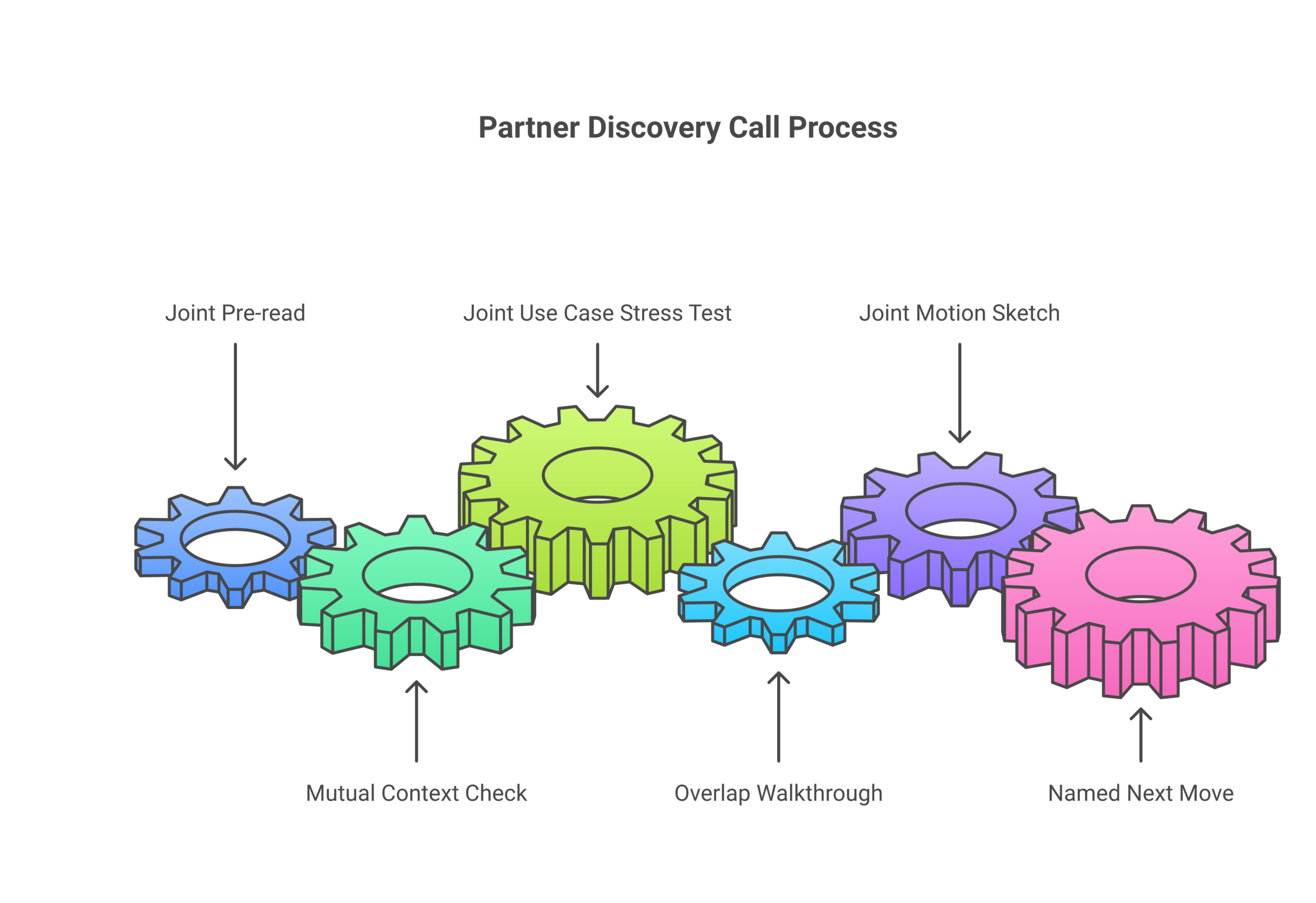
- Joint pre-read (sent twenty-four hours before): A one-page pre-read with the overlap account list (from Crossbeam, Pocus, or Common Room), the draft joint value frame, the proposed motion, and three open questions for the partner side. The pre-read is the diagnostic; the call validates it.
- Mutual context check (five minutes): Each side restates the strategic priority of partnership for their org and the named outcome each is trying to drive this quarter. The mutual check surfaces misalignment before it costs the rest of the call.
- Joint use case stress test (ten to fifteen minutes): Walk through one or two specific named joint customer scenarios with the prospect named or anonymized. The partner-side counterpart says what their seller would do in the scenario; the host side says what their AE would do. The stress test surfaces whether the motion is operationally real.
- Overlap walkthrough (ten minutes): Open the overlap account list and walk through the named Tier 1 and Tier 2 signals. The partner side validates the relationship reads and adds the partner-side context; the overlap goes from data to a candidate target list.
- Joint motion sketch (ten minutes): Sketch the first co-sell motion (joint discovery on an overlap account, a joint pitch deck, a small MDF event, a joint marketplace listing). The sketch is one to two pages, not a plan; the plan is downstream.
- Named next move (five minutes): One of three outcomes. A scoped co-sell pilot with a named target account list and a defined next call; a deferral with a named re-engagement trigger; a clean no with the diagnostic reason. The call closes on a captured decision.
The call runs at sixty minutes with the joint motion sketch, or at thirty minutes with the motion sketch deferred to a second call.
Common pitfalls in running a partner discovery call
- Running the call as a vendor pitch: An intro deck on the host product is the wrong opening. The partner-side counterpart has heard ten of these; the working diagnostic is what differentiates the call.
- No pre-read: The partner-side counterpart shows up with no overlap data, no joint value frame, and no read on the motion. The call burns thirty minutes on context and runs out of time before the diagnostic. Send the pre-read.
- Skipping the joint use case stress test: A discovery call without a named joint use case produces a relationship, not a motion. The stress test is where the partnership becomes operationally real or falls apart.
- No named next move: The call ends with a vague “we will be in touch” and the motion never materializes. The named next move is what turns the call into a co-sell investment.
- Talking past the partner-side counterpart’s compensation structure: If the partner-side seller’s compensation does not pay for the host’s joint motion, the motion will not happen. Ask early; design the motion to match the comp.
What this looks like in practice
A growth-stage B2B SaaS team had three Tier 1 SI candidates in the pipeline and was running discovery calls with an intro deck and a relationship hello. Conversion to a scoped co-sell pilot was running at one in eight, and the partner-side counterparts often ghosted after the first call. The head of partnerships rebuilt the call as a working diagnostic: a one-page pre-read with an overlap list (Crossbeam), a draft joint value frame, and three open questions, sent twenty-four hours before. The call ran sixty minutes with a joint use case stress test on a named anonymized prospect and an overlap walkthrough on twenty Tier 1 and Tier 2 signals. Three of the next eight calls converted to scoped co-sell pilots within two weeks, and two more produced a deferred re-engagement trigger that activated in the following quarter. The conversion rate on the discovery-call funnel moved from one in eight to three in eight, and the partner-side counterparts who said yes were higher-quality than the prior cohort.
Forecastable’s POV on partner discovery calls
The partner discovery call is the highest-leverage hour in the partnerships motion. The teams that run it as a working diagnostic produce a short list of high-conviction partner pilots; the teams that run it as a vendor pitch produce a long list of polite no-replies. The pre-read, the joint use case stress test, and the named next move are the three components that differentiate the two outcomes.
The deeper read is that the partner discovery call is where most partnerships teams lose pipeline before it ever ships. A program that converts one in eight discovery calls to a working co-sell motion is a program with a low ceiling, regardless of how many partners it signs. Doubling the conversion rate doubles the program output without recruiting a single additional partner.
The candor on the call length question is that sixty minutes is the working session length and thirty minutes is the truncated working session. A fifteen-minute call is a vendor pitch slot; a ninety-minute call is a relationship meeting that the partner side does not have time for. Run it at sixty when the agenda fits; otherwise run thirty and defer the motion sketch.
The candor on the partner-side counterpart question is that the right counterpart is the partner-side partnerships leader or the partner-side regional sales leader, not the partner-side BD or the partner-side intern. If the right counterpart is not on the call, defer the call until they are.
Forecastable is a partnerships operating platform; the tools above (Crossbeam, Pocus, Common Room, Tackle, Labra, Suger, Clazar, Introw, Euler, Impartner, PartnerStack, Channelscaler) are independent third-party platforms, and naming them is not an endorsement of any specific deployment over another. Evaluate each on your own motion.
Frequently asked questions
What is the right agenda for a partner discovery call?
Mutual context check, joint use case stress test, overlap walkthrough, joint motion sketch, and named next move. The pre-read goes out twenty-four hours before; the call validates the pre-read.
How long should a partner discovery call run?
Sixty minutes is the working session length; thirty minutes is the truncated version that defers the motion sketch to a second call. Anything shorter is a vendor-pitch slot, not a discovery call.
Who should be on a partner discovery call?
The host partnerships leader or partner manager, and the partner-side partnerships or regional sales leader. AEs and BD reps can join the second call; the first call is the working diagnostic.
What is the right pre-read for a partner discovery call?
A one-page document with the overlap account list, a draft joint value frame, the proposed motion, and three open questions for the partner side. Sent twenty-four hours before the call.
How do we measure partner discovery call performance?
Conversion rate from discovery call to scoped co-sell pilot, and the time to first co-sell deal on the pilot. Mature programs run at three to four in eight conversion; weaker programs run at one in eight or below.
Should we use a slide deck on a partner discovery call?
Use the one-page pre-read and the overlap account list; skip the slide deck. A working diagnostic does not need a deck; an intro deck signals a vendor pitch and lowers conversion.
What is the right next move if the partner discovery call goes well?
A scoped co-sell pilot with a named target account list, a defined first joint motion (joint discovery, joint pitch, MDF event), and a follow-up call inside two weeks. The named next move goes into the PRM (Introw, Euler, Impartner, PartnerStack, or Channelscaler) as the deal-registration workflow opens.
Next step
If a partner discovery call is on the calendar this week, the move now is to send the one-page pre-read with the overlap account list and the draft joint value frame twenty-four hours before, lock the joint use case stress test, and pre-write the three candidate next moves before the call opens.
Start your growth journey now to install a working partner discovery call motion in your specific environment, or read the orientation on the partner program for the broader operating model.
Uncover Your Growth Potential
Schedule a Discovery Call