Ideal Partner Profile: How to Define and Use One

What is an ideal partner profile?
Short answer: an ideal partner profile is the explicit definition of the partner type a program is built to recruit, activate, and scale, expressed as a small set of measurable traits rather than a logo wish-list. In 2026, the programs that produce partner-sourced pipeline have a written profile they actually use; the ones that do not produce a roster instead of revenue.
The how to build a partner program sequence treats the profile as Pillar 1 because everything downstream depends on it, and the partner recruitment strategy work runs the profile against a named target list. The profile is the filter; recruitment is the application.
A working profile has three properties. It is narrow: one partner type per profile, not three motions wearing one label. It is measurable: each trait is something you can observe before you sign a partner. And it is production-focused: the traits predict whether the partner will source or co-sell pipeline, not whether the partner looks impressive on a slide.
Why an ideal partner profile matters in 2026
Partnerships teams are capacity-constrained, and the ideal partner profile is the filter that decides where capacity goes. Without one, recruitment becomes opportunistic and the roster grows uneven across motions.
Three forces make this urgent. First, partner rosters grew during the easy-money years, and many programs now have more partners than they can support; the profile is how you triage future recruitment. Second, partner-sourced revenue is now a board number, which means the program has to be built around the partner type that produces, not the one that looks like a logo win. Third, the AE/sales-team side of the company is paying closer attention to which partners actually warm pipeline, and a fuzzy partner profile shows up there fast.
The mechanical case is simple. A program with a clear profile recruits 12 partners that all produce; a program without one recruits 50 partners, of which six produce and the rest sit idle. The first program is funded; the second loses budget arguments because the math reads as poor productivity per partner.
This is also a partner-side signal. Partners that match the profile feel the alignment immediately; partners that do not, drift away on their own. Both outcomes are useful.
How an ideal partner profile actually works
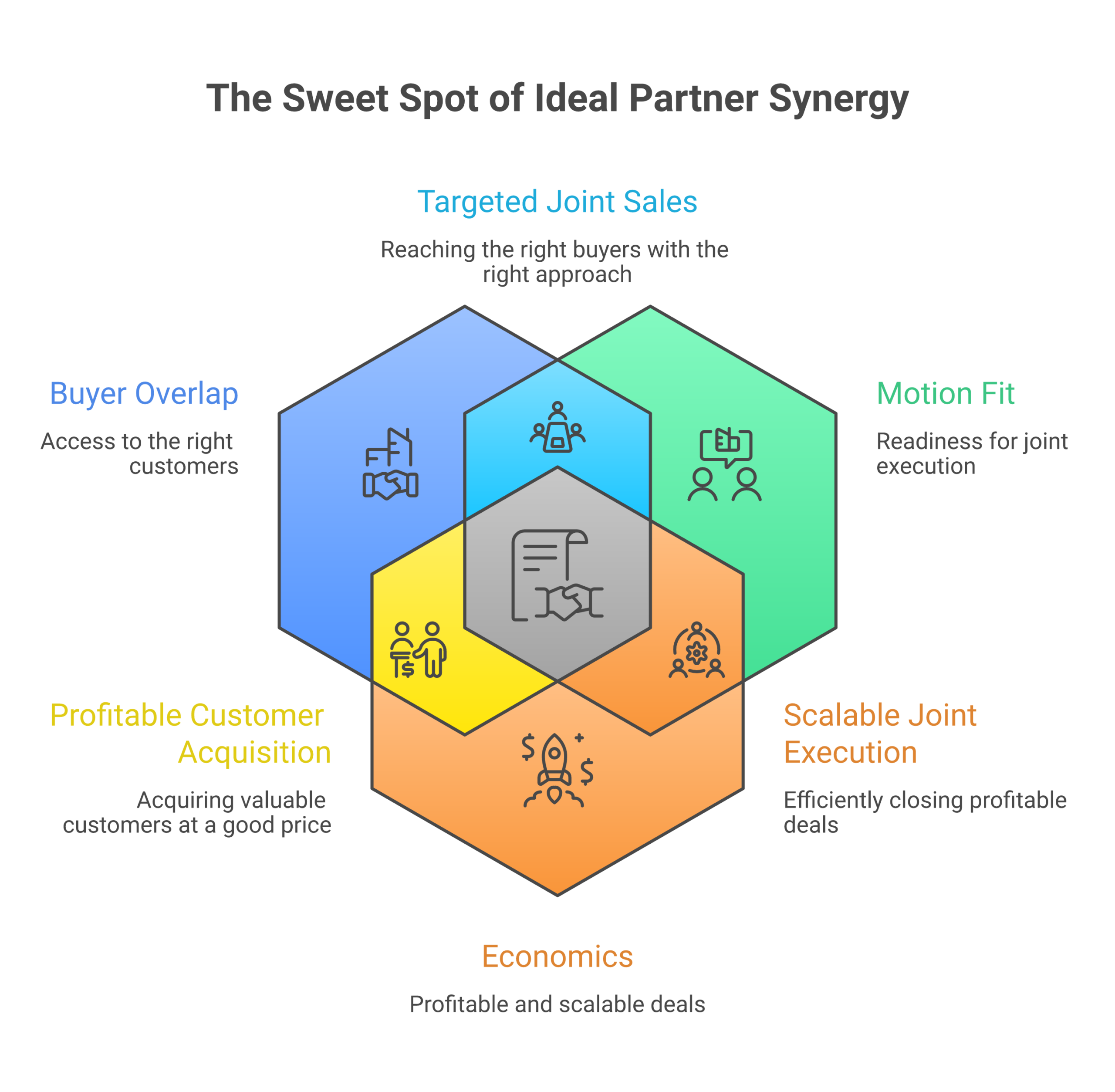
Five steps build a profile that survives contact with the recruitment pipeline. Each step is a discipline, and skipping any one produces a profile that exists on a slide but not in the calendar.
- Pick one partner type per profile: reseller, SI, tech ISV, referral. Do not write a profile that tries to describe all four. If the program serves multiple types, write one profile per type and prioritize.
- Write the joint solution the partner would deliver: what does the partner sell or implement, and what becomes possible for the customer when your offering is in the mix? If the joint solution is not crisp, the profile is aspirational, not operational.
- Define the production traits, not the company traits: customer overlap, target-account ICP fit, presence at the buying committee, willingness to register deals, and a named champion inside the partner who will sponsor the motion. These traits predict pipeline; company size and brand prestige rarely do.
- Make every trait observable before signing: a trait you cannot verify pre-contract becomes a hope after-contract. Build verification into the recruitment process via the partner recruitment strategy so the profile filters the funnel.
- Connect the profile to weekly allocation decisions: each week, ask whether the team’s time and dollars went to partners who match the profile. If not, either the profile is wrong (revise) or the allocation is drifting (correct).
Programs that run all five build a profile that becomes the recruitment filter and the investment filter. Programs that stop at step three end up with a definition that sounds right and changes no behavior.
Common pitfalls
Four repeating failures show up across ideal-partner-profile drafts, and all four are recognizable early.
- The logo wish-list: writing the profile as a list of brands the team wants to win produces a vanity recruitment pipeline. Logo prestige rarely predicts partner-sourced pipeline; production traits do. Tier on output, not on letterhead.
- One profile that tries to be every profile: a profile that mixes reseller, ISV, and referral signals describes no one. Write one profile per motion; if the team cannot support multiple profiles yet, narrow the program to one.
- Traits the team cannot verify pre-sign: “demonstrates strong intent to co-sell” sounds right and is unverifiable. Replace with observable proxies (named champion identified, account-overlap confirmed, prior deal registration with a peer vendor).
- A profile that never re-checks against recruited partners: a profile written once and never re-run drifts. Quarterly, check whether recruited partners match the profile and whether the matching ones outperform the non-matching ones. If they do not, the profile is wrong.
What this looks like in practice
An ideal partner profile sits at the intersection of three operating systems: the partner CRM/PRM where partners are tracked, the ecosystem platform where overlap is measured, and the recruitment process where the profile gets applied.
a mid-stage SaaS company writes one profile for its reseller motion and a second for its tech ISV motion. The reseller profile names five production traits, customer-base overlap with target ICP, named champion at the partner’s regional director level, prior co-sell experience with at least one peer vendor, deal-registration willingness confirmed pre-contract, and a specific named-account target list of 25 accounts. The team applies the profile to every prospective reseller and walks away from any partner that misses two or more traits. Recruitment slows in volume and the average partner produces twice as fast. The board-deck number moves.
Forecastable’s POV
The ideal partner profile is the cheapest, highest-leverage artifact in a partner program, and the one most teams quietly skip. Writing the profile takes a week. Not writing it costs eighteen months of recruitment that the team has to undo later.
The most common failure mode I see is treating the profile as a marketing document. Marketing writes profiles in aspirational language: “innovative partners with strong intent to co-sell.” Those documents read well at all-hands and predict nothing in the field. A profile that is actually used reads more like a checklist than a manifesto: five traits, each observable, scored before any contract gets near the legal team. The team that uses such a profile walks away from logos that the marketing version would have welcomed, and the average partner produces.
The second move is to write one profile per partner type and accept that the program may need to narrow temporarily. The instinct in a young program is to recruit broadly across reseller, ISV, and referral simultaneously, in case any of them work. That instinct creates a small portfolio of underdeveloped relationships across three motions, and three motions take three operating cadences the team does not have. Pick one motion, write one profile, recruit to it, and prove the motion before adding the next.
The third move is to re-check the profile against the recruited roster quarterly. The check is simple: do partners who matched the profile outperform partners who did not? If yes, hold the profile and tighten recruitment. If no, the profile is wrong, and the wrong profile is far more expensive than no profile because it scales the wrong recruitment confidently. Use the quarterly check as a fact-finding exercise, not a defense of the original document.
Forecastable is an independent third-party professional services company. Our evaluations of partner-profile and ecosystem platforms are based on publicly-available information as of May 2026 and our own client experience.
Frequently asked questions
What should an ideal partner profile include? A single partner type, the joint solution it would deliver, and five or so production traits that are observable before signing, customer overlap, ICP fit, named champion at the partner, willingness to register deals, and target-account alignment.
How is an ideal partner profile different from an ICP? An ICP describes the end customer; an ideal partner profile describes the partner who will help you sell to that ICP. The two work together, a good partner profile is built around a clear ICP.
Should you have one profile or multiple? One per partner type (reseller, SI, tech ISV, referral). A single profile that tries to describe all types describes none. If the program serves multiple types, prioritize and roll out one at a time.
What traits actually predict partner-sourced pipeline? Customer-account overlap with your ICP, willingness to register deals pre-contest, a named champion at the partner who will sponsor the motion, and prior co-sell behavior with a peer vendor. Company size and logo prestige rarely predict pipeline.
How often should you revise the ideal partner profile? Quarterly at first. Check whether matching partners outperform non-matching ones. If the profile predicts production, hold it. If it does not, the profile is wrong and needs revision.
Who owns the ideal partner profile? The partnerships leader owns it, but it should be reviewed with sales and RevOps each quarter. A profile that only the partnerships team touches drifts away from the production reality.
What is the most common reason ideal partner profiles fail to drive behavior? They get written, presented, and then ignored. The profile only matters if it is the recruitment filter and the investment filter, applied weekly. A profile on a slide is decoration.
Next step
Pull your current list of prospective partners and apply your profile as a filter. If you do not have a profile yet, write one, pick one partner type, name five production traits, make each one observable before signing. Walk away from any prospect that misses two or more.
Talk to our team about writing an ideal partner profile that drives recruitment, not aspiration →
The partner program hub holds the broader context on where the ideal partner profile fits inside the program design.
Uncover Your Growth Potential
Schedule a Discovery Call