Partner Certification: What It Is and How to Design It

Short answer: partner certification is the test a vendor uses to confirm a partner rep can sell, set up, or support the product to a set bar. In 2026, it matters less for the badge. It matters more for what it unlocks: selling rights, tier status, MDF access, and co-sell entry. So the real question is not who holds a badge. It is who earns the rights.
What is partner certification?
Partner certification is the test that gates what a partner rep is allowed to do. It is both a quality bar and a program lever. Done right, it sorts which partners get which rights. So the badge is the surface. The gate is the point.
A working cert has four traits:
- Role-specific. Sales, technical, and delivery tracks are not the same. Each one has its own content.
- Outcome-tied. Passing the cert unlocks something real. That means selling rights, tier status, MDF, or co-sell entry, not just a badge.
- Time-bound. Certs expire on a 12-month cycle, sometimes 24 months. The expiry keeps reps current as the product changes.
- Measurable. The cert gives the partner team data to act on. Think pass rates, retake rates, and time-to-cert.
Certs that are not tied to outcomes become vanity badges. By contrast, certs that never expire create drift. The rep’s knowledge and the live product slowly split apart.
Why partner certification matters in 2026
A cert is the only credible way to hold quality across hundreds of outside sellers. Without it, every partner rep sells on whatever they recall from a kickoff six months ago.
Three things changed since five years ago. First, programs got bigger. A vendor with 50-plus partners and 300-plus reps cannot run quality with email. Second, AI-graded recorded-pitch certs cleared the cost-and-friction bar in 2024 and 2025. That made pitch certs work at scale. Third, partner-influenced revenue started showing up in CFO decks. So cert quality became a finance question, not just a partner team one. Forrester’s channel research has tracked this shift toward partner-influenced revenue as a board-level metric (Forrester channels research).
Consider the math. An uncertified rep selling on stale messaging closes at a much lower rate than a freshly certified peer in the same role. So the cert is not a credential. It is a competence guarantee. It protects the customer.
How partner certification actually works
Define the roles. Build the tracks. Gate the rights. Automate the recert cycle. Report the data. Each step has a common failure mode if you skip it.
Here is the standard flow.
Step 1, define partner roles. Sales (AE), technical (SE or SA), delivery (services), and support (CS). Each role gets its own track.
Step 2, build the tracks. For each role, write down the prep content, the knowledge test, the applied test (role-play, scenario, or pitch recording), and the pass bar.
Step 3, gate the rights. Selling rights, tier status, MDF access, and entry into partner activation for SaaS companies all flow from the cert. Without that gate, the cert carries no weight. So adoption falls off fast.
Step 4, automate the recert cycle. Set a 12-month window, or 24 months for stable products. Email the rep 60 days before expiry. Then pull selling rights or tier status if the window closes.
Step 5, report. Track pass rate, retake rate, time-to-cert, and firm-level cert coverage. Then coach the partner team off this data, not off gut feel.
A working cert ships all five steps. However, most early programs ship steps 1 through 3, then stall on recert. The partner team cannot bring itself to pull selling rights from partners who have lapsed.
Types of partner certifications
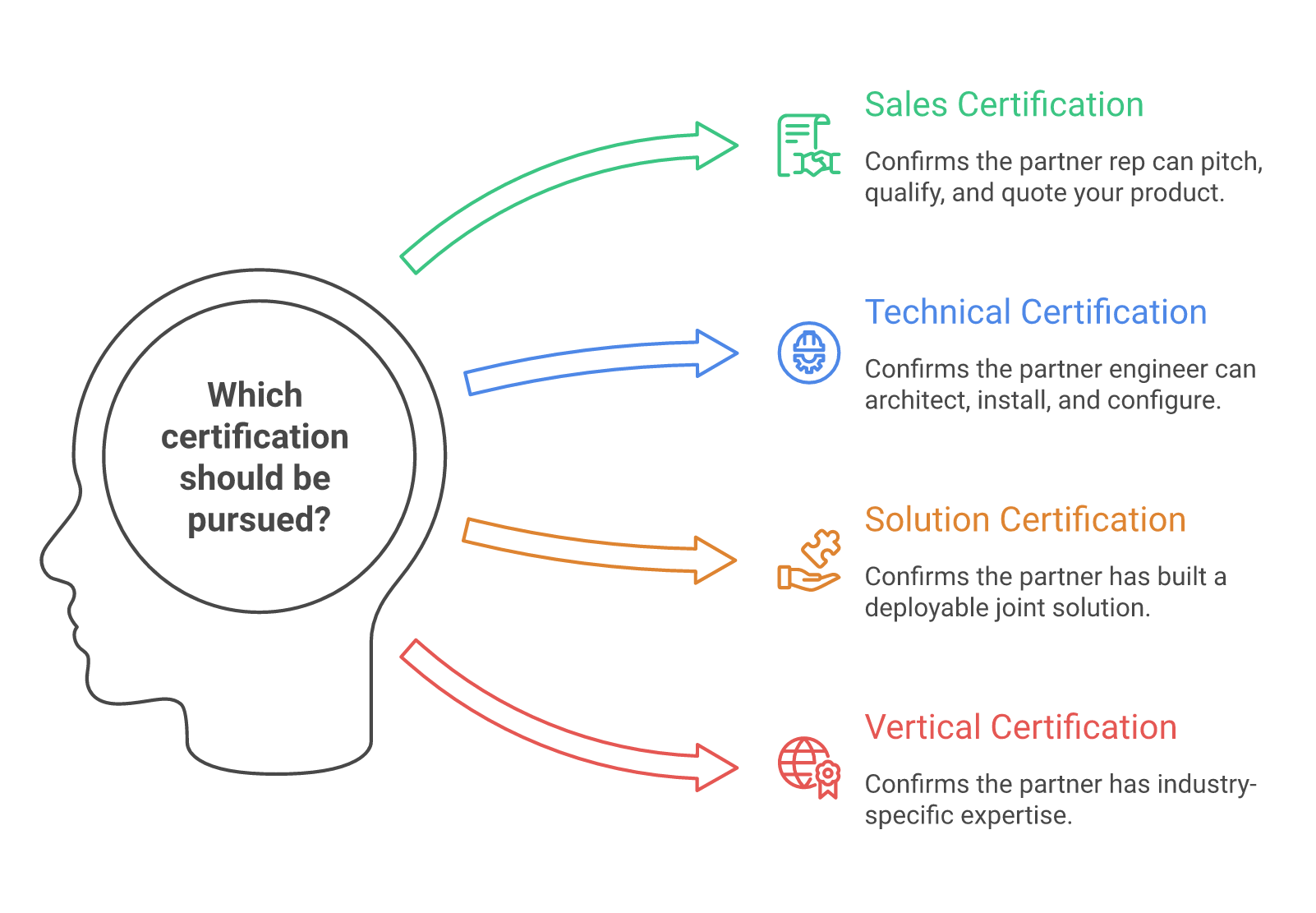
Sales, technical, delivery, and support are the four core tracks. Then programs at scale add specialty tracks (industry, solution, integration) on top of the role tracks.
| Track | Audience | Test style | What it unlocks |
|---|---|---|---|
| Sales cert | AE, BDR, sales lead | Knowledge test plus recorded pitch | Selling rights, tier status |
| Technical cert | SE, SA, engineer | Knowledge test plus technical demo | Pre-sales engagement rights |
| Delivery cert | Services teams | Knowledge test plus scenario walkthrough | Delivery rights, scope ownership |
| Support cert | CS, support | Knowledge test plus ticket simulation | Tier 2 support rights |
| Specialty cert | Industry, solution, or integration | Layered on top of a role cert | Specialty badge, marketplace listing |
In practice, mature programs run role tracks plus specialty layers. But new programs should ship sales and technical first. Then delivery and support come once the program has volume.
Common pitfalls
Five patterns kill cert programs. They are bookish content, no gating, no recert, no reporting, and pass-rate-as-vanity-metric.
Pitfall 1: bookish content. Long video lectures and dense PDFs that no rep finishes. Instead, the fix is short modules of 5 to 15 minutes. Use scenario-based drills. Then test by demonstration, not by recall.
Pitfall 2: no gating. A cert that unlocks nothing becomes decor. If a rep can sell without the cert, they will. So gate the cert to selling rights or tier status.
Pitfall 3: no recert. Programs that certify once and never recert create drift. The cert needs a 12-month expiry. The program needs the nerve to enforce it.
Pitfall 4: no reporting. Pass rate, retake rate, time-to-cert, and firm-level coverage are the four metrics that matter. Without them, the partner team is flying blind.
Pitfall 5: pass-rate-as-vanity-metric. A 98% pass rate is a calibration problem, not a quality win. In fact, healthy certs run 65% to 80% first-attempt pass rates with useful retake cycles.
What modern partner certification looks like
The 2026 best practice mixes four things. Microlearning. Recorded-pitch tests with AI grading. Applied scenarios. And a 12-month recert tied to selling rights.
Here are the features that set 2026-grade certs apart from 2020-grade certs:
- Microlearning. Modules run 5 to 15 minutes, not 90-minute lectures.
- Recorded-pitch test. The rep records a pitch to a made-up buyer. Then the AI grades it on key talking points, objection handling, and timing.
- Applied scenarios. Role-play or written cases, not multiple-choice trivia.
- Adaptive paths. AEs from one reseller and AEs from another get different scenario sets.
- Recert tied to selling rights. A lapsed cert means paused selling rights, handled on its own.
When programs ship all five, they tend to win on every readiness metric. That means close rate, ramp time, and customer complaint volume. Industry surveys of channel programs point the same way (Channelnomics channel research).
Forecastable’s POV on partner certification
Most certs fail because nobody pulls selling rights when reps lapse. The cert has to have teeth. Those teeth come from the CRO, not from a partner team trying to enforce alone.
The cert is only as strong as its consequence
Here is the note I repeat most across the cert programs I have reviewed. The cert is only as strong as the cost of not having one. If a rep can sell without it, because nobody pulls selling rights when it lapses, the program decays within 18 months. The fix is CRO sponsorship of the gating logic. Pair that with an auto-enforce step in the PRM.
Switch sales certs to recorded pitches
The second move is to switch sales certs from knowledge tests to recorded pitches. The AI-grading tools cleared the cost-and-quality bar in 2024 and 2025. A five-minute recorded pitch tells you more about a rep’s readiness than a 40-question quiz ever could.
Instrument firm-level cert coverage
The third move is to track firm-level cert coverage. Do not just report rep-level cert status. Instead, report what share of each partner firm’s active sales team is currently certified. That is the metric that predicts partner-sourced pipeline quality.
Frequently asked questions
What is the difference between partner certification and partner onboarding?
Onboarding is the program-level admit process for the partner firm. A cert is the rep-level test that proves an individual rep can sell, set up, or support the product.
How long should a partner certification take?
For a sales cert, plan on 4 to 8 hours of content plus a 30 to 60 minute test. For a technical cert, plan on 8 to 16 hours plus a longer applied test. A delivery cert takes more, based on scope.
Should partners pay for certification?
Sometimes. Keep it free for the certs that drive tier status at lower tiers. Charge for advanced specialty certs, or have the partner firm fund them. Most credible programs make core certs free and specialty certs paid.
How does AI grading work for partner certifications?
The rep records a pitch or scenario response. Then the AI scores it against a rubric. That rubric covers key talking points, objection handling, timing, and tone. Your enablement team sets the rubric. The AI applies it the same way for every rep.
How do you keep certifications current?
Use a 12-month recert with auto reminders at 60 days. Pull selling rights or tier status if the window closes. Then refresh the cert content each quarter as the product changes.
Do partner certifications work for consulting and SI partners?
Yes, with the delivery track. SI reps need scope and delivery certs more than a sales cert. So tune the rubric for delivery readiness, not pitch readiness.
Where does partner certification live, the PRM, the LMS, or a content platform?
Most often it lives in an LMS or content platform with a PRM link, the core of a partner enablement platform. So the PRM owns selling rights and gating. Meanwhile, the LMS or content platform owns the learning and the test.
How do you handle partners who consistently fail certification?
Coach first. Use retake gating second. Consider tier demotion or exit third. Most cert failures point at content or rubric problems, not at the rep. So review your own materials before you blame the partner.
Next step
Audit your current partner certification this week. Ask three questions. First, does passing the cert unlock something economic? Second, does the cert expire? Third, do you actually enforce the expiry by pulling selling rights? If any answer is no, that is your next fix. The teeth, not the content, are usually where these programs break.
Talk to our team about designing a partner certification program that gates real privileges →
Uncover Your Growth Potential
Schedule a Discovery Call