Partner Incentives and Incentive Programs: Designing Ones That Work

Partner incentives are the financial and non-financial mechanisms a vendor uses to motivate partner behavior beyond the baseline margin. Strong partner incentive programs are designed around four principles: tied to outcomes the partner team can actually drive, paid out fast enough to influence behavior, simple enough to communicate without a deck, and audited often enough to prevent gaming. Done well, partner incentives compound on the partner motion; done badly, they produce administrative overhead and gamed behavior that erodes program integrity.
Most partner incentive programs I see at customer organizations were designed by finance to protect the vendor’s margin and not by the partner team to drive partner behavior. The result is a program that finance can defend on the spreadsheet and that partners route around in practice. Strong programs flip the design priority: partner behavior comes first, finance defensibility comes second, and the program is audited annually to keep both honest.
This piece covers what partner incentives are, the four canonical incentive types, the four design principles that determine whether the incentive will actually drive behavior, the failure modes I see most often, and how partner incentives fit inside the broader partner program.
(Note: this piece is canonical for the closely-related search term “partner incentive programs,” which shares the same parent topic in Ahrefs. Both terms point to the same operating discipline.)
What are partner incentives?
Partner incentives are the financial and non-financial mechanisms a vendor uses to motivate partner behavior beyond the baseline margin or fee. Common types include margin uplift on registered deals, market development funds (MDF), seller-level SPIFFs, volume-based rebates, certification incentives, and tier-advancement bonuses. The unifying purpose is to reward the partner for behavior the vendor wants more of: faster registration, deeper engagement, broader reach, more certified sellers.
The category sometimes overlaps with the broader partner-program economics and sometimes operates as a discrete layer on top. Strong incentive programs are designed as a discrete layer with clear lines: the baseline margin is the always-on economics; the incentives are the variable layer that rewards specific behavior. Mixing the two produces a program that finance struggles to model and partners struggle to communicate to their sellers.
Partner incentives differ from sales SPIFFs and marketing co-funding in scope and accountability. Sales SPIFFs typically target the vendor’s own sellers; partner incentives target the partner’s behavior. Marketing co-funding is typically tied to specific campaigns; partner incentives are typically tied to broader behavior patterns (registrations, certifications, pipeline volume). Mature partner programs run multiple incentive types in parallel, each targeting a different behavior.
The four canonical partner incentive types
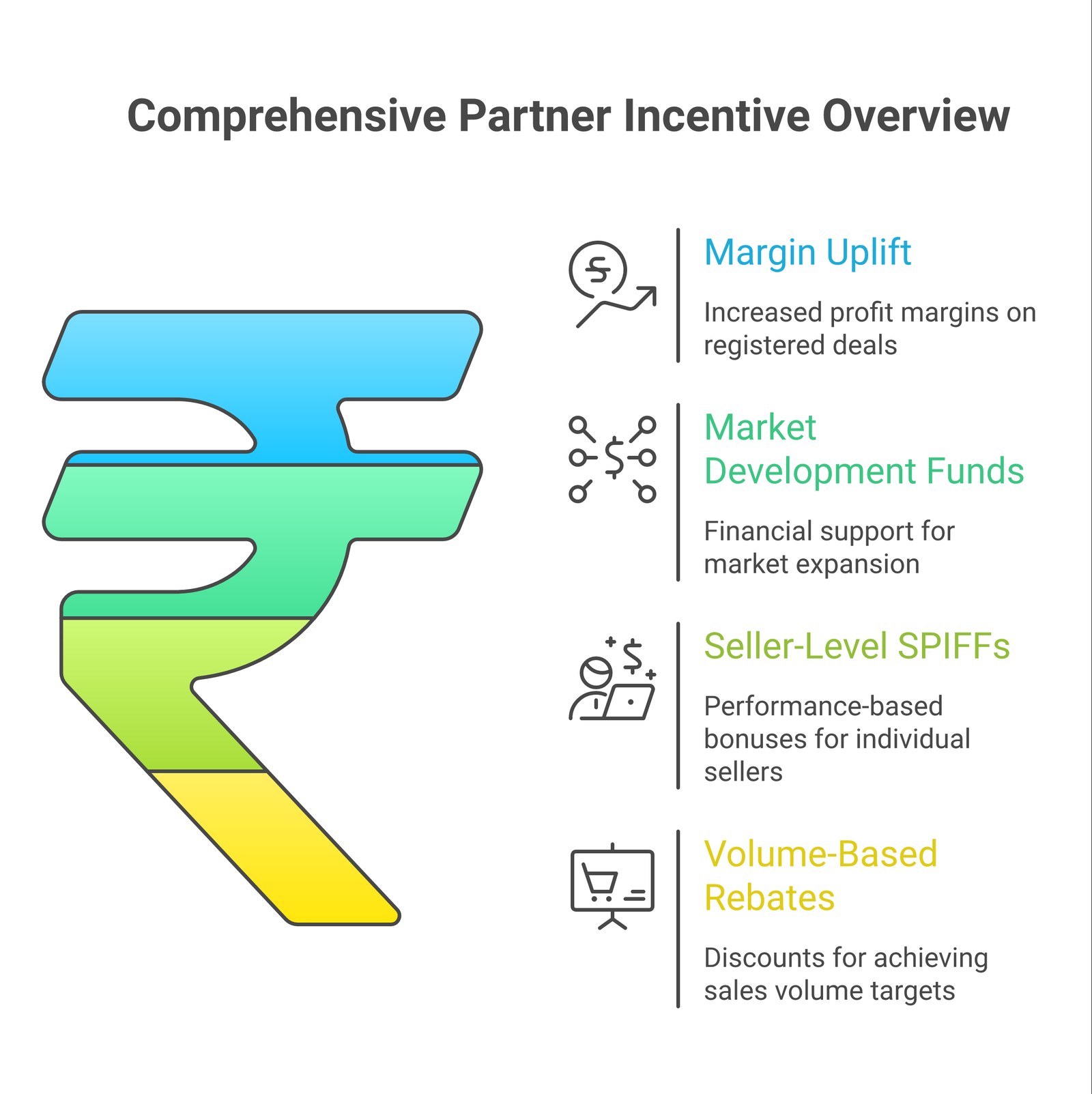
Four canonical incentive types cover most B2B partner programs in 2026: margin uplift on registered deals, market development funds (MDF), seller-level SPIFFs, and volume-based rebates. Each rewards a different behavior, has a different timing profile, and has a different audit requirement.
Margin uplift on registered deals
The vendor offers an additional margin percentage on opportunities that are registered through the deal registration process. The incentive rewards early disclosure of opportunities, which gives the vendor pipeline visibility and reduces channel conflict. Common structures: 5-15% margin uplift on registered deals, with a defined exclusivity window. The audit requirement is the deal-registration data itself.
Market development funds (MDF)
The vendor allocates a budget to the partner for marketing activities, lead-generation programs, customer events, or other demand-creation work. MDF is typically structured as either accrual-based or program-based. The audit requirement is the partner’s submission of receipts and outcome reporting.
Seller-level SPIFFs
The vendor offers cash or non-cash bonuses directly to the partner’s individual sellers for closing deals on the vendor’s product. SPIFFs are typically structured as flat cash per deal or percentage of deal value, with caps and qualifying criteria. SPIFFs reward individual seller behavior and are most useful when the partner’s seller has multiple competing products in their portfolio.
Volume-based rebates
The vendor offers a rebate percentage on cumulative partner-sourced revenue above a threshold. Rebates reward overall partner volume and are typically paid quarterly or annually. The structure rewards partners for hitting volume tiers and creates an incentive for the partner to push more volume through the relationship.
The four design principles for partner incentives that actually work
Strong partner incentives run on four design principles: tied to outcomes the partner team can actually drive, paid out fast enough to influence behavior, simple enough to communicate without a deck, and audited often enough to prevent gaming. Programs that violate any of the four produce incentives partners route around or game.
Tied to outcomes the partner team can drive
The incentive must reward behavior the partner team can actually control. Margin uplift on registered deals rewards registration behavior, which the partner team controls. MDF tied to vendor-led campaigns rewards behavior the partner can’t control and produces frustration and gaming. Strong incentives are tied to outcomes the partner sees on their own dashboard.
Paid out fast enough to influence behavior
The lag between behavior and payout determines whether the incentive influences behavior. SPIFFs paid 90 days after the deal closes don’t influence the seller’s behavior at the deal stage. Margin uplift paid at the time of deal close influences behavior at registration time. Strong programs minimize the lag and pay incentives as close to the triggering behavior as possible.
Simple enough to communicate without a deck
Partner-side sellers don’t read 12-page incentive program documents. The incentive needs to fit in one or two sentences a partner-side leader can communicate to their team. Complex incentives that require modeling spreadsheets to predict produce sellers who don’t respond to them.
Audited often enough to prevent gaming
Every incentive program creates gaming incentives. Margin uplift on registered deals creates an incentive to register deals that wouldn’t otherwise be registered. MDF creates an incentive to submit expenses that don’t drive demand. Strong programs run quarterly audits to catch gaming early and adjust the program design before the gaming becomes structural.
Common pitfalls in partner incentive design
Five recurring failure modes account for most of the underperformance I see at customer organizations. All five are design issues at the program-architecture level.
- Too many incentive types layered together. Vendors that run six or seven incentive types in parallel produce a program that’s incomprehensible to the partner.
- Slow payout. Incentives paid 60+ days after the triggering behavior don’t influence behavior. Compress the payout lag aggressively.
- No audit layer. Programs without quarterly audits accumulate gaming behavior that becomes structural and hard to unwind.
- Tied to vendor outcomes the partner can’t drive. Incentives that reward outcomes the partner doesn’t control produce partner frustration and don’t move behavior.
- No partner-side communication plan. A vendor’s incentive program that the partner’s seller never hears about doesn’t influence the seller’s behavior.
Tools and operating cadence stack
| Operating stage | Incentive workflow | Payout | Audit |
|---|---|---|---|
| Pilot (1-3 incentive types) | Shared spreadsheet | Manual processing | None |
| Early (3-5 types) | PRM-native incentive module | Quarterly automated | Spot-check |
| Operating (5-7 types) | PRM with workflow automation | Monthly automated | Quarterly audit |
| Mature (multi-tier programs) | Full incentive management platform integrated with finance | Real-time accrual + monthly payout | Quarterly audit with finance review |
Forecastable’s POV
My take is that partner incentives are the operating layer most partner-program leaders treat as a finance question and most should treat as a behavior-design question. Finance can model the cost; only the partner team can predict whether the incentive will move behavior. Programs designed from the finance side produce defensible spreadsheets; programs designed from the behavior side produce partner motion.
The pattern that compounds
The partner incentive programs I see compound across multi-year horizons share four traits. The incentive design started with a named partner behavior the team wanted to drive. The payout lag is short, typically under 30 days from triggering behavior. The communication is consistent and partner-side. The audit is quarterly and actually enforced.
The contrarian position
The contrarian position is that the right number of partner incentive types is fewer than most programs run. The conventional wisdom adds incentives to address every observed gap. The contrarian framing is to pick the three or four highest-leverage incentives and invest in operating discipline around those, rather than adding new incentives to address every gap.
Frequently asked questions
What are partner incentives?
Financial and non-financial mechanisms a vendor uses to motivate partner behavior beyond the baseline margin. Common types include margin uplift on registered deals, MDF, seller-level SPIFFs, and volume-based rebates.
What are partner incentive programs?
The structured operating layer of incentives a vendor offers to its partner cohort. Strong programs run multiple incentive types in parallel, each targeting a different behavior.
What are the four canonical partner incentive types?
Margin uplift on registered deals, market development funds (MDF), seller-level SPIFFs, and volume-based rebates.
What are the four design principles for partner incentives that actually work?
Tied to outcomes the partner team can drive, paid out fast enough to influence behavior, simple enough to communicate without a deck, and audited often enough to prevent gaming.
What is the most common partner incentive design mistake?
Layering too many incentive types together until the program is incomprehensible to the partner.
How fast should partner incentives be paid?
As close to the triggering behavior as possible. Payout under 30 days is a useful target.
How should partner incentive programs be audited?
Quarterly, with documented audit methodology and a small sample of incentive payments verified against the underlying data.
Next step
If your incentive program isn’t moving partner behavior, the answer is more likely a design issue than a budget issue.
Talk to our team about designing partner incentives that actually move behavior →
By Alex Buckles
Uncover Your Growth Potential
Schedule a Discovery Call