Partner Enablement Platform: What It Is and How to Choose

Short answer: a partner enablement platform is the software layer that gives a vendor’s external partners training, certs, sales assets, deal-reg workflows, and co-sell support. In 2026, the right one mirrors the program you run. It does not design the program for you. So judge it on one thing. Does it move partner sellers from trained to running deals.
What is a partner enablement platform?
A partner enablement platform is software that hosts and delivers what a partner needs to sell, implement, and renew the vendor’s product. That means content, training, certs, deal-reg, and shared pipeline visibility.
This category sits at the intersection of three older ones. Those are the LMS (learning management), the DAM (digital asset management), and the PRM (partner relationship management). Most modern partner enablement platforms include pieces of all three. They also add connectors to the vendor’s CRM, marketing automation, and account-mapping tools.
So what separates an enablement platform from a generic LMS? In practice, the answer is partner context. The system knows which partner a learner belongs to. It also tracks the partner’s tier, the products they can sell, and the deals in flight. That context is the difference between a system that drives partner-sourced revenue and a video library nobody opens twice.
Why a partner enablement platform matters in 2026
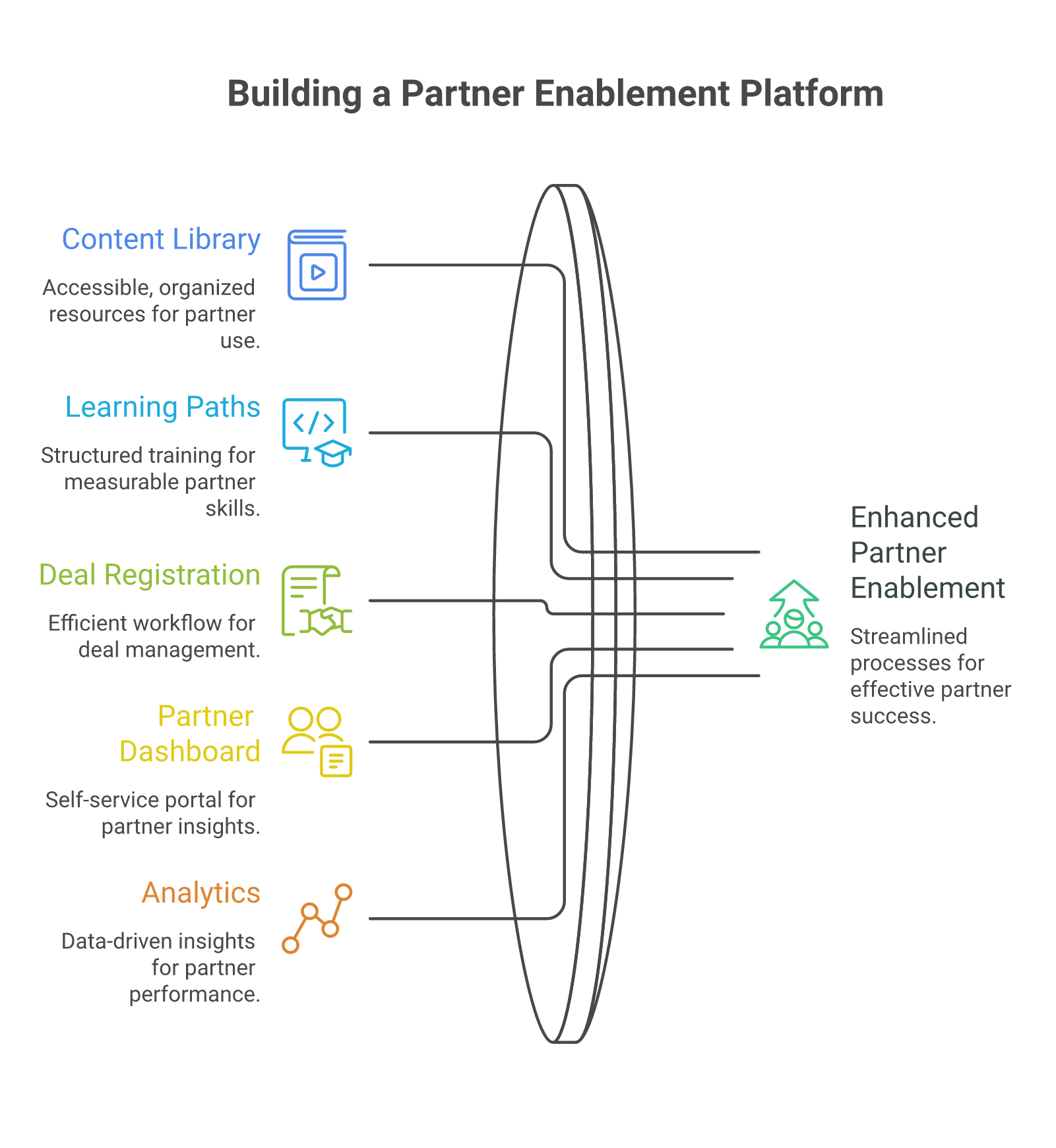
Partner pipeline scales with partner reps trained, certified, and equipped to sell. So a platform is how a vendor with 20 or more partners stops doing 1:1 enablement. Instead, it starts running 1:many enablement that still feels current. The framing matters here. Enablement should be centered on partner activation for SaaS companies. The unit of measurement is partner sellers running deals, not partner sellers finishing courses.
Three forces have made these platforms a 2026 priority. First, ecosystem-led GTM has pushed partner-sourced pipeline up the CFO’s priority list. Forrester’s channel and partner ecosystem research has tracked that shift for years. Second, partner reps now expect the same self-serve digital experience their internal peers get. Third, the AI features added to most platforms in 2024 and 2025 finally cleared the bar for partner-rep adoption. Those features include asset summaries, partner-side copilots, and persona-tagged content.
The mechanical case is simpler. Consider a vendor with 50 partners and 6 reps each. That team has to keep 300 external sellers current on positioning, integrations, comp, and deal-reg. No partnerships team gets that done with email and quarterly calls. So the platform becomes the only surface that scales. Coverage from Channelnomics on partner program maturity reaches the same point. Programs scale on systems, not on headcount.
How a partner enablement platform actually works
The platform takes in vendor content. Then it packages that content by audience. Delivery happens inside the partner’s workflow. Use and certs get tracked along the way. Finally, the platform reports back on which partners are sales-ready. Here is the flow most platforms run, in order.
- Content ingestion. The vendor’s partner-marketing team uploads decks, one-pagers, demo videos, scripts, battle cards, integration docs, and pricing.
- Audience packaging. Content is tagged by partner tier, role, product, region, and use case. So partner reps see only what is relevant.
- Delivery. Partner reps reach content through a portal, an embed in the partner’s CRM, a Slack app, or a mobile app. The surface should be one the partner already uses.
- Training and partner certification. Learners take training paths. They pass certs gated by quizzes, role-play scoring, or AI-graded recorded pitches.
- Deal registration. Approved partner reps register deals against the vendor’s CRM right from the platform.
- Reporting. The vendor sees who is trained, who is certified, which content drives use, and which partners have readiness gaps.
A working platform ships all six steps. However, most early rollouts ship steps 1 through 3 and then stall. They stall on certs and deal-reg. Specifically, those steps need the vendor’s RevOps and CRM admin to make changes the partnerships team cannot authorize alone.
What features actually matter
Buy on partner-side adoption, content audience targeting, certification flexibility, CRM bidirectional sync, and analytics. By contrast, do not buy on AI feature counts or category-leader badges. Five features separate the platforms that drive partner pipeline from the platforms that just sit there.
- Partner-side adoption. Does the platform live inside the partner’s CRM, Slack, or a clean web portal? Or does it force yet another login? Adoption decides everything else.
- Audience packaging. Can you slice content by tier, role, product, and region? Untagged content libraries become digital landfills.
- Certification flexibility. Can the platform run quiz certs, role-play certs, AI-graded recorded pitches, and time-bound recertification? Programs that need pitch certs mature faster.
- CRM bidirectional sync. Does the platform write partner-registered deals, cert status, and content use back into Salesforce or HubSpot? Without this, partner data lives on an island.
- Analytics. Does the platform report at partner-firm, partner-rep, and content-asset level? You need all three.
By contrast, some things do not distinguish one platform from another. AI feature counts, homepage badges, category-leader claims, and SOC 2 status are now baseline. Every credible vendor has them.
Common pitfalls
Failures show up in five places. First, buying the platform before the program is designed. Second, treating it as a partnerships-team project. Third, dumping ungated content. Then skipping CRM sync. Finally, over-customizing the portal.
Pitfall 1: Platform-before-program
Most partner enablement platform regrets I hear come from teams that bought the platform before the partner program had a documented motion. So the platform amplifies whatever discipline, or chaos, the program already has.
Pitfall 2: Partnerships-team-only ownership
A rollout that excludes sales enablement, RevOps, and partner marketing produces a product no one else will support. Therefore the platform has to land inside the broader enablement system.
Pitfall 3: Content dumping
Uploading every asset you have ever made with no audience tagging guarantees no partner rep returns after the first visit. Instead, tag every asset before it goes live.
Pitfall 4: No CRM sync
Deal-reg flows that do not write back to the vendor’s CRM produce dual-entry friction. As a result, partner reps stop registering deals entirely.
Pitfall 5: Portal vanity
Spending six months customizing the partner portal’s CSS while skipping content packaging is a category error. So choose function over polish at every step.
How partner enablement platforms compare in 2026
The 2026 buying field splits into PRM-led platforms, LMS-led platforms, and content-led platforms. There is also an account-mapping layer that sits next to all of them. So pick by which side of the workflow your partners actually live on. Here is a simplified view of the field.
| Platform type | Examples | Strength | Best for |
|---|---|---|---|
| PRM-led | Introw, Impartner, Zinfi, PartnerStack, Channelscaler, Magentrix | Deal-reg, portal, partner ops | Channel-heavy programs with reseller motions |
| LMS-led | Mindtickle, WorkRamp, 360Insights | Training, certifications, scoring | Tech partners needing pitch-cert maturity |
| Content-led | Highspot, Seismic (partner SKU) | Content packaging, AI surfacing | Vendors already running content-led internal enablement |
| Account-mapping layer | Crossbeam, PartnerTap | Overlap data and co-sell coordination | Programs identifying which accounts to co-sell on |
Most mature programs run two of these, not one. So the PRM handles deal-reg and the portal. Meanwhile the LMS or content platform handles training and certs. Forcing one tool to do everything is the common 2026 mistake. For the data layer, an account-mapping platform answers a different question, covered in our guide to what co-sell is and how the motion runs.
Forecastable’s POV
Do not buy a partner enablement platform before you can describe the partner journey end to end on a whiteboard. The platform is leverage on top of program design. It is not a substitute for it.
Here is the coaching note I repeat most to partnerships leaders shopping for a platform. First, write the program. Document the partner journey on a whiteboard, from recruit to onboard to enable to certify to co-sell to renew. Then name the artifacts each step needs. Name the metrics that measure each step. Finally, evaluate platforms against that flow. Programs that buy first spend twice to undo defaults that did not fit their motion.
The second move is to weight your evaluation. Specifically, put 60 percent on partner-side adoption, 25 percent on RevOps sync, and 15 percent on everything else. So the platform partner reps actually use beats the one with the prettier feature matrix.
The third move is to pilot with three partners before you sign for everyone. The signal you want is not whether the platform demos well. Instead, watch whether your top reseller’s top AE logs in twice in week two and finishes a cert in week three. If that does not happen with three pilots, then no rollout to 50 partners will save it.
Frequently asked questions
What is the difference between a partner enablement platform and a PRM?
A PRM (partner relationship management) is heavier on deal-reg, portal, and channel ops. By contrast, a partner enablement platform is heavier on training, certs, and content delivery. Most modern PRMs include enablement features. Likewise, most enablement platforms include some PRM features. So the line is blurry. In practice, pick by where your weight sits.
Do I need both a PRM and a partner enablement platform?
For mature programs with 50 or more partners, usually yes. However, for programs under 25 partners, one tool, typically the PRM, is enough. The break point comes when training and cert volume outgrow what a PRM’s basic learning module can handle.
How long does a partner enablement platform implementation take?
Plan on 60 to 120 days for a basic rollout with content packaging and one certification path. By contrast, a fully integrated rollout with CRM sync, deal-reg, and multi-path certification runs 6 to 9 months.
What does a partner enablement platform cost in 2026?
The range is wide. Specifically, entry-tier PRM-led platforms start around 20,000 to 40,000 dollars a year for small programs. Meanwhile, enterprise content-led or LMS-led platforms can run 100,000 to 300,000 dollars or more, depending on partner-seat count and modules.
Can we run partner enablement on our internal sales enablement tool?
Sometimes. For example, Highspot and Seismic both have partner-facing SKUs. Still, the real question is whether your partners will adopt the same tool your internal sellers use. Often they will not, because of login friction or branding mismatches.
How does AI change partner enablement platforms?
Most platforms shipped AI features in 2024 and 2025. For instance, content summaries, persona-tagged surfacing, recorded-pitch scoring, and partner-side copilots. The features that matter are scoring and surfacing. By contrast, AI homepages and brand-named assistants do not.
How does a partner enablement platform fit with account-mapping tools?
Account-mapping tools answer which accounts to co-sell on. Meanwhile, enablement platforms answer how partner reps know what to do once you have the account. So most modern programs run one of each.
Forecastable is an independent third-party professional services company. Our evaluations of other vendors are based on publicly-available information as of May 2026 and our own client experience.
Talk to our team about designing a partner enablement program that activates →
Uncover Your Growth Potential
Schedule a Discovery Call