Partner Onboarding: A 90-Day Operating Cadence That Compounds

Partner onboarding is the structured 90-day program that takes a newly signed partner from contract close to first sourced deal. Most teams treat onboarding as a one-week checklist; the partners who actually produce revenue went through a 90-day cadence with weekly close dates, an executive sponsor, and a forcing function on the first joint deal. Week one sets the trajectory; the first 90 days is the actual onboarding.
The pattern across the partnerships I’ve helped run is consistent. Partners who close their first joint deal inside 90 days continue to produce; partners who don’t close inside 90 days rarely produce in any quarter after that. The 90-day window is not arbitrary. It’s the operating window in which the partner’s account team learns how to position you and either commits or moves on.
This piece covers what partner onboarding is, the four phases of a working 90-day program, the operating decisions that determine whether a partner closes their first joint deal, the failure modes I see most often, and how onboarding ties to the broader partner program.
What is partner onboarding?
Partner onboarding is the structured program that turns a signed partner into a producing partner. The artifacts are well known: joint value proposition, technical enablement, deal-reg setup, co-sell playbook, account mapping, executive sponsor pairing. But the artifact list is not the program. The program is the operating cadence that makes sure the artifacts get used.
The artifacts are necessary but not sufficient. Most onboarding programs deliver a complete artifact pack on day one and then go quiet for 60 days. The partner team finishes the certification, the AE never sees the playbook, and the first joint deal never happens because nobody scheduled the joint motion. Strong onboarding programs invert this: the cadence drives the artifact use, and the artifacts get refreshed when the cadence reveals a gap.
The right north-star metric for onboarding is time to first joint sourced deal. Not certifications completed, not portal logins, not training modules consumed. Sourced deals are the only metric that tells you the partner’s account team has internalized the motion enough to bring you a real opportunity. Track sourced deals from day one.
Why partner onboarding matters
The asymmetry in partner economics is that partners who don’t close inside 90 days mostly never close. Onboarding is therefore the highest-leverage 90 days of the entire partnership; what happens in those 90 days determines whether the partnership produces for the next two years or churns silently.
Two structural reasons drive this asymmetry. First, attention is a depreciating asset inside a partner organization. Their AEs got pinged about you in week one; if there’s no joint motion in week six, they’ve forgotten you. Second, account-team trust is built on co-sold deals, not on co-marketing. Without a joint deal in 90 days, the partner’s account team doesn’t have a reference experience to draw on next time a customer brings up your category.
The teams that win onboarding treat the 90 days as a forcing function. Every week has a specific joint outcome: a joint account list in week two, a joint pipeline review in week four, a co-sell motion on a real deal in week six, a forecasted joint close in week ten. The cadence is the program; the artifacts support the cadence.
How partner onboarding works
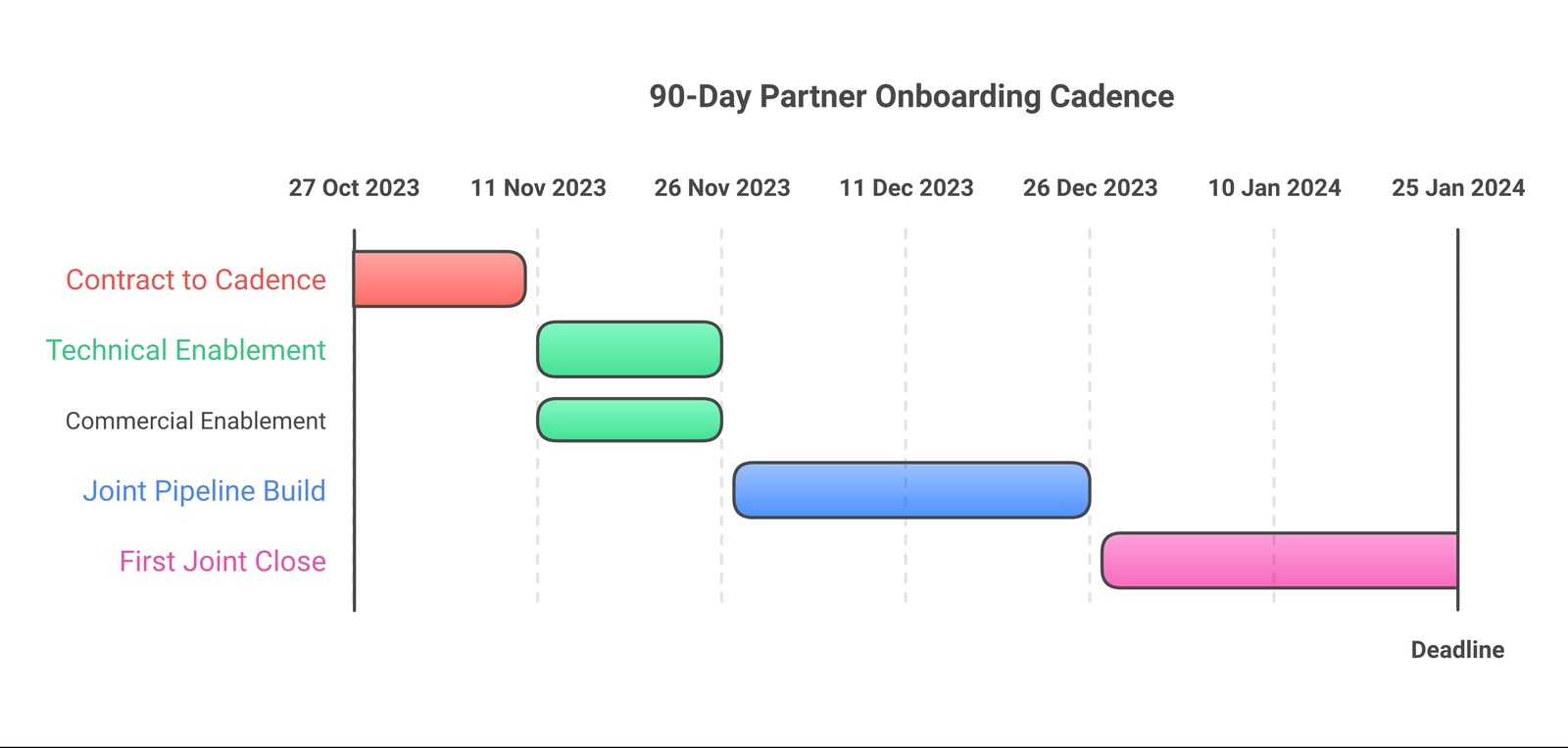
A working 90-day onboarding program has four phases, each with a specific operating outcome. Treat the phases as gates: progress to the next phase is conditional on the prior phase’s outcome being met, not on time elapsing.
- Days 0-14, contract-to-cadence. Contract signed; legal artifacts delivered; executive sponsor named on both sides; weekly partnership cadence calendared; joint value proposition co-authored. The phase outcome is a calendar invite series with both sides committed.
- Days 15-30, technical and commercial enablement. Sales enablement delivered to partner AEs (one session, not a deck); technical enablement delivered to partner SEs; deal registration process tested with a synthetic deal; account mapping tool deployed and the first overlap report shared. The phase outcome is a partner AE who can run a 10-minute pitch on your product without your help.
- Days 31-60, joint pipeline build. Joint account list ranked by overlap density and stage; first joint outreach motion (either co-marketing campaign or AE-to-AE introduction); first joint pipeline review with named opportunities; co-sell playbook validated against a live deal. The phase outcome is at least three named joint opportunities in pipeline.
- Days 61-90, first joint close. One forecasted joint deal in commit; weekly forecast call between partner reps and yours; executive sponsor checks in at the 75-day mark; quarterly business review scheduled for day 100. The phase outcome is one closed-won joint deal, or a structured retrospective on why the deal didn’t close.
Common pitfalls
The pitfalls in onboarding are operating pitfalls, not enablement pitfalls. The artifacts are usually fine; the cadence is what breaks. Three patterns repeat across underperforming onboarding programs.
The first pitfall is treating onboarding as a one-week event. The kickoff meeting happens, the welcome packet ships, the slack channel goes quiet by week three. There’s no phase-two gate, no joint pipeline review, no forcing function on the first deal. The partnership exists on paper for two quarters and then quietly atrophies.
The second pitfall is enabling the wrong people. The partner program team gets enabled in week one; the partner’s actual sellers never see the material. Sales enablement has to be delivered to the partner AE who will close deals, not the partner program manager who will report on deals.
The third pitfall is no executive sponsor on the partner side. An exec sponsor is the lever that escalates a stalled motion into action. Without one, every escalation lands on the partner program manager’s desk, and the partner program manager doesn’t have authority to redirect their AE team’s attention. Name the exec sponsor in the contract, not after onboarding stalls.
Tools and templates
| Phase | Tool / artifact | What it produces |
|---|---|---|
| Days 0-14 | Joint value proposition doc; calendar series; exec-sponsor email intro | Cadence committed |
| Days 15-30 | Sales enablement deck; technical enablement session; PRM ( Intro, Euler, Channelscaler, Impartner, ZINFI, or PartnerStack); deal-reg flow | Partner AE pitch capability |
| Days 31-60 | Account mapping tool (Crossbeam); joint pipeline doc; co-sell playbook | Three named joint opportunities |
| Days 61-90 | Forecast call template; QBR agenda template | First joint close or structured retro |
The PRM choice matters less than people assume. Introw, Channelscaler, Impartner, ZINFI, PartnerStack, and Mindmatrix are all production-grade for the onboarding use case at the SMB-mid band. The decision criteria that matter most are CRM integration depth, partner-side ease of use, and content management capability for enablement assets.
Forecastable’s POV
Time to first sourced deal is the only onboarding metric that matters at 90 days. Everything else is a leading indicator. Teams that hit the 90-day deal compound for years; teams that miss the 90-day deal mostly churn silently.
Two specific calls Forecastable makes consistently. First: the executive sponsor on the partner side is the highest-leverage element of the onboarding plan. Naming the right exec, calendaring their two check-ins, and giving them a specific decision to make at each one is worth more than any enablement asset. Second: the joint pipeline review at day 30 is the gate; if there are no named joint opportunities by day 30, the program is already in trouble and a structured intervention should happen before day 60.
The HubSpot Partner Program publishes useful onboarding artifacts and process documentation that’s worth borrowing from. The AchieveUnite “Partner Excellence Framework” and PartnershipLeaders’ onboarding playbooks are also high-quality references. Treat these as benchmarks; the operating cadence still has to be built for your specific motion.
Frequently asked questions
How long should partner onboarding take?
Plan for 90 days from contract close to first joint sourced deal. The artifact delivery happens in the first 30 days; the joint pipeline build happens in days 31-60; the first close happens by day 90. Partners who don’t close inside 90 days mostly don’t close at all.
What’s the difference between partner onboarding and partner enablement?
Onboarding is the structured program for the first 90 days of a new partnership; enablement is the ongoing capability-building that runs for the life of the partnership.
Who owns partner onboarding?
The partner manager (or alliance manager) on your side and a named partner manager on the partner side. The two of them are the operating team; the executive sponsors are the escalation lever.
How do I onboard a HubSpot partner?
HubSpot has a published partner onboarding flow inside their App Partner and Solutions Partner programs. Treat the HubSpot onboarding flow as a checklist that runs in parallel with the joint sourced-deal cadence.
What metrics should I track during partner onboarding?
Time to first joint sourced deal (north star). Leading indicators: partner AE certification completion by day 30, joint account list completed by day 30, joint pipeline review held by day 45, named joint opportunities by day 60, first forecasted close-won by day 90.
What’s the most common reason partner onboarding fails?
No forcing function on a real deal. The artifacts get delivered, the kickoff happens, the relationship goes quiet. Without a specific deal in commit by day 90, there’s nothing to keep the partner’s AE team engaged.
Should I onboard multiple partners at once?
Only if your team has the capacity to run a real cadence with each. Two well-onboarded partners produce more pipeline than ten poorly-onboarded ones.
Next step
If you’re starting a partner onboarding program, write the 90-day cadence calendar before you write the welcome packet. The cadence is the operating contract; the packet is supporting material. Block the four phase-gate meetings (days 14, 30, 60, 90) on both calendars and make them non-optional.
Forecastable is an independent third-party professional services company. Our evaluations of other vendors are based on publicly-available information as of May 2026 and our own client experience.
Talk to our team about building a partner onboarding motion that activates partners →
By Alex Buckles
Uncover Your Growth Potential
Schedule a Discovery Call