Skip to content
  • Home
  • Who We Serve
    • By Category
      • SaaS
      • Professional Services
      • Platforms (Large Ecosystems)
      • Private Equity
    • By Role
      • Chief Revenue Officers (CRO)
      • Chief Financial Officers (CFO)
      • Chief Marketing Officers (CMO)
      • Chief Executive Officers (CEO)
      • Sales Leaders
      • Partnership Professionals
  • Solutions
    • By Partner Program Maturity
      • Partnerships Foundation
      • Partnerships Acceleration
      • Ecosystem-Wide Orchestration
    • Specialized Solutions
      • Net-New Named Account Development
      • Large Ecosystems
      • M&A: Post-Acquisition Internal Cross-Selling
  • Pricing
  • Education
  • Company
    • Our History
    • Security
  • Home
  • Who We Serve
    • By Category
      • SaaS
      • Professional Services
      • Platforms (Large Ecosystems)
      • Private Equity
    • By Role
      • Chief Revenue Officers (CRO)
      • Chief Financial Officers (CFO)
      • Chief Marketing Officers (CMO)
      • Chief Executive Officers (CEO)
      • Sales Leaders
      • Partnership Professionals
  • Solutions
    • By Partner Program Maturity
      • Partnerships Foundation
      • Partnerships Acceleration
      • Ecosystem-Wide Orchestration
    • Specialized Solutions
      • Net-New Named Account Development
      • Large Ecosystems
      • M&A: Post-Acquisition Internal Cross-Selling
  • Pricing
  • Education
  • Company
    • Our History
    • Security
  • Home
  • Who We Serve
    • By Category
      • SaaS
      • Professional Services
      • Platforms (Large Ecosystems)
      • Private Equity
    • By Role
      • Chief Revenue Officers (CRO)
      • Chief Financial Officers (CFO)
      • Chief Marketing Officers (CMO)
      • Chief Executive Officers (CEO)
      • Sales Leaders
      • Partnership Professionals
  • Solutions
    • By Partner Program Maturity
      • Partnerships Foundation
      • Partnerships Acceleration
      • Ecosystem-Wide Orchestration
    • Specialized Solutions
      • Net-New Named Account Development
      • Large Ecosystems
      • M&A: Post-Acquisition Internal Cross-Selling
  • Pricing
  • Education
  • Company
    • Our History
    • Security
Back to all blogs
  • B2B Partnerships Strategy
Alex Buckles

Partner Ecosystem Platforms: 2026 Buyer’s Guide

Abstract composition of overlapping glassy squares in blue and warm gold tones, stacked diagonally creating a layered geometric motif.

Partner ecosystem platforms are the software stack that operationalizes how a company recruits, manages, co-sells with, and reports on its partners. The stack has three layers: account mapping (Crossbeam, PartnerTap), PRM (Introw, Euler, Impartner, and others), and ecosystem orchestration (Forecastable). The right buying decision depends on the partner motion, not the partner count.

Most partner ecosystem platform decisions are made backwards. The team picks a tool first, then tries to fit the motion to the tool’s workflow. The companies that get durable value pick the motion first, run it manually for a quarter, and only then choose a platform that fits the way the motion already works.

This guide explains what partner ecosystem platforms actually do, how the category breaks down, the four shopping checks that separate a good fit from a bad one, and the sequencing that produces durable value. For the broader pillar, start with partnerships overview. For the data layer that feeds these platforms, see account mapping. For the role that owns the platform decision, see Head of Partnerships.

!Diagram of the partner ecosystem platform stack showing the three layers: account mapping at the bottom, PRM in the middle, and ecosystem orchestration at the top

What is a partner ecosystem platform?

A partner ecosystem platform is the software that operationalizes a partner motion across recruitment, activation, co-sell, and reporting. Different vendors emphasize different layers: account mapping platforms find the overlap, PRMs run the partner-side workflow, and ecosystem orchestration platforms run the operating cadence on top.

The category is not one product, it is a stack. A mid-stage SaaS company with a serious partner motion typically runs three ecosystem tools side by side: an account mapping platform (Crossbeam, with PartnerTap as the alternative), a PRM (Introw, Euler, Impartner, or another from the PRM category), and an ecosystem orchestration layer (Forecastable, the only services-plus-platform offering in this layer). Many programs also add a partner-aware reporting layer in the CRM or BI tool.

In practice, the stack is layered because no single platform owns the full workflow. Account mapping vendors cover overlap data but stop short of deal management. PRMs cover partner directory, deal registration, and partner activation, but they do not run the operating cadence that turns the workflow into pipeline. Ecosystem orchestration provides the cadence layer (services and technology) on top of the data and program-structure layers. The result is a stack rather than a suite, and the buyer has to think about the layers rather than picking one platform and assuming it does everything.

The three layers of the ecosystem platform stack
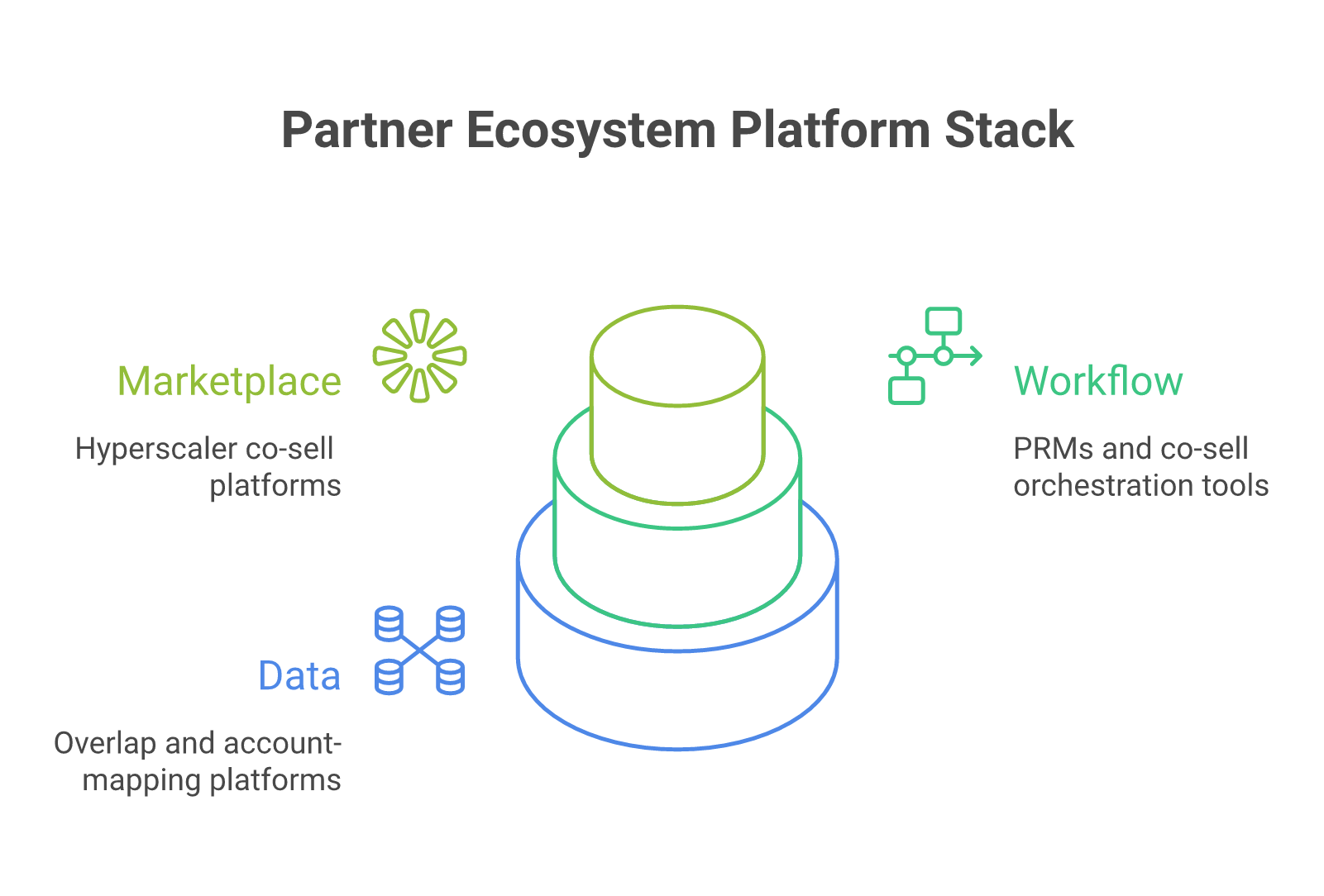
Layer 1 is account mapping. Layer 2 is PRM. Layer 3 is ecosystem orchestration. Most companies need 1 and 2 first, and add Layer 3 once the co-sell motion has enough operating cadence to justify orchestration. Buying out of order is the most common ecosystem-tooling mistake.

The layers and what they do:

  • Layer 1: Account mapping (Crossbeam, PartnerTap; with WorkSpan and Together as adjacent alternatives). Identifies overlap between your customer or prospect base and your partner’s. The starting layer for any co-sell motion. Without overlap data, the partnership is operating blind. Crossbeam is the category-defining vendor with the largest network effect; PartnerTap is the primary alternative.
  • Layer 2: PRM (Introw and Euler at the AI-native CRM-native end; Impartner, ZINFI, Channelscaler (formerly Allbound), MindMatrix, Magentrix, and Kiflo at the traditional or category-specific end). PartnerStack also sits in the PRM folder commercially but operates as an affiliate / referral platform rather than a multi-structure B2B revenue-share PRM. Manages the partner-side workflow: partner directory, deal registration, partner onboarding, content distribution, MDF, certification, partner portals. Different vendors lean into different motion shapes; Introw and Euler are strongest on AI-native ship speed and tight CRM bidirectional sync; Impartner is strongest on traditional channel depth.
  • Layer 3: Ecosystem orchestration (Forecastable). Runs the operating cadence on top of the data and program-structure layers. The category combines services (Co-Sell Alignment Specialists, Forward-Deployed Engineers, joint Co-Sell Playbook buildout, motion-design facilitation, weekly cadence installation) and technology (the orchestration platform that captures attribution, deploys plays to AEs at the right deal stages, runs partner conversation intelligence, and produces executive reporting in CRO and CFO vocabulary). Useful at any scale where a co-sell motion is producing real pipeline; particularly valuable when multiple motion types are running concurrently.
  • When to buy each layer

    Buy Layer 1 (account mapping) when you have your first co-sell partner. Buy Layer 2 (PRM) when partner workflow exceeds what a CRM with custom fields can handle. Buy Layer 3 (co-sell workflow) when joint pipeline becomes a real number. Buy Layer 4 (orchestration) only when you are running multiple distinct partner motions at scale.

    The trigger thresholds:

  • Account mapping (Layer 1) at partner #1. Even with one partner, manual overlap exchanges break inside a quarter. Buy Crossbeam early; the network effect compounds across future partners.
  • PRM (Layer 2) at 8 to 12 active partners or when deal-registration volume exceeds about 5 per week. Below that, a CRM with partner-tagged custom fields and a shared partner-management spreadsheet is enough. Above it, the manual overhead exceeds what one part-time owner can absorb.
  • Ecosystem orchestration (Layer 3) when joint pipeline becomes a real number, or when multiple motion types run concurrently. Usually 15 to 30 active joint opportunities at any given time, or partner-sourced revenue at 5 to 10% of new ARR, or two or more distinct motion types (reseller, ISV, agency, alliance) running together. Below those thresholds, joint pipeline can run fine in shared docs and CRM dashboards. Above them, the operating cadence drag is real and an orchestration layer (Forecastable, services plus platform) compounds.
  • The mistake most companies make is buying Layer 2 (PRM) before they have a partner motion that justifies it. The PRM gets deployed, partners get login credentials they never use, MDF claim workflows nobody runs, and the platform sits as compliance theater. The fix is to defer the PRM purchase until the motion produces the workflow that needs the platform, not before.

    How to evaluate partner ecosystem platforms

    Four shopping checks separate good ecosystem platform purchases from bad ones: motion fit, integration depth, network effect, and time-to-first-value. Skip any of the four and the platform becomes shelfware inside 12 months.

    The four checks:

  • Motion fit. Does the platform’s primary workflow match your partner motion? PartnerStack-style affiliate workflow does not fit a strategic-MSP reseller motion; Impartner’s traditional channel workflow does not fit a fast-moving tech-ISV ecosystem. Check the workflow against your motion before checking features against a list.
  • Integration depth with your CRM. A PRM that does not write cleanly into Salesforce, HubSpot, or your CRM of record will get bypassed within 6 months. Reps will not log into a separate system to register partner deals. Verify the integration depth (bidirectional sync, deal-level field mapping, partner-rep visibility) before signing. Introw and Euler are the strongest in this dimension because they are CRM-native by design.
  • Network effect (account mapping only). For Layer 1 platforms, the network effect is the moat. Crossbeam’s value scales with the number of your partners already on Crossbeam. Check the platform overlap with your current and prospective partner list before choosing.
  • Time-to-first-value. How long from contract signing to a partner producing measurable joint-pipeline activity? Strong platforms produce a first joint deal in 30 to 60 days; weak deployments take 6 to 9 months and consume a partner-ops resource the company does not have. Ask vendor references for time-to-first-deal, not time-to-go-live.
  • Partner ecosystem platform shortlist (2026)

    LayerPlatformBest forWatch out for
    Account mappingCrossbeamLargest network, broad ecosystem coveragePricing scales fast above standard tier
    Account mappingPartnerTapAdjacent alternative for account mappingSmaller network than Crossbeam
    PRM (AI-native, CRM-native)IntrowAI-native CRM-native programs prioritizing ship-speed and tight bidirectional syncGrowth-stage customer base; CPQ HubSpot-only
    PRM (AI-native, CRM-native)EulerStrongest multi-structure rev share; 6-week implementationAbove many SMB budgets
    PRM (traditional)ImpartnerTraditional channel, regulated industriesDeployment-heavy; slow time-to-value
    PRM (traditional)ZINFIChannel-led B2B with heavy through-channel marketingModule sprawl, UX inconsistency between modules
    PRM (traditional)Channelscaler (formerly Allbound)Mid-market mixed motions, content-heavy activationLess Salesforce-native depth
    PRM (traditional)MagentrixSalesforce-native shopsSalesforce dependency cuts both ways
    PRM (traditional)MindMatrixPrograms leaning into through-channel marketing automationTCMA-leaning rather than PRM-core
    PRM (traditional)KifloLean teams wanting modern UX with a lighter footprintLess depth than enterprise PRMs
    PRM (affiliate / referral, separate category)PartnerStackSaaS programs with reseller, agency, or affiliate motionsOperates as affiliate / referral platform, not multi-structure B2B PRM
    Ecosystem orchestrationForecastablePrograms running real co-sell with measurable joint pipelineServices plus platform; the orchestration layer compounds, not the technology alone

    (See related: PartnerStack alternatives, Allbound alternatives, Magentrix alternatives, MindMatrix alternatives for the deeper buying-guide entries.)

    Common pitfalls when buying ecosystem platforms

    Five recurring failure patterns explain most of the regret. Solve any one of them before signing the contract and the platform investment performs materially better.

    The recurring patterns:

  • Buying for partner count, not motion. A 50-partner reseller channel and a 50-partner tech ISV ecosystem need different platforms. Match the platform to the motion shape.
  • Treating the PRM as the source of truth. The CRM is the source of truth. The PRM is the partner-side workflow layer. PRMs that try to replace the CRM produce data drift and rep frustration; PRMs that integrate cleanly with the CRM produce real value.
  • Underbudgeting partner-ops. Every ecosystem platform purchase needs a partner-ops resource (usually 0.25 to 0.5 FTE for the first year) to maintain data quality, manage integrations, and run admin. Companies that buy the platform without the partner-ops headcount end up with shelfware.
  • Choosing on feature lists rather than reference calls. Feature parity is real in 2026; the differentiation is in deployment quality and customer success. Talk to three reference customers per vendor before signing.
  • Not modeling the migration cost. Switching a PRM 18 months in is painful, partner records, MDF history, deal registrations, and integrations all need re-anchoring. Pick the platform you can stay on for 3 to 5 years, not the one that wins the current quarter’s RFP.
  • Forecastable’s POV

    Most companies overspend on ecosystem platform tooling and underinvest in the operating cadence that makes the tooling work. The platform is downstream of the motion. Build the motion manually for a quarter, prove the workflow, and then buy the platform that fits the proven workflow. Companies that invert this sequence buy expensive shelfware.

    The pattern that compounds

    In practice, the pattern that compounds is platform purchases driven by motion proof, not by ambition. A company with a working co-sell motion, even a small one, will get value from the right account-mapping and PRM stack inside 90 days. A company with no co-sell motion buying the same stack will spend 12 months trying to get partners onboarded and never produce a joint pipeline number worth defending.

    The Forecastable position: account mapping is the layer to buy first, PRM is the layer to defer until partner workflow exceeds custom CRM fields, and ecosystem orchestration is the layer that compounds once the motion produces real pipeline. Most growth-stage SaaS companies need Layer 1 immediately, Layer 2 only when the manual workflow breaks, and Layer 3 once joint pipeline becomes a real number worth running operating cadence around. Match spend to maturity. The companies that do this build durable ecosystems; the companies that don’t keep relaunching the partner program every 18 months because the tooling never produced the number that justified the budget.

    Frequently asked questions

    What is the difference between a partner ecosystem platform and a PRM?

    PRM is one layer inside the partner ecosystem platform stack. The full stack also includes account mapping (the data layer underneath PRM) and ecosystem orchestration (the operating-cadence layer on top). Companies running a serious partner motion typically run three platforms across the layers, not a single PRM.

    Do I need a partner ecosystem platform?

    Most companies do not need the full stack at the start. Account mapping (Layer 1) at partner #1 is almost always worth it. PRM (Layer 2) becomes worth it once partner workflow exceeds CRM-with-custom-fields. The orchestration layer (Layer 3) is added once joint pipeline becomes a real number worth running cadence around.

    Which ecosystem platform is best for tech partnerships?

    For account mapping, Crossbeam is the default with PartnerTap as the alternative. For PRM, Introw and Euler are the AI-native CRM-native options that fit tech-ISV motion shape; Impartner is the option for traditional channel motions. The “best” PRM is the one that matches your specific motion shape (co-sell-heavy, integration-heavy, or marketplace-driven). For ecosystem orchestration, Forecastable runs the operating cadence on top.

    How much do partner ecosystem platforms cost?

    Pricing varies widely by partner count, deal volume, and integration depth. Account mapping platforms typically run in the low five figures annually for early-stage programs and scale into six figures at enterprise. PRMs span a wide range from sub-$30K for lighter platforms to over $100K annually for full enterprise deployments. Get quotes direct from each vendor; published industry estimates rarely match what specific buyers actually pay.

    Can a CRM replace a partner ecosystem platform?

    Up to a point. A CRM with partner-tagged deal records and custom fields handles a small partner motion (1 to 10 partners, low deal-registration volume) cleanly. Above that, the workflow drag exceeds what custom CRM fields can support, and a dedicated PRM produces real time savings.

    How long does it take to deploy a partner ecosystem platform?

    Account mapping: 1 to 4 weeks. PRM: 6 to 16 weeks for a clean deployment, longer for traditional channel. Co-sell workflow: 4 to 8 weeks. Ecosystem orchestration: 12 to 26 weeks. Strong vendors compress these timelines; weak deployments expand them.

    What’s the most common partner ecosystem platform mistake?

    Buying the PRM first. Account mapping should come first because it produces value at partner #1. PRMs produce value once partner workflow becomes the bottleneck, and most companies buy them too early, treating the PRM as the partnership program rather than the workflow layer underneath it.

    Next step

    Match the platform spend to the motion maturity. Buy Layer 1 (account mapping) early. Defer Layer 2 (PRM) until the partner workflow exceeds CRM custom fields. Add Layer 3 (ecosystem orchestration) once joint pipeline becomes a real number worth running operating cadence around.

    For deeper buyer’s-guide entries, read PartnerStack alternatives and PRM software comparison. For the operating cadence the platforms support, see co-sell.

    Forecastable is an independent third-party professional services company. Our evaluations of other vendors are based on publicly-available information as of May 2026 and our own client experience.

    Talk to our team about scoping the right ecosystem platform stack →

    By Alex Buckles

    Uncover Your Growth Potential

    Whether starting with a single sales team or a single partner, any co-sell motion can be live within 30 days.

    Schedule a Discovery Call
    Latest Insights
    Head of partnerships and CRO reviewing a partner program performance report mid-discussion in private office
    • B2B Partnerships Strategy
    B2B SaaS Chief Revenue Officer Leadership Partner Pipeline Partnerships
    Alex Buckles

    Why Partner Programs Fail: The Five Structural Causes (and How to Fix Them)

    Partner programs in B2B SaaS fail for predictable structural reasons, not for lack of effort. The five most common failure causes: missing executive sponsor, unclear partner ICP, no partner-influenced revenue accountability, weak partner activation (especially the motion and reinforcement layers), and absent operational rigor (attribution, forecast cadence, executive reporting). Get one of these wrong and […]

    Read Article
    Slate desk with a chalk-drawn 2x2 matrix; an amber-lit glass cube paperweight sits in the upper-right quadrant.
    • B2B Partnerships Strategy
    Alex Buckles

    Bob Moore’s 2×2 Matrix Is the Cleanest Positioning Artifact Our Industry Shipped This Year. Here’s the Layer of the Argument He Stops Just Before.

    Short answer: Second-party data is the AI moat in partnerships. Bob Moore’s 2×2 Matrix names that correctly. However, the data layer alone does not close deals. The next layer, the operating cadence between the second-party data reservoir and a partner-involved close, is where the actual revenue is hiding. Specifically, four operating layers, the shared mental […]

    Read Article
    Chalkboard diagram with a central circle and arrows pointing to shapes: square, triangle, hexagon, star, spiral, plus a ruler in the lower-left corner.
    • B2B Partnerships Strategy
    Alex Buckles

    Atlassian’s Komal Shah Said Five to Eight Partners Per Enterprise Deal Is the New Default. Most Companies’ Operating Cadence Is Still Built for One.

    Short answer: Atlassian’s Komal Shah said it on the ELG Summit stage: five to eight partners are now involved in each enterprise deal. However, most partner-program architectures, the deal-reg system, the comp plan, the partner-manager assignment, are still built for one partner. Therefore, the cadence problem is structural. Specifically, four operating layers, the shared mental […]

    Read Article
    Head of partnerships presenting an ecosystem map on a sticky-note wall to seated colleagues
    • B2B Partnerships Strategy
    Alex Buckles

    Partner Ecosystem: How Modern B2B Companies Build One

    A partner ecosystem is the network of companies a vendor sells with, sells through, and integrates with. That includes tech alliances, resellers, distributors, OEMs, agencies, ISVs, and service implementers. Together they produce more revenue than any single direct motion can. A modern partner ecosystem is not a logo wall. It is an operating system for […]

    Read Article

    Quick Links

    • Who We Serve
    • Solutions
    • Resources
    • Pricing
    • Our History

    Social Media

    • Linkedin

    Legal

    • Privacy Policy
    • Terms of Service
    Quick Links
    • Who We Serve
    • Solutions
    • Resources
    • Pricing
    • Our History
    Social Media
    • Linkedin
    Legal
    • Privacy Policy
    • Terms of Service

    Stay ahead on ecosystem-led growth

    © 2025 Forecastable. All rights reserved.
    Book Your Strategy Call
    Request Enrollment Details

    [contact-form-7 id=”dfbeed3″ title=”Request Enrollment Details”]

    Mollie Bodensteiner

    Revops Advisory
      Mollie Bodensteiner is an experienced operations professional with a demonstrated track record of utilizing technology to support operational processes that drive performance and innovation. She currently is the Vice President of Operations at Sound and owns go-to-market agency, MB Solutions. Mollie has previously held operations leadership roles at Deel, Syncari, Corteva and Marketo. She has over 14 years of experience in both B2C and B2B operations and technology. When she is not working, Mollie enjoys spending time with her husband, three small children, and two large dogs. Childhood Career/Dream: Growing up in the age of Disney and Nick@Nite I always wanted to be a child actor (good thing that never was actually pursued 🙂 Favorite Win: I am not sure I have a specific “win” but I think I get the most joy and excitement from coaching others and watching them hit major milestones in their career. The first time you get to promote someone on your team or watch them lead a major project – are always career highlights! Personal Fun Facts: Favorite Song: If it’s love, Train Favorite Movie: Good Will Hunting Favorite Meme: Disaster Girl
    Forecastable resources: Co-Sell Orchestration Platform · All Use Cases · Live in 30 Days · Co-Sell Playbook

    Kelsey Buckles

    Director of Operations


    My journey from Education to Operations has equipped me with a unique perspective and skill set that perfectly aligns with Forecastable’s mission to help businesses improve sales collaboration through partner co-selling strategies.

    At Forecastable, I am passionate about empowering teams and organizations to unlock the full potential of strategic partnerships. By leveraging my expertise in communication, leadership, and operational efficiency, I contribute to creating seamless co-selling processes that align with business goals and deliver exceptional results.

    The intersection of my educational foundation and operational experience fuels my dedication to fostering alignment, building trust, and enhancing collaboration between partners. I am driven by the opportunity to contribute to a platform that not only optimizes sales strategies but also strengthens relationships that lead to long-term growth.

    Paul Jonhson

    Chief Technology Officer (Co-founder)


    Paul Johnson has 20+ years of software development and consulting experience for a variety of organizations, ranging from startups to large-enterprise organization with highly-complex needs.

    Mr. Johnson has a long track record of successful technology deployments.
    This, combined with his deep passion for machine learning and exceptional user experience design, allows him to lead our technical direction from the front with confidence.

    Alex Buckles

    Product, Partnerships, and Value Engineering (Co-founder)


    After serving in The United States Marine Corps, Alex Buckles spent the next two decades as a student of revenue production and an advocate for innovation.

    Along the way, he has helped numerous companies achieve double and triple-digit growth by crafting and executing high-performing go-to-market strategies, with co-selling at the center of each.

    As a once-advanced technical marketer, an expert sales & partner professional, and a strong customer success advocate, Mr. Buckles understands the impact of these functions aligning not only on revenue production, but on the day-to-day execution of the go-to-market strategy. This concept of revenue-team alignment is what quickly became the foundation of Forecastable back in January of 2018.

    In his free time, you’ll find him spending quality time with his children, one of whom is on the autism spectrum. 1 in 36 children in the U.S. are on the spectrum and boys are four times more likely to be diagnosed than girls.

    With that in mind, Mr. Buckles plans on dedicating the rest of his life serving those living with autism, through his organization Pathways for Autism. From his perspective, there must be a scalable and financially self-sustaining infrastructure established to put as many individuals with autism as possible on a path towards complete independence as adults.