Partnerships in 2026: A Revenue Function or a Marketing Function With the Wrong Title
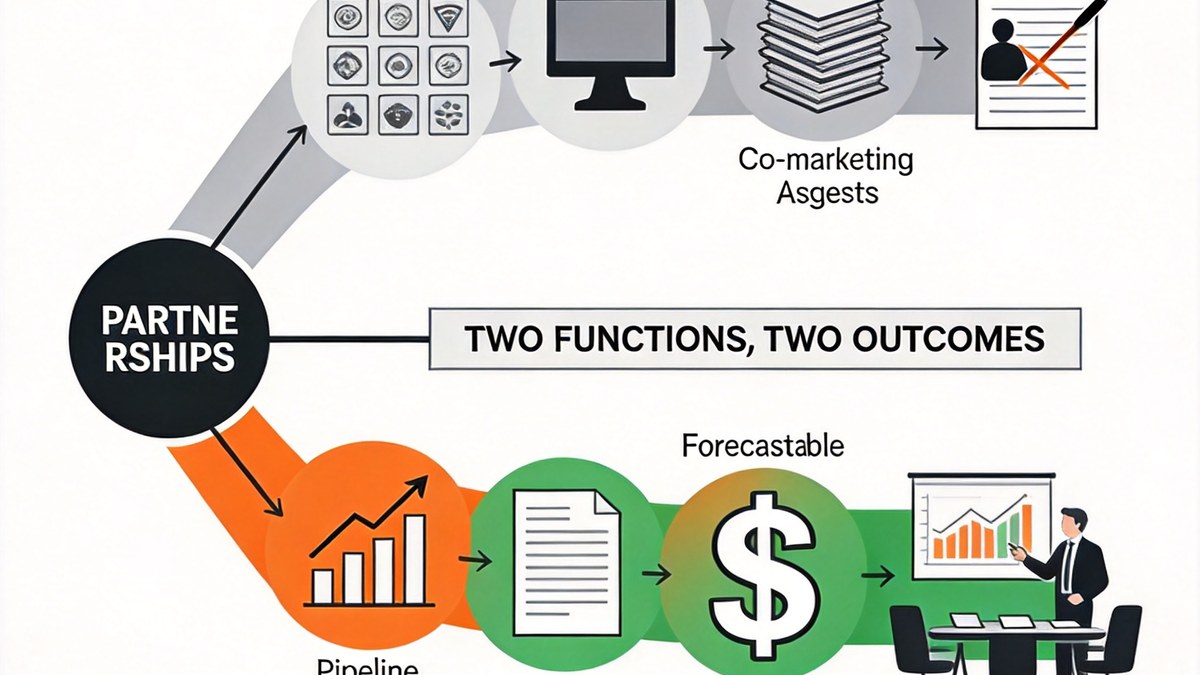
Partnerships is the function inside a B2B company that builds and runs revenue-generating relationships with other companies. Tech, ISV, and integration partnerships, reseller channels, agency partnerships, distributors, OEMs. The defining feature is not the kinds of partners involved. It’s that the partnerships team owns or co-owns a revenue number.
When the partnerships team doesn’t own a number, what’s actually being run is partner marketing. That’s a useful function. It just isn’t partnerships.
This distinction is unforgiving and most B2B SaaS teams calling themselves “partnerships” in 2026 will fail it under CFO scrutiny. They generate logos. They run webinars. They produce slick co-marketing assets. They cannot produce a defensible partner-sourced ARR number. They report into the CMO. They get cut at the next budget review and the company quietly concludes “partnerships didn’t work for us.”
The partnerships motion does work, when it’s run as a revenue function with the operational discipline of direct sales. This post defines what a partnerships function actually is, gives you a four-question diagnostic to test your own, walks through the four operational pillars that make a partnerships function produce a number, names the five failure modes that kill them, and finishes with the two structural decisions that determine whether your function survives 2027.
What is a partnerships function?
Partnerships is a revenue function. The team builds and runs revenue-generating relationships with other companies. The motion spans five distinct partner archetypes inside the same team.
The five archetypes:
- Tech / ISV / Integration partnerships. Same category, different labels for the same thing. Software vendors whose product complements yours, often connected through a technical integration. Produces co-sell pipeline plus stickiness plus marketplace-attributed revenue.
- Reseller channels. Partners who resell your product on their paper. Produces channel-attributed bookings.
- Agency partnerships. Services firms who deploy your product to their clients. Produces implementation-attached pipeline plus retention.
- Distributors. Two-tier channels who aggregate resellers, especially in international markets. Produces leveraged channel-attributed bookings.
- OEMs. Partners who embed or rebrand your product inside their own offering. Produces embedded or royalty revenue plus distribution.
Each archetype has its own playbook, comp model, and primary metric. A working partnerships function picks two or three archetypes deliberately, builds depth in each, and refuses to spread thin across all five.
| Function | Owns a revenue number? | Reports to | Primary measurement |
|---|---|---|---|
| Partnerships | Yes | CRO (when functional) | Partner-sourced ARR plus partner-influenced ARR |
| Business development (BD) | Sometimes | CRO or CEO | Strategic deal value, M&A pipeline |
| Channel sales | Yes | CRO | Channel-attributed bookings |
| Partner marketing | No (supports the number) | CMO | Co-marketing leads, MDF utilization, content reach |
The most common mistake is calling the team “partnerships” but funding it like partner marketing. The shape doesn’t match the title. The number doesn’t show up. The CFO asks why.
The diagnostic: partnerships function or partner-marketing function?
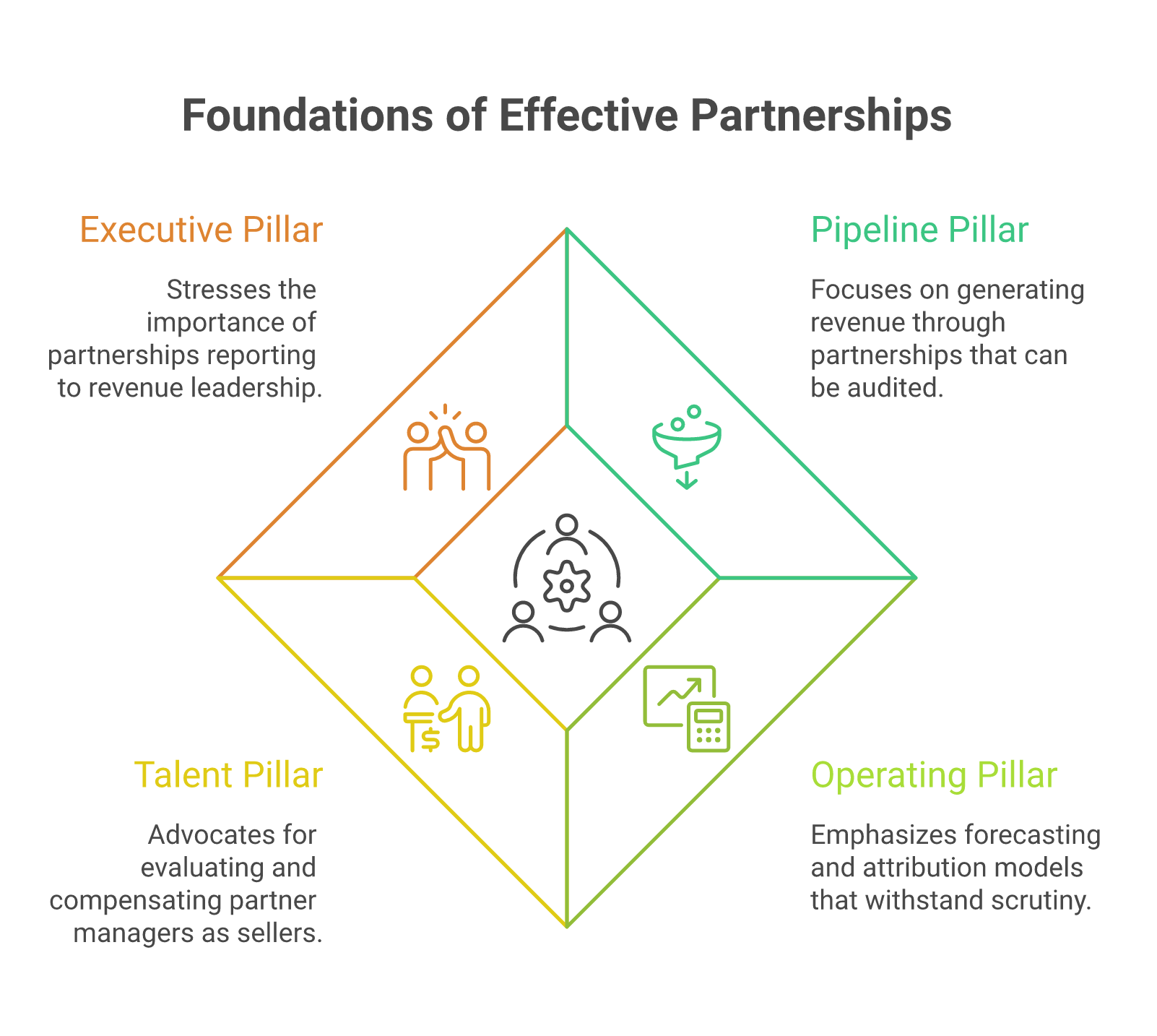
Four questions. Answer honestly. Three of four wrong means you have a partner-marketing function with a partnerships title. Two of four wrong means you have a function in transition. All four right means you have a real partnerships function.
- Does the partnerships team own a revenue number that lives on the same page as direct-sales pipeline in the CRO’s report? Right answer: yes, on a single dashboard, refreshed weekly. Wrong answer: the partnerships number lives in a separate appendix, gets cited at the QBR, and disappears between cycles.
- Does the AE comp plan reward partner-attributed deals at parity with direct deals? Right answer: yes, with a defined attribution rule that AEs trust. Wrong answer: AEs ignore partner-sourced leads because the comp plan doesn’t reward them, attribution rots, the partner-sourced number becomes garbage data.
- Can the partnerships leader produce a defensible partner-sourced ARR number on demand? Right answer: a single slide, on a Tuesday, with the methodology defended in 90 seconds. Wrong answer: the team can produce a number that took two days of CRM scrubbing and that the CFO doesn’t believe.
- When the CFO asks for the ROI on partnerships investment last quarter, does the answer take less than 90 seconds? Right answer: 90 seconds, single slide, anchored on partner-sourced ARR with a partner-influenced ARR delta. Wrong answer: a 20-minute deck with eight failure modes for why the number is hard to produce.
The diagnostic is binary on each question by design. Partial credit isn’t useful. A function survives a budget review when it can answer all four cleanly. Anything less and the function is exposed.
The four pillars of a working partnerships function
Strategy, program, motion, measurement. Four pillars. Each one has a named failure mode that breaks the function. Skip a pillar and the function breaks at a predictable point in the lifecycle.
Pillar 1, Strategy
Pick the partner archetypes that match your buyer journey. Quality over quantity. Two to three anchor partners is plenty for a $10M to $50M ARR company. The “sign 200 partners in year one” approach produces zero revenue and a logo wall. Anchor partners get force: you show up with three people on the call, you bring credibility and expertise, you feed them deal flow proactively. Non-anchor competitors tell partners to “eat what you kill” and end up with an ecosystem of mediocre partners who do nothing.
Named failure mode: spray-and-pray. A program of 200 partners with five active producers. Fix: tier ruthlessly, kill the long tail, concentrate co-sell on the top five to ten, accept that the rest of the directory is dormant.
Pillar 2, Program
Define tiers, deal-registration rules, MDF policy, certification requirements, and the comp model. The program is the contract between vendor and partners. What does the partner have to do, and what do they get in return? Most failed partnerships functions wrote a fuzzy program and hoped partners would self-organize. They never do. Partners optimize for whichever vendor’s program is the clearest. Make yours the clearest.
Named failure mode: PRM as program. Buying a PRM and assuming the software is the program. The PRM is plumbing. The program is the people, the rules, and the motion. Software amplifies a clear program. It does not rescue an unclear one.
Pillar 3, Motion
Run co-sell plans, joint webinars, account-mapping motions, partner-led customer success. The motion is day-to-day execution. It’s where the revenue actually happens. It is also where most partnerships teams under-invest. They spend their week in dashboards and decks; they spend an hour a week running an actual joint motion with a named partner on a named account.
Named failure mode: activity, not outcomes. “We had 200 partner meetings this quarter” is not a partnerships number. “We sourced $2.4M of ARR through partners this quarter” is. Activity reports are noise. Outcome reports are signal. The partnerships leader who reports activity is months from being cut.
Pillar 4, Measurement
Track partner-sourced and partner-influenced pipeline with a defensible attribution rule. Tie the partnerships investment to the revenue number quarterly. Skip this and the program loses budget at the first downturn. The four leading indicators we use with our customers, refreshed weekly:
- Number of new rep contacts per partner.
- Number of resellers or reseller contacts activated per partner.
- Completion of plan milestones.
- Incremental pipeline growth.
Named failure mode: no executive sponsor. A partnerships function reporting to a junior leader who can’t move decisions across sales, product, and finance. The function gets stuck because it can’t change AE comp, can’t access RevOps to fix attribution fields, and can’t get product to prioritize a partner-requested integration. Fix: a VP-level executive sponsor with the authority to break ties. Without that sponsor, the function will not reach Pillar 4.
The five failure modes (and what they actually look like)
Five named patterns. Each one has killed a partnerships function I have worked with in the last five years. The fix for each is operational, not strategic.
- Logo collecting. A program signs 200 partners in year one and produces no revenue. The dashboard shows breadth. The pipeline shows nothing. Fix: tier ruthlessly, kill the long tail, concentrate co-sell on the top five to ten partners.
- No comp alignment with sales. AEs ignore partner-sourced leads because their comp plan doesn’t reward partner-attributed deals. Attribution rots. The partner-sourced number becomes garbage data within two quarters. Fix: change the AE comp plan before launching the partnerships program. A 100% comp uplift on partner-sourced ARR for the first year is a common starting point.
- PRM as program. Buying a PRM and treating the software as the program. The PRM goes live. Partners are confused. The program goes nowhere. Fix: design the program (tiers, deal-reg rules, comp model, motion) before buying the software. PRM amplifies a working program; it does not create one.
- No executive sponsor. A partnerships function reporting to a junior leader without authority to break cross-functional ties. Fix: explicit VP-level executive sponsorship from day one, with monthly cadence on the partnerships number.
- Activity, not outcomes. Partnerships reports meeting counts, partner activations, content downloads, and webinar attendance. The CFO asks for revenue. The team can’t produce it. Fix: define partner-sourced and partner-influenced ARR rules upfront, build the dashboard, refresh weekly, report monthly to the CRO.
When to start a partnerships function (and when to wait)
Start once direct sales has crossed $5M to $10M ARR with a working motion. Before that, build the product and prove direct repeatability. Pre-PMF partnerships borrows trust you cannot pay back.
Two failure modes bracket the timing. Too early kills the function. A pre-PMF company that pivots to partnerships is asking partners to introduce them to customers without a product the customers will keep. Six months later, the partner has burned introduction credit, the customers churn, the partnership relationship breaks. The partnerships team gets cut and the company concludes partnerships didn’t work. The conclusion is wrong; the timing was wrong.
Too late lets a competitor own the ecosystem. By the time you arrive, the strategic partner already has a tight integration with your competitor, the comp plan favors the incumbent, and the AEs at the partner have learned to pitch the other product. Catching up is more expensive than starting.
The right hire profile for the first partnerships leader: someone with sales muscle plus partnership operations experience plus comfort with cross-functional politics. Not a logo-collecting BD veteran. Not a partner-marketing manager looking for a title bump. Someone who has owned a number and can do it again with a partner attribution flag in the CRM.
Typical first-year cost for a mid-market SaaS partnerships function: one leader plus one partner manager plus tooling. All-in, $300K to $500K loaded. The function should produce one to two times its loaded cost in partner-sourced ARR by month 12 to be considered on track.
Roles and structure (who does what)
Partnerships team headcount should track partner count and motion complexity, not GTM headcount. A typical mid-market team has one leader per 30 to 50 active partners, plus motion specialists.
| Role | What they own | When you hire |
|---|---|---|
| VP / Head of Partnerships | Strategy, program, executive sponsorship, the number | Day one |
| Partner Manager | Specific partner relationships and the joint motion with each | Per partner archetype, ~30 to 50 partners each |
| Partner Marketing | Joint content, MDF, co-marketing campaigns | When MDF spend reaches ~$200K/year |
| Partner Operations | Tooling, attribution, CRM/PRM hygiene | When deal-reg volume exceeds ~30/month |
| Partner Enablement | Certification, training, content gating | When tiering goes live |
| Co-Sell Alignment Specialist | Cross-functional co-sell motion ownership | When co-sell pipeline crosses ~$1M ARR |
| Chief Partner Officer (CPO) | C-level partnerships, executive briefings, board reporting | Enterprise scale, ~100+ active partners |
The most common structural mistake is overweighting partner-marketing headcount and underweighting partner-operations and co-sell-alignment headcount. Marketing produces logos and content. Operations and co-sell alignment produce revenue. The ratio matters and most teams have it backwards.
The two structural decisions that determine whether your function survives
Two decisions. The function survives 2027 only if you make both right. Most partnerships leaders never explicitly make either one and discover later that the answer is wrong.
Decision 1: Will partnerships own a revenue number?
If yes, you are running a partnerships function. Comp plans align to that number. Reporting cadence aligns to that number. The function gets defended at budget time because it has a number to defend.
If no, you are running a partner-marketing function. That’s a real and useful function. The mistake is calling it partnerships, expecting it to produce a partnerships number, and being surprised when it doesn’t. Give the team the right title. Set the right expectations. Fund it like marketing, not like sales.
Decision 2: Will partnerships report into the CRO or the CMO?
When partnerships owns a revenue number, it belongs under the CRO. The reporting line keeps the function measured on revenue. The CRO has the authority to change AE comp, fix CRM attribution, and prioritize partner-driven product asks.
When partnerships is mostly a co-marketing function, it sits under the CMO. The reporting line keeps the function measured on what it actually does (logos, content, awareness, MDF utilization).
The first structure produces revenue. The second produces logos. Pick the one that matches the goal you’ve signed up to deliver. The decision is the most underrated lever in the function.
Forecastable’s POV
Three positions. One contrarian prediction, one structural recommendation, one defense test.
The 80% prediction. Eighty percent or more of the partner managers in role today will not be in role 24 months from now. Crossbeam research cited by Chris Lavoie shows roughly 43% partner-manager attrition in the last 12-month window we have data on. Our read is that the next 24 months accelerate that. Some teams will be cut. Some partner managers will be replaced by salespeople with more rigor. Some will be replaced by an AI execution layer plus a half-time orchestration specialist. The partner managers who survive will own a number, not a logo wall.
The CRO-not-CMO move is the most underrated lever in the function. Org structure determines incentive structure. Reporting line determines measurement. Get the reporting line right and most other failure modes correct themselves. The wrong reporting line is the upstream cause of most of the other failures we see. Fixing it is one quarter of patience and one quarter of org-chart politics, and it pays back for the next five years.
The partnerships investment that survives 2027 is the one you can defend with a partner-sourced ARR number on a single slide. Everything else is theater. The slide doesn’t have to be pretty. It has to be defensible. If you can’t produce that slide today, the work for the next 90 days is to be able to produce it at the next QBR. At Forecastable, that’s the work we deliver with you. We don’t sell software. We don’t sell services. We sell revenue outcomes. Partner-led pipeline built with your team, with sales rigor and full visibility, on a partner-sourced ARR outcome the CRO can defend.
Frequently-Asked Questions
Is partnerships the same as business development (BD)? Partnerships is a subset of BD focused on partner motions and ecosystem revenue. BD is broader and can include M&A, strategic deals, and non-revenue partnerships. Most modern SaaS companies have separated the two functions.
Should partnerships report to the CRO or the CMO? When partnerships owns a revenue number, it belongs under the CRO. When partnerships is mostly a co-marketing function, it sits under the CMO. The first structure produces revenue. The second produces logos.
How big should a partnerships team be? Roughly one partnerships head per 30 to 50 active partners, plus shared services for ops, marketing, and enablement. Headcount tracks partner count and motion complexity, not company headcount.
What’s the difference between partnerships and channel sales? Channel sales is one specific motion (partners resell your product on their paper). Partnerships is the broader function that includes channel plus tech alliances, ISV, agency, and integration motions.
What tools does a partnerships team need? At minimum, a CRM with partner-attribution fields, account-mapping software, and (above 30 partners) a PRM. Layer in co-sell coordination, partner-marketing automation, and ecosystem analytics as the program scales.
When should a SaaS company start a partnerships function? Once direct sales has crossed $5M to $10M ARR with a working motion. Before that, build the product and prove direct repeatability.
What is a partner program? The contract between vendor and partner. Defines tiers, deal-registration rules, MDF policy, certification, and the comp model. The program is the framework; the motion is the day-to-day execution against that framework.
Why do most partnerships programs fail? Five named failure modes: logo collecting, no comp alignment with sales, PRM as program, no executive sponsor, and reporting activity instead of outcomes. Each has a clear fix; the failure is in the function design, not in the partner relationships.
Next step
If you’re reading this and you can’t answer all four diagnostic questions cleanly, the work for the next 90 days is to be able to answer them at the next QBR. The function survives a budget review when the partnerships leader can produce the number on a single slide and defend the methodology in 90 seconds.
If you want a 30-minute version of the diagnostic conversation tailored to your team and your CRO, that’s the first conversation we have at Forecastable with every customer. The output is a one-slide read on which diagnostic questions you pass, which you don’t, and the named change you’d make this quarter to fix the gap. We don’t sell software. We don’t sell services. We sell revenue outcomes. Partner-led pipeline built with your team, with sales rigor and full visibility. Talk to Forecastable.
For deeper reading on the parts of the function this pillar references, the co-sell motion and the ecosystem-led growth pillar both expand on the operational layer above the diagnostic.
By Alex Buckles
Forecastable is an independent third-party professional services company. Our evaluations of other vendors are based on publicly-available information as of May 2026 and our own client experience.
Uncover Your Growth Potential
Schedule a Discovery Call