Co-Sell: The 2026 Definition, Motion, and Playbook

Short answer: co-sell is a B2B sales motion where two companies plan and execute against shared accounts together, with both AE teams working the deal and both sides recognizing revenue or influence on the close. In 2026, it is the highest-leverage partnership motion in B2B SaaS because it compounds AE productivity instead of just adding raw pipeline.
What is co-sell?
Co-sell is the joint sales motion where two companies, typically a vendor and a partner, work a shared customer account together, share opportunity visibility, and both recognize revenue or influence on the close.
The term “co-sell” gets used three different ways. So before any meeting starts, be precise about which one you mean:
- Co-sell as motion, where two AE teams, yours and a partner’s, actively work a shared account together from intro through close.
- Co-sell as program, a structured partner program built around that motion, with account mapping, deal registration, joint planning, and revenue attribution documented.
- Co-sell as marketplace mechanic, the AWS, Azure, GCP, and Salesforce-style “private offer plus ACE/IPN/MAP” motions where the marketplace becomes the contracting layer.
Partnerships leaders typically mean the motion. By contrast, CROs typically mean the marketplace mechanic. That mismatch is the source of an enormous amount of internal friction.
Why co-sell is the highest-leverage partnership motion in 2026
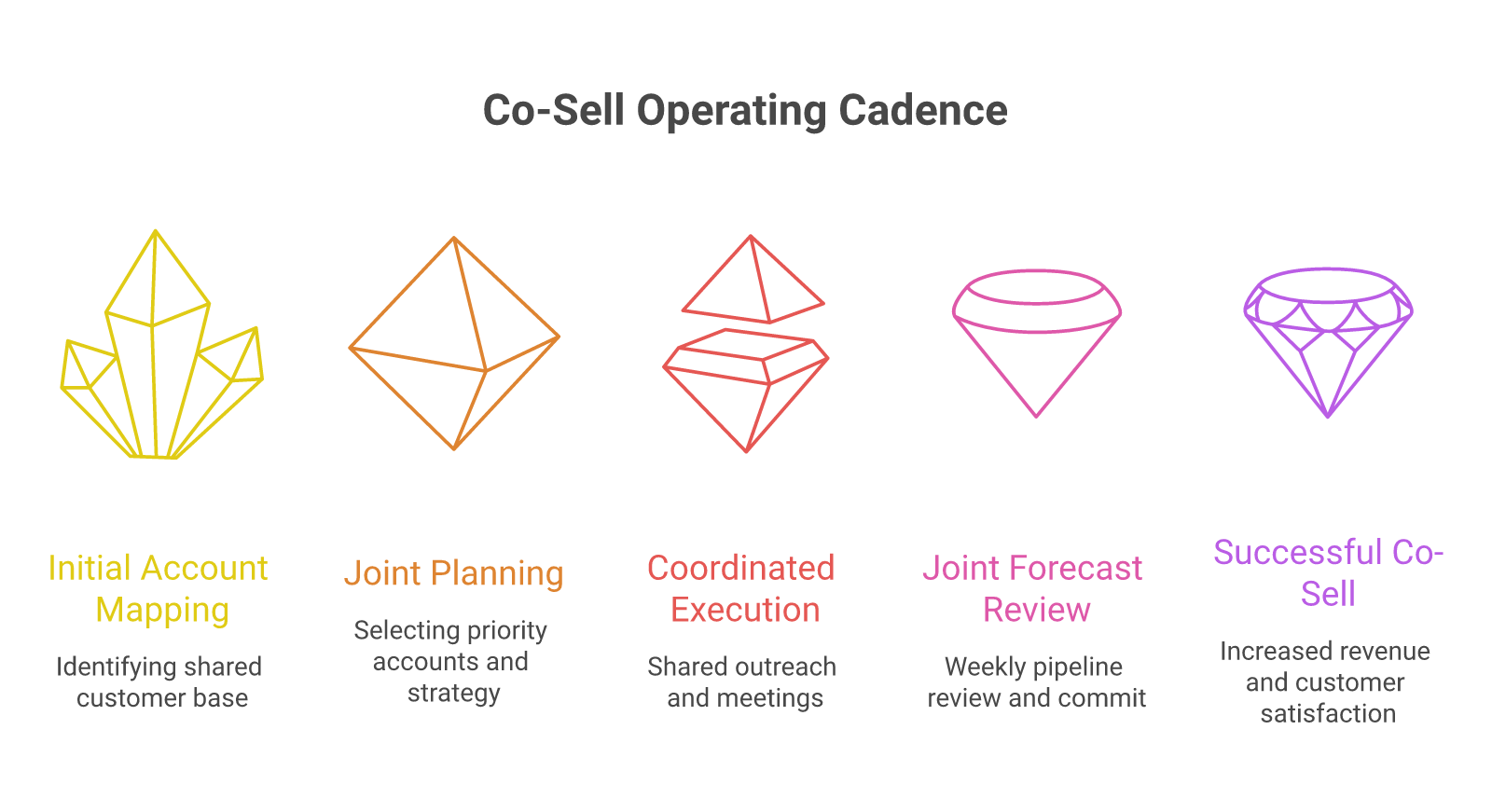
Co-sell compounds AE productivity rather than just adding pipeline. Done well, the same quota gets carried with materially higher close rates, shorter cycles, and bigger deal sizes.
The shift from channel-as-distribution to ecosystem-as-influence finally has the data to back it. Crossbeam reports, Partnership Leaders surveys, and PartnerTap analyses converge on the same finding. Specifically, deals with partner overlap close at 2-3x the rate of deals without it. They also run shorter cycles and bigger ACVs. Crossbeam’s ecosystem-led research and Forrester’s channel coverage both point the same way.
What co-sell does mechanically is replace cold prospecting with warm orchestration. Specifically, the vendor AE learns, through overlap data, that a trusted partner already has the same prospect as a customer. Then the partner introduces, the partner AE joins the deal, and the buying committee gets two voices instead of one. The motion is not faster because it is “warmer.” It is faster because the buyer’s information cost drops sharply.
The reason co-sell beats classic channel in 2026 is structural. Buyers are tired of SDR outreach. They trust their existing vendors. Increasingly, they buy ecosystems, not point tools. So co-sell is the motion that maps to how modern enterprise buying actually works.
How co-sell actually works
Six steps, in order: account mapping, qualification, intro, joint plan, joint execution, attribution. Skip any one and the motion breaks.
Here is the six-step co-sell motion in practice.
Step 1, Account mapping. First, both companies share target accounts (CRM data, prospect lists, customer lists) through Crossbeam or a shared spreadsheet. The output is a list of accounts where one side is selling and the other side is already trusted.
Step 2, Qualification. Next, both partner managers, and ideally both AEs, qualify the overlap accounts against buying signals, timing, and budget. Volume without qualification destroys partner-side trust.
Step 3, Intro. Then the partner who knows the account makes a warm intro to the partner AE. The intro names the opportunity, the stakeholder, and the specific reason a co-sell makes sense.
Step 4, Joint plan. After the intro, both AEs build a one-page joint plan: customer outcome, each side’s value contribution, stakeholder map, close plan, and revenue attribution agreement.
Step 5, Joint execution. Now both AEs work the deal. The partner-side AE joins discovery, presents integrated value, supports objections, or leads specific stakeholder conversations. No joint execution means no co-sell.
Step 6, Attribution. Finally, both sides record the opportunity with partner influence flagged. Both comp plans recognize the contribution. Attribution that only one side respects breaks down in year two.
A working co-sell motion ships all six. However, most early programs ship steps 1 to 3 and stall, because steps 4 to 6 require process changes only the CRO can authorize.
Co-sell vs other partnership motions
Co-sell, referral, reselling, and OEM are four different motions with different revenue mechanics. Conflating them is the most common 2026 framing error.
| Motion | Who closes | Revenue mechanic | Partner contribution |
|---|---|---|---|
| Co-sell | Both AEs work the deal | Each side books its own revenue plus partner-influenced credit | Active selling, customer trust, joint plan |
| Referral | Vendor AE closes | Vendor pays a referral fee or rev-share | Intro only, no active selling |
| Reselling | Partner closes; vendor delivers | Partner buys at discount, resells at margin | Owns end-customer relationship |
| OEM | Licensee closes; licensor invisible | Royalty, per-seat, rev-share | Technology only, no GTM role |
| Marketplace co-sell | Vendor closes via marketplace | Marketplace handles the contract; co-sell incentives may apply | Marketplace plus partner combine; varies |
Here is the most common mis-framing. Teams call a referral motion “co-sell” because the partner sometimes shows up on a call. Yet if the partner AE does not carry part of the close, you are running a referral program with extra meetings.
Common pitfalls in co-sell
Failures show up in five places: wrong AEs paired, no joint plan, attribution disputes, partner-only effort on intros, and absent CRO sponsorship.
Pitfall 1: Wrong AE pairings. Co-sell at AE level is only as strong as the chemistry between the two sellers. So pair by territory, segment, persona affinity, and prior collaboration.
Pitfall 2: No joint plan per account. “We will figure it out on the call” produces co-sells that look promising and never advance. A one-page plan is the minimum bar.
Pitfall 3: Attribution disputes. Agree in writing, before the first deal closes, how revenue and influence are attributed. Disputes about whether a deal “counts” kill programs.
Pitfall 4: Partner-manager intros without AE follow-through. When PMs manufacture intros but AEs do not run joint plans, the program looks busy on the dashboard and produces no pipeline.
Pitfall 5: No CRO sponsorship. Co-sell is a sales motion change, not a partnerships team initiative. Without CRO authority to change forecasting, attribution, and comp, the motion stalls inside the partnerships team.
How to start co-sell without buying a new platform
You can run a credible co-sell motion with a shared spreadsheet, Slack Connect, and a CRM custom field. The platform is leverage on top of discipline, not a substitute for it.
Here is a minimum viable co-sell stack.
- Account mapping: Crossbeam, or a shared spreadsheet for the first 30 days.
- Joint planning: A shared Google Doc with the one-page joint plan per account.
- Communication: A Slack Connect channel with the partner team.
- Pipeline tracking: A CRM custom field for “partner influenced” and “partner sourced” on opportunities.
- Cadence: A weekly 30-minute partner pipeline review.
Programs that wait until they have a PRM, an overlap platform, and a co-sell automation tool to start have already lost 12 months. Instead, start with the spreadsheet. Then earn the right to buy the platform with pipeline data. If you want the layer above the motion, our co-sell pillar walks through the operating model.
Forecastable’s POV on co-sell
Most partnerships teams talk co-sell and run referral programs in disguise. The fix is to put partner-side AEs on the call and put attribution in writing.
Here is the single most-repeated coaching note across the co-sell motions I have reviewed. Partner managers run the intros and walk away. The AE-to-AE handoff happens in email. The partner-side AE never joins a discovery call. So the deal closes, or does not, on the vendor AE’s standard motion. That is referral selling. In fact, the difference shows up in close rates, cycle time, and ACV. Those are the three numbers co-sell is supposed to compound.
The second move is to write the attribution rule before the first deal closes. “We will figure it out” produces 18-month disputes about whether a deal “really” had partner influence. So document the rule once, in writing, signed by both CROs. Then enforce it.
The third move is to pick three accounts this quarter, pair the AEs, write the joint plan, and run the full six-step motion. Co-sell is learned in the practice, not in the planning. Indeed, three accounts with full-loop execution teach the program more than 50 referrals dressed up as co-sells.
Frequently asked questions
What is the difference between co-sell and referral selling?
Co-sell has both AEs actively working the deal. By contrast, referral selling has one AE working the deal after a partner intro. Different motion, different outcomes, different comp.
Do I need Crossbeam to run a co-sell motion?
No. You can start with a shared spreadsheet for 30 days. Then buy the platform once you have pipeline data that justifies the spend.
Who should own co-sell internally?
A named partner manager runs the motion day-to-day. Meanwhile, the CRO owns forecasting, attribution, and AE participation. Co-sell without CRO sponsorship stalls.
How long does co-sell take to ramp?
Expect the first three deals in 90 to 120 days if the motion runs end to end. Programs that ship steps 1 to 3 only ramp slower and rarely produce pipeline.
Does co-sell work in PLG motions?
Yes, with adjustments. In practice, co-sell in PLG often runs through joint integration messaging and event-based intros rather than AE pairing. The mechanic is similar; the surface area is different.
Should partner AEs and vendor AEs share a comp plan?
No. Both sides should book their own revenue plus partner-influenced credit. Trying to share a single comp plan across two companies’ AEs almost always fails.
What is the right number of co-sell partners to start with?
Three. Run the full motion with three partners and earn the right to scale to ten. Programs that start with 20 partners run outreach, not co-sell.
How does marketplace co-sell (AWS, Azure, GCP) fit?
Marketplace co-sell is the contracting layer, not a substitute for the motion. The same six-step motion applies. Meanwhile, the marketplace becomes the payment rail and, in some programs, provides co-sell incentives or buyer-funded credits.
Next step
Pick three target partners this week. Pull an account overlap with each. Then choose one account per partner where both sides have strong AE chemistry. Build a one-page joint plan. Run the full six-step motion.
Forecastable is an independent third-party professional services company. Our evaluations of other vendors are based on publicly-available information as of May 2026 and our own client experience.
Talk to our team about installing the co-sell motion in your program →
Uncover Your Growth Potential
Schedule a Discovery Call