PRM vs CRM: 2026 Comparison and How They Work Together

Short answer: PRM vs CRM is not a fight. It is a layering question. A CRM manages internal sellers and direct customer accounts. A PRM manages external partner reps and partner-sourced deal flow. Most B2B SaaS above $5M ARR run both. The PRM writes back to the CRM as the revenue source of truth.
At a glance: PRM vs CRM
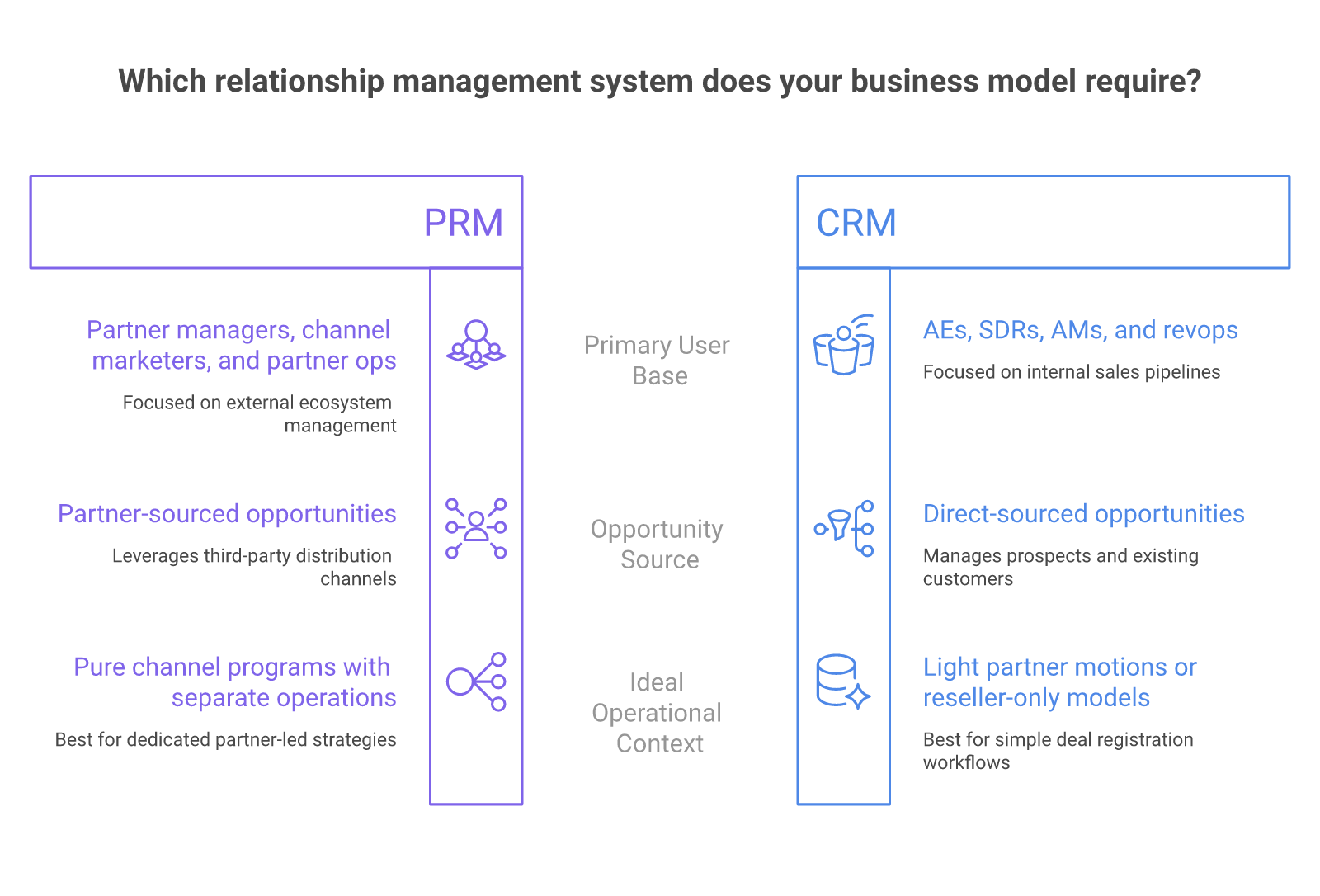
A CRM tracks internal sellers and direct customers. By contrast, a PRM tracks external partners and partner-sourced deals. The two overlap on deals, accounts, and contacts. That overlap is where most integration pain happens.
| Dimension | CRM (Salesforce, HubSpot) | PRM (Introw, Euler, Impartner) |
|---|---|---|
| Primary user | Internal AE, CSM, RevOps | External partner rep, internal partner manager |
| Core objects | Account, contact, opportunity, lead | Partner, partner rep, deal registration, MDF, certification, partner education (LMS) |
| Pipeline source | Direct sales | Partner-sourced or partner-influenced |
| Compensation engine | Internal AE comp | Partner payouts, referral fees, rev-share, MDF |
| Content | Internal enablement | Partner portal, certifications, co-branded assets |
| Reporting unit | AE, segment, territory | Partner firm, partner rep, partner tier |
| Source of truth | Revenue, customer record | Partner status, partner-sourced credit |
Here is the simple rule. Every dollar of revenue lives in the CRM. Meanwhile, partner credit, certs, deal-reg approvals, and payouts live in the PRM. The integration is where partner-sourced revenue gets reconciled.
One framing note before you go further. A PRM and a CRM are both workflow tools. Neither one is the orchestration layer. Deciding which accounts to co-sell, which partners to activate, and how the joint motion runs is a separate job. That job sits above both systems. We at Forecastable call it the Ecosystem Orchestration layer. It is services plus technology, not another PRM. Keep that in mind. Most “PRM vs CRM” confusion is really a missing-orchestration problem.
When to choose a CRM only
Programs with under 10 active partners and under 20% partner-influenced pipeline rarely justify a PRM. A CRM custom object plus a shared spreadsheet does the job.
Say you are running a small program. Under 10 partners. Under 20% partner-influenced pipeline. No certification or MDF. In that case, a PRM is over-tooling. Most teams here get more value from a few lightweight moves.
- One “Partner” custom object in Salesforce or HubSpot.
- Two opportunity flags: “Partner Sourced” and “Partner Influenced.”
- One shared Google Sheet for deal registration and joint plans.
- Slack Connect channels for partner communication.
The PRM becomes worth it when partner volume outgrows the CRM’s native partner support. In practice, that means around 15 to 25 active partners, multiple tiers, and explicit MDF or co-marketing commitments. Until then, a CRM-only setup keeps your reporting clean and your spend low.
There is a second reason to wait. Teams that build the partner-attribution habit in the CRM first tend to write cleaner deal-reg rules later. So the discipline you build now pays off when the PRM finally lands.
When to choose both PRM and CRM
Programs above 15 to 25 active partners need both. So do programs with deal registration, certifications, MDF, or multiple tiers. The PRM writes partner-sourced deals back to the CRM. The CRM stays the source of truth for revenue.
Here are the signals that say you have outgrown CRM-only partner management.
- More than 15 to 25 active partners with regular deal flow.
- A multi-tier program (for example, Authorized, Silver, Gold, Platinum) with different rules per tier.
- Active deal registration with approval workflows.
- MDF disbursement, rebate, or rev-share payouts at scale.
- Partner certifications gated to selling rights or tier eligibility.
- Partner enablement that exceeds what your internal LMS will cleanly serve to external users.
At that scale, forcing the CRM to do partner-portal duty creates three problems. First, confused internal users. Second, partner-rep friction, or worse, no portal at all. Third, partner data that breaks every CRM cleanup. A PRM solves all three.
The PRM market has consolidated around a few clear leaders. Introw, Euler, and Impartner lead the category in 2026. Zinfi, PartnerStack, Channelscaler, Magentrix, and Mindmatrix are the other established options. Each one shifts the same partner workflows out of the CRM and into a system built for external users. Forrester’s channel-software coverage tracks how this category has matured.
Edge cases
Co-sell-heavy programs, marketplace-led GTM, and SI-partner-heavy programs each have specific patterns that change the PRM vs CRM calculus.
Co-sell-heavy programs
Say your partner motion is primarily co-sell, not reseller. You may end up running an account mapping platform such as Crossbeam alongside the CRM, with no traditional PRM at all. Co-sell programs do not need partner-portal, deal-reg, or MDF tooling the way reseller programs do. For the motion itself, our co-sell breakdown walks through the six-step model.
Marketplace-led GTM
Say most partner-sourced revenue flows through AWS, Azure, GCP, or Salesforce marketplaces. Then the marketplace becomes the deal-reg and contracting layer. The PRM still helps for partner enablement and certification. Still, the deal-reg workflow lives in the marketplace.
SI-heavy or consulting-heavy programs
Systems integrators and consultancies do not behave like resellers. They need delivery enablement, scope tracking, and project-based credit. Most PRMs handle this poorly. So expect to either configure your PRM heavily or add project tooling.
Methodology
This comparison draws on hands-on builds across SaaS partner programs. It also draws on vendor docs and customer feedback from G2 and Capterra reviews, collected through May 2026.
Here are the sources for this comparison.
- Direct build experience across reseller, tech, OEM, and co-sell programs.
- Vendor docs from Salesforce, HubSpot, Introw, Euler, Impartner, PartnerStack, Zinfi, and Magentrix as of May 2026.
- G2 and Capterra reviews for CRM and PRM categories, filtered to reviews from May 2024 onward.
- Public benchmark content from Crossbeam’s ecosystem research, Partnership Leaders, Channelnomics, and Forrester’s recent partner-tech work.
What is not in scope: pricing. Vendors negotiate too broadly for static pricing tables to be useful. So get pricing direct from vendors with your actual partner-seat count and module list.
Forecastable’s POV
The PRM vs CRM debate is misframed. Above $5M ARR with a partner motion, you need both. The real question is which tool owns which workflow. And how cleanly the integration writes partner credit back to the CRM.
Here is the single most-repeated coaching note across the PRM and CRM implementations I have reviewed. Stop treating PRM vs CRM as a “which one” question. Start treating it as a workflow-ownership question. Partner enablement, deal-reg, certifications, MDF, and partner-rep onboarding belong in the PRM. Opportunity records, customer records, and revenue belong in the CRM. The line gets crossed when integrations break. So design the integration first, not last.
The second move is simple. Do not buy a PRM under 15 to 25 active partners. The “build muscle in the CRM first” path makes better partner managers. It also makes for a cleaner PRM build when the program finally outgrows the CRM. Programs that buy a PRM at five partners almost always underuse it. Then they resent the spend.
The third move is to write the partner-sourced and partner-influenced flags into the CRM, with or without a PRM. Those two flags are the foundation of every partner-attribution report you will ever run. So get them right early. And remember the layer above both tools. Neither a PRM nor a CRM decides which accounts to co-sell or which partners to activate. That orchestration work is where Forecastable operates, above the data layer and the PRM layer.
Frequently asked questions
Do I need both a PRM and a CRM?
Above 15 to 25 active partners with deal-reg, certs, MDF, or multiple tiers, usually yes. Below that, a CRM custom object and a shared sheet usually do the job.
Can a PRM replace a CRM?
No. A PRM is built for partner ties and partner-sourced deal flow. It is not built to run internal sales or customer-success work.
Does Salesforce have a native PRM?
Salesforce sells Partner Cloud (Experience Cloud plus PRM templates). It works for some programs. Still, it usually needs heavy setup, or a bolt-on PRM such as Impartner, for serious partner motion.
Does HubSpot have a native PRM?
HubSpot has partner-program features and supports custom objects. Yet it does not ship a full PRM. Most HubSpot-centric partner programs run Introw, PartnerStack, or Magentrix alongside HubSpot.
How does a PRM integrate with a CRM?
Through a two-way API sync on deals, accounts, and contacts. Deal-reg approvals in the PRM write to deal records in the CRM. Partner credit flows back the same way.
What is the cost difference between PRM and CRM?
CRM seats are priced per internal user. By contrast, PRM is priced per partner firm or partner rep, often with module add-ons (deal-reg, MDF, learning). Both scale with usage. PRM scales with partner volume. CRM scales with internal headcount.
Where do co-sell tools (Crossbeam, PartnerTap) fit?
They are a third layer. CRMs manage direct pipeline. PRMs manage partner programs. Account mapping tools manage account overlap and the joint motion. Mature ecosystems run all three, with an orchestration layer on top.
Next step
Map your current partner-sourced and partner-influenced pipeline this week. If it is under 20% with under 10 active partners, stay in the CRM. Just add the two attribution flags. If it is above that, and you run deal-reg by hand, start the PRM review.
Forecastable is an independent third-party professional services company. Our evaluations of other vendors are based on publicly-available information as of May 2026 and our own client experience.
Talk to our team about mapping PRM and CRM to your partner motion →
Uncover Your Growth Potential
Schedule a Discovery Call