Partner Deal Stages: A Working Co-Sell Pipeline Definition

What are partner deal stages?
Short answer: Partner deal stages is the structured set of pipeline stages a co-sell deal moves through, with exit criteria at each stage that name both the host-side and the partner-side moves required to advance. It exists because the direct-sale stage map does not capture the partner-side work that makes a co-sell deal close, and finance will not fund a partner pipeline forecast on a generic stage definition that treats partner-touched deals the same as direct.
The shortcut is to take the existing CRM stages and overlay a partner-side mirror on each stage. The host-side moves stay the same; the partner-side moves are added as required exit criteria. Most co-sell pipeline drift happens because the partner-side moves are not written into the exit criteria.
Why partner deal stages matter in 2026
Three forces have made partner deal stages a forecast question. First, partner-sourced and partner-influenced pipeline now represent a meaningful share of total pipeline at mature programs, and finance cannot underwrite the forecast without a stage definition that holds. Second, co-sell deals slip more often than direct deals because the partner-side moves (joint discovery, technical pre-brief, exec intro, marketplace procurement) happen on a different cadence than the host-side moves, and the AE cannot tell when the deal is actually advancing. Third, the partner-side seller and the host AE need the same stage definition to operate the deal, and the absence of a shared definition is a leading indicator of a stalled co-sell motion.
A working partner deal stages definition is short, signed, and operational. It does not invent new stages; it adds partner-side exit criteria to the existing stages. The teams that build a new parallel pipeline produce a second forecast that finance does not trust; the teams that overlay partner moves on the existing stages produce one fundable forecast.
The shortcut is to start with the existing CRM stages, name the partner-side move at each stage, and write the exit criteria as the joint condition.
How partner deal stages actually work
A working stage definition runs on five components. Each component is named, signed by RevOps and the head of partnerships, and operational in the CRM and the PRM.
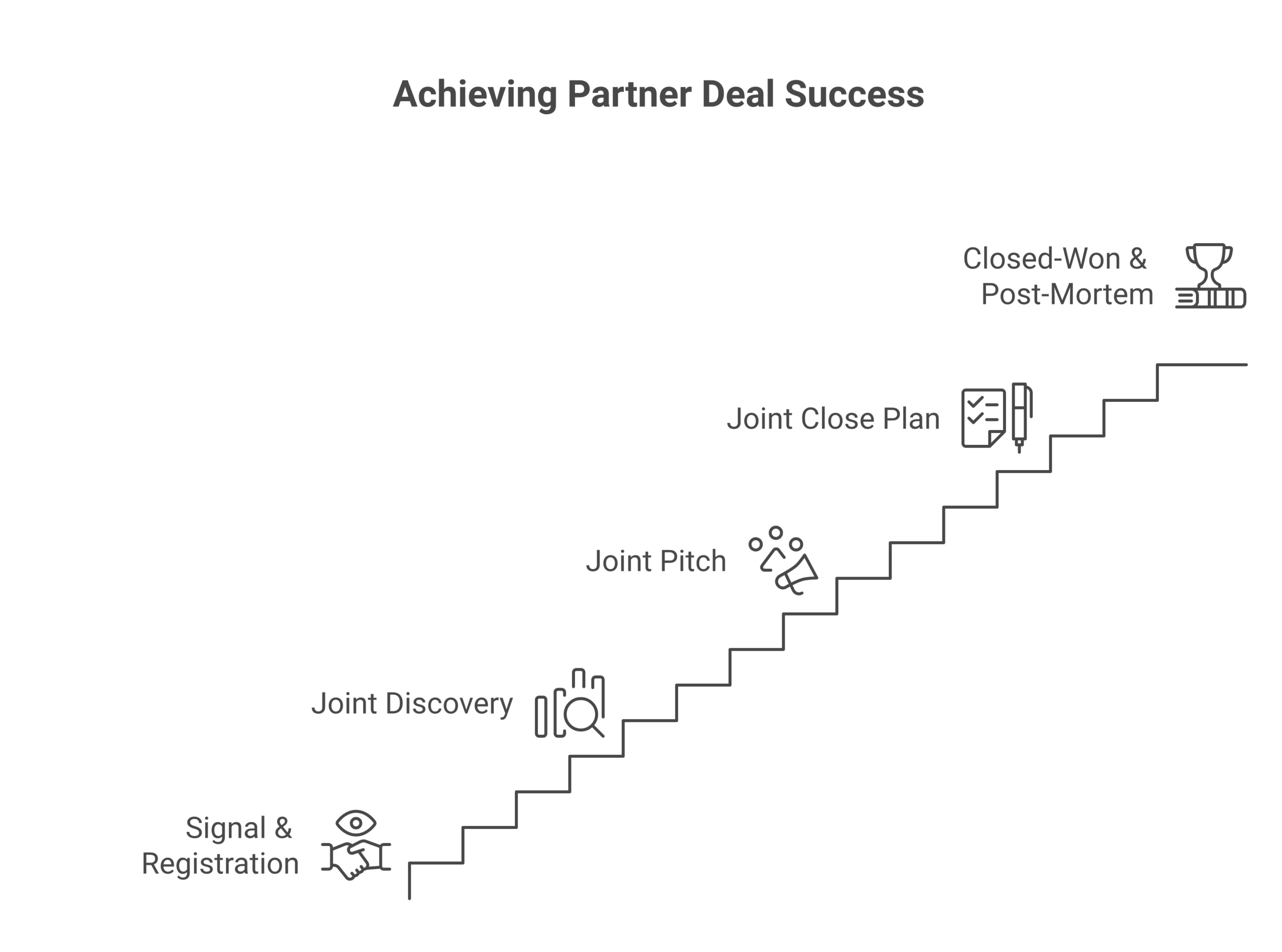
- Stage 0: Signal and registration: Partner-side signal (overlap, intent, referral) is captured and the deal is registered in the PRM (Introw, Euler, Impartner, PartnerStack, or Channelscaler). Exit criterion: a named partner-side counterpart and a signal tier (Tier 1, 2, 3, or 4).
- Stage 1: Joint discovery: The host AE and the partner-side seller run a joint qualification call. The partner-side move is the relationship intro and the buying-committee map; the host-side move is the technical and pricing discovery. Exit criterion: a one-page joint scorecard with MEDDIC fields populated on both sides.
- Stage 2: Joint pitch and technical pre-brief: The two sides run a joint pitch deck with the partner-side use case integrated, plus a technical pre-brief if the deployment is non-trivial. Exit criterion: a documented next-step from the buyer with a named champion on the buyer side.
- Stage 3: Joint close plan and procurement path: The host-side commercial owner and the partner-side counterpart agree on the close plan (procurement steps, marketplace path if relevant, joint exec sponsorship). Exit criterion: a signed mutual action plan and a marketplace deal ID if applicable (Tackle, Labra, Suger, or Clazar).
- Stage 4: Closed-won and joint post-mortem: Deal closes; within seven business days, host and partner side run a joint post-mortem on what worked and what slipped. Exit criterion: a one-page learning that feeds the next ten deals on the same partner.
The stage map runs as the host CRM stages with the partner-side mirror written into each exit criterion.
Common pitfalls in defining partner deal stages
- Inventing a parallel pipeline instead of overlaying the existing stages: A parallel pipeline produces two forecasts that fight in the QBR. Overlay the partner-side moves on the existing stages; one pipeline, one forecast, one set of exit criteria.
- No exit criteria for the partner-side move: A stage definition that says “joint discovery” without naming what produces the exit criterion is unenforceable. Every partner-side move has to produce a named artifact (joint scorecard, mutual action plan, marketplace deal ID).
- Partner manager owning the stage advancement instead of the AE: The AE owns the deal and the stage; the partner manager owns the partner-side support. When the partner manager owns the stage, the deal stalls because the AE is not in the loop.
- Skipping the joint post-mortem at stage 4: The compounding gain is in the post-mortem, not the stage definition. A team that closes ten co-sell deals without a single joint post-mortem rebuilds the same stage gaps on the next ten.
- Treating signal as a stage: Signal is the prerequisite for stage 0; it is not a stage. A deal in pre-registration is not in the forecast and should not be reported in pipeline.
What this looks like in practice
A mid-market B2B SaaS team had a four-stage direct-sale pipeline and was running co-sell as an unstructured side motion. Co-sell deal slip rate was sixty percent at stage two, and finance would not include partner-sourced pipeline in the quarterly forecast. The head of revenue ops and the head of partnerships ran a two-week design sprint to overlay partner-side exit criteria on the existing four stages: signal-and-registration as stage zero, joint scorecard at stage one, mutual action plan at stage three. The CRM and Introw were updated with structured fields and required-field validation. Within six weeks, the slip rate at stage two had dropped from sixty percent to thirty-eight percent, finance accepted partner-sourced pipeline on the forecast for the first time, and the quarterly partner business review ran against actual stage movement instead of anecdotes. The same stage map now operates across nine co-sell partners.
Forecastable’s POV on partner deal stages
Partner deal stages are not a new pipeline; they are the existing pipeline with the partner-side moves named in the exit criteria. The teams that build a parallel co-sell pipeline produce a second forecast finance does not trust; the teams that overlay partner moves produce one fundable forecast.
The deeper read is that the absence of partner deal stages is the root cause of most stalled co-sell motions. The host AE does not know what the partner-side counterpart is supposed to do at stage two; the partner-side seller does not know what the host AE is supposed to deliver at stage three; the deal stalls and the two sides blame each other. A written stage definition with named exit criteria removes the blame and makes the stall diagnosable.
The candor on the stage-count question is that more stages do not produce more clarity. Four to five stages with strong exit criteria outperforms eight stages with weak ones. The exit criterion is the work; the stage count is the container.
The candor on RevOps ownership is that the stage definition has to be signed by RevOps and partnerships jointly, not by partnerships alone. RevOps owns the CRM workflow and the forecast rollup; partnerships owns the partner-side moves. The two sides have to design the stage map together, or RevOps will not enforce the partner-side exit criteria.
Forecastable is a partnerships operating platform; the tools above (Crossbeam, Pocus, Common Room, Tackle, Labra, Suger, Clazar, Introw, Euler, Impartner, PartnerStack, Channelscaler) are independent third-party platforms, and naming them is not an endorsement of any specific deployment over another. Evaluate each on your own motion.
Frequently asked questions
How many partner deal stages should we use?
Four to five, with strong exit criteria at each. The stage map should overlay the existing direct-sale stages; do not invent a parallel pipeline.
Who owns partner deal stage advancement?
The AE owns stage advancement; the partner manager owns the partner-side support. The PRM (Introw, Euler, Impartner, PartnerStack, or Channelscaler) hosts the stage workflow; the CRM is the system of record for the forecast.
What is the right exit criterion for stage 1 (joint discovery)?
A one-page joint scorecard with MEDDIC fields populated on both sides. The scorecard is the artifact that proves stage one is complete; without it, the deal sits at stage one.
Should we use the same partner deal stages across all partner types?
Yes for the stage definition; no for the named partner-side moves at each stage. The exit criteria adapt by partner type (SI, ISV, reseller, marketplace), but the stage map is the same.
How does the marketplace procurement path fit into partner deal stages?
At stage three, with the marketplace deal ID (Tackle, Labra, Suger, or Clazar) as the exit-criterion artifact. The marketplace path is a procurement variant of stage three, not a separate stage.
What is the leading indicator of a stalled co-sell deal?
A deal at the same stage for two weeks past the average dwell time for that stage and that partner type. The PRM should surface the dwell-time alert and trigger a partner manager intervention.
Does the partner deal stages definition affect partner attribution?
Yes. The partner-side move at each stage feeds the attribution model (sourced vs influenced; see the partner attribution model). The two definitions have to be consistent, signed by the same executives, and operating together.
Next step
If a co-sell pipeline is being defined or rebuilt this quarter, the move this week is to overlay partner-side exit criteria on the existing CRM stages, get RevOps and partnerships to co-sign the map, and ship structured fields in the CRM and the PRM before the next forecast cycle.
Start your growth journey now to install a working partner deal stages definition in your specific environment, or read the orientation on the partner program for the broader operating model.
Uncover Your Growth Potential
Schedule a Discovery Call