Sales Pipeline Automation: What to Automate First

Short answer
Short answer: Sales pipeline automation uses software to run the repeatable parts of the pipeline, data capture, stage updates, follow-up reminders, and reporting, so reps sell and the CRM stays accurate without manual upkeep. It pays off when it removes busywork, and it backfires when it automates a process the team never agreed on.
Here is the position. Automation makes a good pipeline faster and a broken one broken faster, so the order is fix the process, then automate it.
What is sales pipeline automation?
Sales pipeline automation is the use of workflows and rules to handle the mechanical parts of moving deals through a pipeline. That includes logging activity automatically, updating deal stages on defined triggers, routing leads, sending follow-up reminders, and refreshing reports without anyone rebuilding a spreadsheet. The work that a rep used to do by hand, and often skipped, the software does consistently.
The goal is twofold: give reps back selling time, and keep the CRM honest. Manual data entry is the first thing a busy rep drops, and a pipeline built on half-entered data produces a forecast nobody can trust. Automation attacks both problems by making the accurate thing the automatic thing.
What automation does not do is decide how the pipeline should work. The stages, the exit criteria, the definition of a qualified deal, those are human decisions. Automation enforces the process you give it; it cannot invent one. That is why automating a messy process just produces mess faster.
Why sales pipeline automation matters in 2026
Rep capacity is expensive and data trust is low, and automation targets both. Every hour a rep spends updating the CRM is an hour not selling, and every field a rep leaves blank is a hole in the forecast. As go-to-market teams run leaner, the pressure to remove manual pipeline work and still keep the data clean keeps rising.
Here is the risk that comes with it. Automation amplifies whatever process it runs on. Point it at a clean, agreed pipeline and it compounds the value: accurate data, faster handoffs, reliable reports. Point it at a pipeline where nobody agrees what each stage means and it compounds the confusion, moving deals on triggers that encode a process the team never settled.
The teams that win treat automation as the last step, not the first. They fix the stage definitions and the data model, then automate the parts that are genuinely repeatable, and they keep the judgment calls with humans. In my work with revenue teams, the most common automation failure is a beautifully automated pipeline running a process the team quietly disagrees with, which produces confident, consistent, wrong data.
How sales pipeline automation actually works
Sales pipeline automation works as a five-part sequence, and the order matters because each part depends on the one before it.
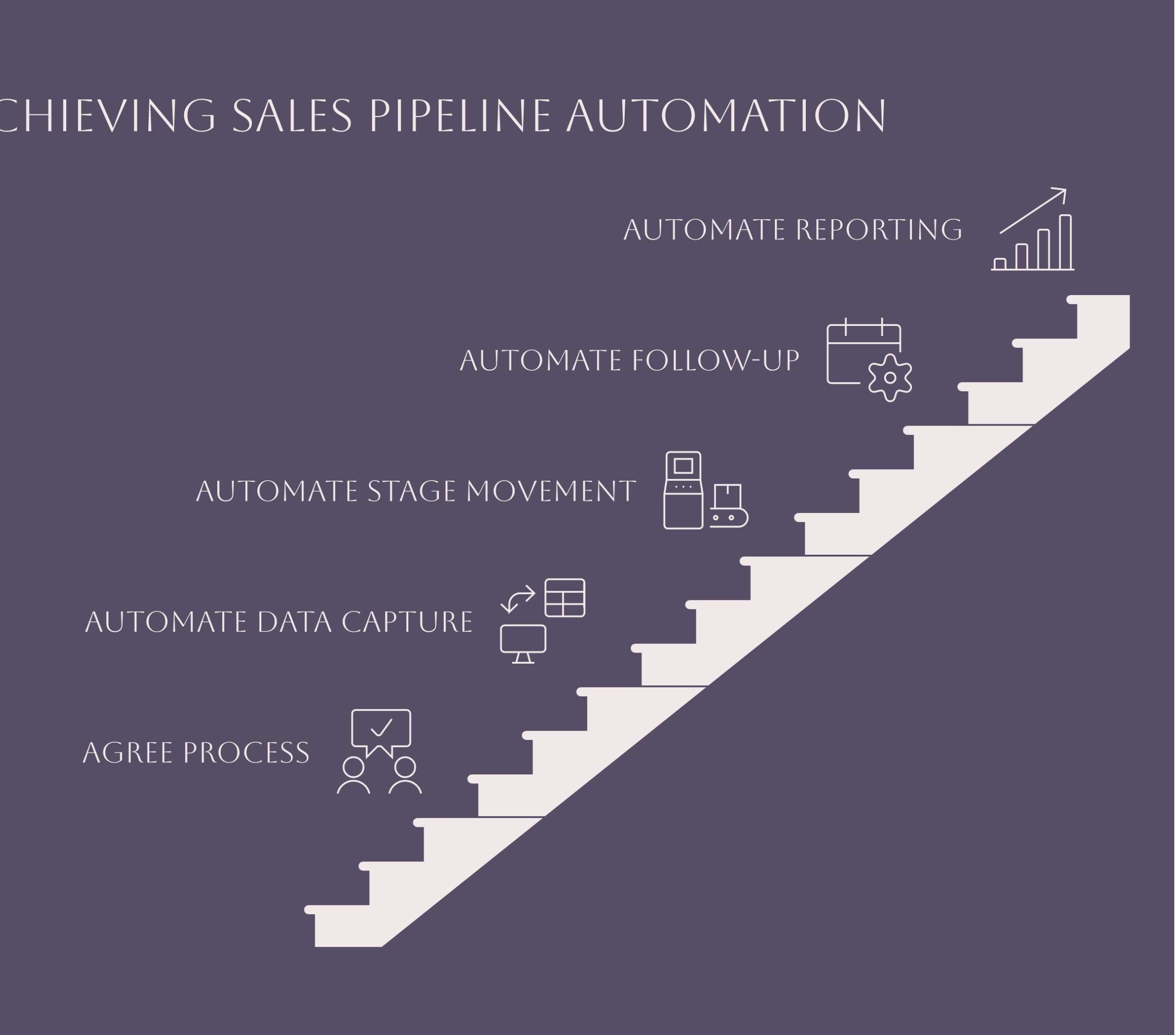
- Agree the process first: define stages, exit criteria, and the meaning of a qualified deal before automating anything, because automation enforces whatever you encode. The agreement is the foundation everything else runs on.
- Automate data capture: log emails, calls, and meetings automatically so the record stays complete without rep effort, because manual capture is the first thing a busy rep drops. Clean capture feeds everything downstream.
- Automate stage movement: move deals on defined triggers and exit criteria rather than rep mood, so the pipeline reflects reality and not optimism. Rules replace the Friday guess.
- Automate follow-up: trigger reminders and next steps on deal state so nothing stalls silently, because the deals that die quietly are the ones nobody chased. Consistency beats memory.
- Automate reporting: refresh pipeline metrics and the forecast from live data, so leadership reads one current picture instead of a rebuilt spreadsheet. Live reporting is the payoff of the four steps above.
The through-line is that automation is only as good as the process underneath it. Settle the process, automate from data capture up, and keep the judgment where it belongs.
Common pitfalls
- Automating a broken process: encoding stages and rules nobody agreed on, so the automation produces consistent, confident, wrong data at speed.
- Automating judgment: using rules to decide whether a deal is qualified, when that call needs a human and automation should only enforce the agreed criteria.
- Over-automating outreach: blasting automated sequences that read as automated, which burns trust and deliverability for a small efficiency gain.
- No clean data model: automating on top of a messy CRM, which spreads the mess faster instead of fixing it.
- Losing the partner signal: automating the direct pipeline while partner-sourced deals and introductions stay in email and Slack, uncaptured and unattributed.
What this looks like in practice
A worked example shows why order matters. A team buys an automation tool to fix a messy pipeline. They wire up stage movement and reporting first, before agreeing what each stage means. The dashboards light up, the forecast refreshes automatically, and it is still wrong, because deals move on triggers that encode three different reps’ private definitions of a qualified opportunity. The team pauses, agrees the stages and exit criteria in a room, cleans the data, and only then turns the automation back on. Now the same tooling produces a forecast leadership trusts. Nothing about the software changed; the process underneath it did.
The second lesson from that team: their partner-sourced deals never entered the automated pipeline at all, because the introductions lived in email. Once they captured partner touches into the CRM, the automation finally covered the warmest channel instead of only the direct one. The automation had been running at full speed on two-thirds of the pipeline and quietly ignoring the third that converted best, which is the most expensive blind spot an automated pipeline can have.
Forecastable’s POV
Automation is a multiplier, and multipliers work in both directions. A clean, agreed pipeline gets faster and more accurate; a messy one gets wrong faster. The discipline is to automate the repeatable mechanics and keep the judgment calls human, in that order, never the reverse.
The channel automation most often misses is the partner channel, because partner introductions and commitments live in conversations, not CRM fields. At Forecastable we are a partnerships operating platform that connects partner conversations and actions to CRM pipeline and revenue, so partner-sourced deals get captured and attributed in the same pipeline your automation already runs, instead of sitting in an inbox. Our Co-Sell Alignment Specialist is delivered as part of the service and uses the platform to turn partner touches into tracked pipeline.
My bet: the teams that fix the process before they automate it, and bring the partner channel into the automated pipeline, are the ones whose automation produces trust instead of faster confusion.
Forecastable is an independent third-party. Any tools, vendors, or third-party figures referenced here are described from public information for the reader’s own evaluation, not as paid placements.
Frequently asked questions
What should I automate first in my sales pipeline? Data capture, logging emails, calls, and meetings automatically, because it is the highest-value, lowest-risk automation and it keeps the CRM honest. Automate stage movement and reporting only after the stage definitions are agreed.
What should not be automated in the pipeline? Judgment calls. Whether a deal is genuinely qualified, or whether an account is a real fit, needs a human. Automation should enforce the criteria the team agreed, not decide them, and it should never replace the relationship work.
Does pipeline automation improve forecast accuracy? Only if the process underneath is sound. Automation keeps data complete and stages consistent, which helps a trustworthy forecast; but automating a pipeline nobody agreed on just produces consistent, confident, wrong numbers.
Will automating the pipeline replace sales reps? No. It removes the manual upkeep reps already skip and gives them back selling time. The relationship, the qualification judgment, and the deal strategy stay with people; the mechanical upkeep moves to software.
How does automation handle partner-sourced deals? Poorly by default, because partner introductions live in email and Slack rather than CRM fields. Capturing partner touches into the pipeline is what lets automation cover the warm partner channel instead of only the direct one.
What is the risk of automating too much? Automated outreach that reads as automated erodes trust and deliverability, and rules that overreach into judgment encode mistakes at scale. The safe boundary is to automate the repeatable mechanics and keep the human decisions human.
Next step
Before you automate anything, get the team in a room and agree what each stage means and what makes a deal qualified. Automate data capture first, then build up from there once the process is settled.
If the channel your automation misses is partner-sourced pipeline, that is what we capture. Start your growth journey with Forecastable and we will bring partner touches into the pipeline your automation already runs. Our sales pipeline management guide covers the operating model, and the partner-sourced pipeline guide shows why the partner channel is worth capturing.
Uncover Your Growth Potential
Schedule a Discovery Call