Revenue Operations Software: A 2026 Buyer’s Guide

Short answer
Short answer: Revenue operations software is the set of tools that unify the data, process, and reporting behind sales, marketing, and customer success, so a company can run one forecast off one source of truth. The right stack is decided by your data model and your worst handoffs, not by the longest feature list, and buying features before fixing the model is the most common and most expensive mistake.
Here is the position. Software does not create RevOps discipline; it enforces it. Get the data model and the definitions right first, then buy tools that keep them honest.
What is revenue operations software?
Revenue operations software is a category of tools that connect the systems behind every revenue-facing team. At the center is the CRM as the system of record, surrounded by tools that handle forecasting and pipeline analytics, conversation intelligence, data quality and enrichment, and attribution. Together they let a RevOps team standardize definitions, keep data clean, and produce a single forecast instead of three competing dashboards.
The point of the category is unification. Each team already has tools; RevOps software is what stops those tools from fragmenting into islands with different numbers. You are buying a connected system that reflects one data model, not a pile of best-of-breed point solutions that each tell a different story about the same pipeline.
Why revenue operations software matters in 2026
Go-to-market stacks sprawled, and the cost of that sprawl is now obvious. When data lives in disconnected tools with inconsistent definitions, the forecast becomes an argument and leadership loses trust in the number. RevOps software earns its budget by collapsing that into one picture, which matters more as more revenue sources, product-led, partner-sourced, outbound, feed the same pipeline.
The trap is buying features to fix a model problem. In my work with revenue teams, the companies with the most RevOps tools are often the ones with the least trustworthy forecast, because they bought analytics on top of a data model nobody agreed on. Software built on a broken model produces faster, prettier, equally wrong reports. The teams that get value fix the model and the definitions first, then choose tools that enforce them.
How revenue operations software actually works
A revenue operations stack works as a four-layer system, with each layer only as good as the one beneath it.
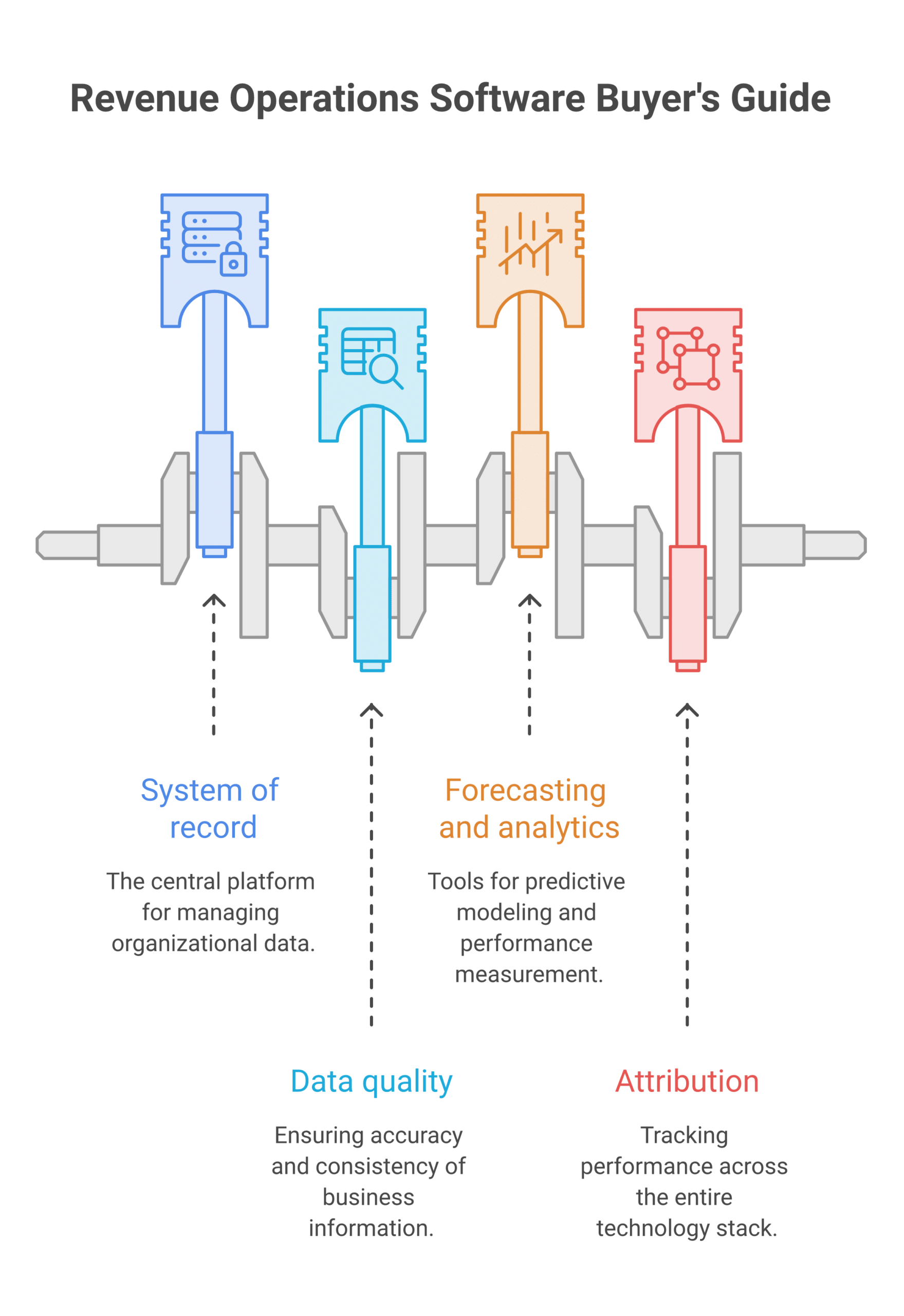
- The system of record: the CRM holds the accounts, deals, and definitions everything else depends on, so the data model here decides the ceiling for every tool above it. Start here or the rest is built on sand.
- Data quality: enrichment and hygiene tooling keeps the record clean and complete, because a forecast is only as honest as the data under it. Clean inputs are the precondition for trustworthy outputs.
- Forecasting and analytics: pipeline analytics and forecasting tools turn the clean record into one forecast leadership inspects, instead of parallel ones. This is the layer people shop for, and it only works if the two below it are solid.
- Attribution across the stack: attribution ties revenue back to the sources that created it, across every layer, so budget follows what works. This is where partner-sourced revenue usually falls through the cracks.
The through-line is that you buy from the bottom up. Fix the model and the data, then add analytics, and insist attribution spans the whole stack rather than sitting in one tool.
Common pitfalls
- Buying analytics before fixing the model: layering forecasting tools on an inconsistent CRM, which produces faster reports that are still wrong.
- Tool sprawl: adding point solutions that each hold their own version of the truth, so the number never reconciles.
- No owned definitions: expecting software to define a qualified lead or a sourced deal, when those are decisions the team has to make and enforce.
- Weak attribution for partner revenue: choosing a stack that credits partner-sourced and partner-influenced deals to the last-touch rep, so the fastest-growing source is the worst-measured.
- Features over adoption: buying the richest tool the team will not use consistently, instead of the one that fits the motion and gets adopted.
Tools and examples
Revenue operations software is best evaluated by category, not brand. Decide which layers you need, then shortlist within each.
| Category | What it does | What to check |
|---|---|---|
| CRM / system of record | Holds accounts, deals, and the core data model (for example Salesforce, HubSpot) | Whether your data model and definitions are clean before you add anything on top |
| Forecasting and pipeline analytics | Turns the record into one inspectable forecast (for example Clari) | That it reads from a trusted model, not a separate copy of the data |
| Conversation intelligence | Captures call signal and surfaces deal risk (for example Gong) | That insights flow back into the CRM, not a side system |
| Attribution | Credits revenue to the sources that created it | Whether it handles partner-sourced and influenced deals, not just first and last touch |
A quick worked example shows the sequence. A company shops for forecasting software to fix a missing number. The demo is impressive, but after rollout the forecast is still wrong, because the CRM data model underneath was never agreed and partner-sourced deals are credited to whichever rep logged the last activity. The team stops shopping for features, fixes the stage and sourcing definitions in the CRM, cleans the data, and only then adds the analytics layer, with attribution that finally captures partner-sourced revenue. The forecast becomes trustworthy. The tool was never the problem; the order of operations was.
Forecastable’s POV
Revenue operations software enforces discipline; it does not create it. The teams that get burned buy the analytics layer first and discover that a tool cannot agree your definitions for you. Fix the model and the data, then buy from the bottom up.
The layer that fails most quietly is attribution, specifically for partner-sourced revenue, which most stacks credit to the last-touch rep. At Forecastable we are a partnerships operating platform that connects partner conversations and actions to CRM pipeline and revenue, so the partner contribution is captured in the same system of record the rest of your RevOps stack reads from, instead of in a separate deck nobody reconciles. Our Co-Sell Alignment Specialist is delivered as part of the service and uses the platform to keep that attribution clean where it normally breaks.
My bet: the teams that buy revenue operations software from the data model up, and insist attribution covers partner-sourced revenue, are the ones whose forecast finally stops surprising them.
Forecastable is an independent third-party. Any tools, vendors, or third-party figures referenced here are described from public information for the reader’s own evaluation, not as paid placements.
Frequently asked questions
What is revenue operations software? It is the set of tools that unify the data, process, and reporting behind sales, marketing, and customer success, centered on the CRM and surrounded by forecasting, conversation intelligence, data quality, and attribution tools. The goal is one forecast off one source of truth.
What tools are part of a RevOps stack? A system-of-record CRM, data quality and enrichment, forecasting and pipeline analytics, conversation intelligence, and attribution. The specific products vary, but the layers are consistent, and each depends on the one beneath it.
How do I choose revenue operations software? Start from your data model and your worst handoffs, not the feature list. Fix the CRM definitions and data first, then buy the analytics layer, and make sure attribution covers partner-sourced revenue rather than just first and last touch.
Does revenue operations software replace a RevOps team? No. Software enforces the definitions and process a team sets; it does not decide what a qualified lead or a sourced deal means. A tool on top of an unowned model produces fast, confident, wrong reports.
Why does attribution matter in a RevOps stack? Because budget should follow the sources that create revenue. Many stacks credit partner-sourced and influenced deals to the last-touch rep, which hides the fastest-growing source and sends budget to the wrong channel.
Next step
If you are shopping for revenue operations software, check the foundation before the features. Can your teams agree what a sourced deal means, and is it enforced in the CRM? If not, buy that discipline first.
If the layer you most need to fix is partner attribution, that is what we instrument. Start your growth journey with Forecastable and we will put partner-sourced revenue in the same system of record as the rest of your stack. Our revenue operations guide covers the operating model, and the co-sell guide shows how partner-sourced deals get credited cleanly.
Uncover Your Growth Potential
Schedule a Discovery Call