Pipeline Generation: How to Build Pipeline That Closes

Short answer
Short answer: Pipeline generation is the work of creating new qualified opportunities across every channel, from outbound and inbound to events and partner introductions, so sales always has enough real pipeline to hit the number. It is judged by what closes, not by what gets created, and the two diverge more than most teams admit.
Here is the position. Generating pipeline is easy; generating pipeline that converts is the actual job, and the channel you under-invest in is almost always the one that closes best.
What is pipeline generation?
Pipeline generation is the set of motions a revenue team runs to produce new opportunities. It spans outbound prospecting, inbound demand capture, events and webinars, product-led signups, and partner-sourced introductions. Every one of these is a way to turn a stranger or a signal into a qualified opportunity in the pipeline.
The word covers both the volume and the quality question. Anyone can generate more opportunities by loosening the bar for what counts; the discipline is generating opportunities that convert. A pipeline generation engine is healthy only when the opportunities it creates become revenue at a predictable rate, not when the raw count looks impressive.
The reason it gets its own name is that pipeline is the leading indicator of revenue. If you want to know what next quarter looks like, you look at the pipeline being generated this quarter and the rate at which it converts. Get the generation engine right and the forecast follows; get it wrong and no amount of closing skill rescues the number.
Why pipeline generation matters in 2026
Pipeline got more expensive and less predictable at the same time. Cold channels are noisier, paid costs rose, and the easy inbound of a looser market dried up. That puts pipeline generation at the center of every board conversation, because the gap between pipeline created and pipeline converted is where forecasts go to die.
Here is the shift that matters most. As channels multiplied, teams started reporting one blended pipeline number that hides which channel actually converts. Outbound, inbound, and partner-sourced opportunities land in the same total at widely different conversion rates, so the headline looks healthy while the mix quietly rots. The number is fine until the one channel carrying it slows down.
The teams that come out ahead generate pipeline by channel with eyes open about conversion. They invest where the opportunities actually close, not where the raw count is highest. In my work with revenue teams, the most consistent blind spot is partner-sourced pipeline: it is usually the warmest and highest-converting source, and it is the one most teams treat as unmeasurable and therefore under-fund.
How pipeline generation actually works
Pipeline generation works as a five-part engine, and the teams that run all five produce pipeline that holds, not just pipeline that looks good.
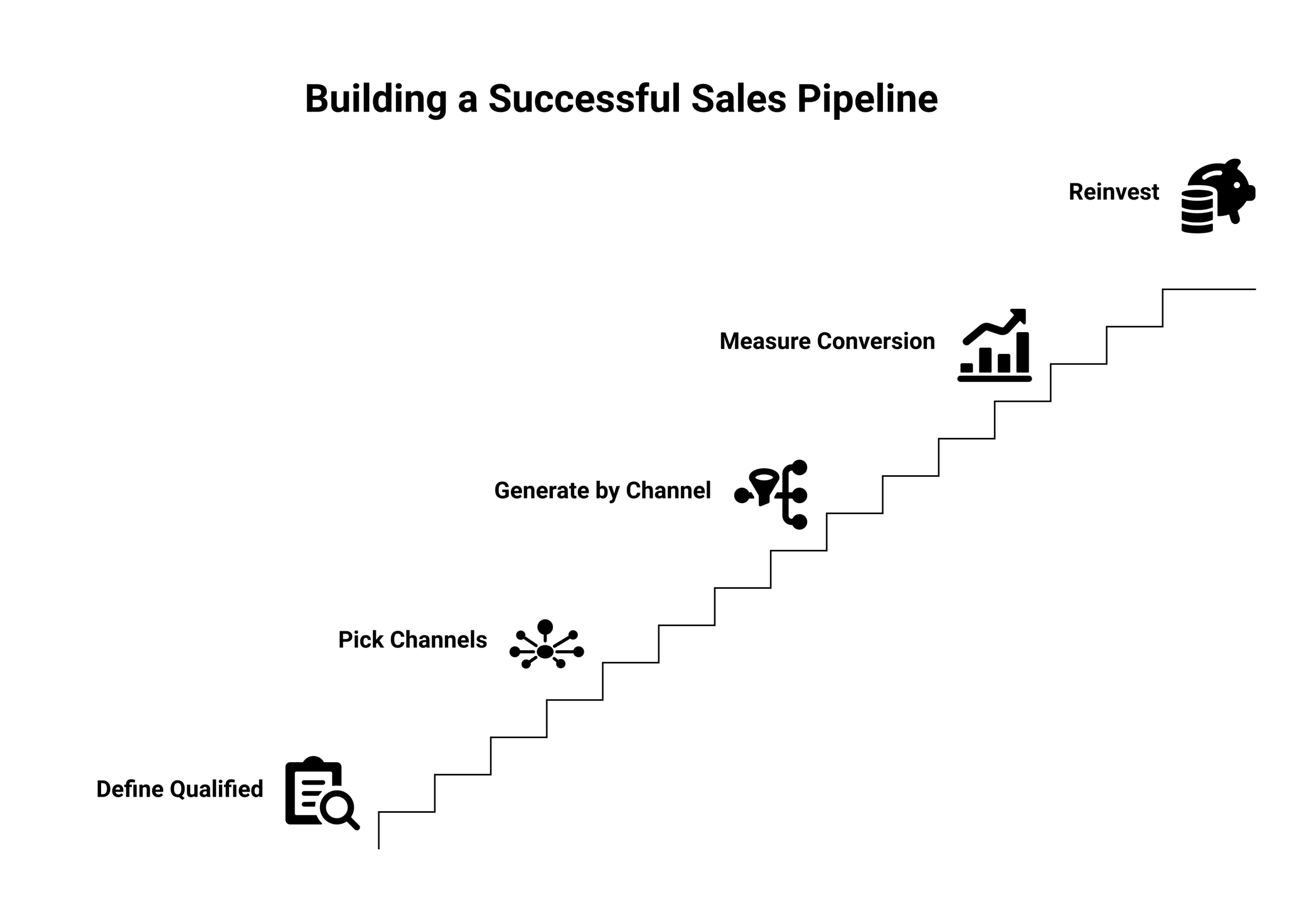
- Define qualified: agree what an opportunity must contain to count, so the engine produces real pipeline and not inflated volume. The definition sets the honesty of every number after it.
- Pick the channels: choose the mix of outbound, inbound, events, and partner-sourced motions that fits your market, rather than running all of them at half strength. Focus beats breadth here.
- Generate by channel: run each motion with a real owner and a real target, because a channel with no owner produces nothing and blames the channel. Ownership is what turns a plan into pipeline.
- Measure conversion by source: track how pipeline from each channel converts to revenue, not just how much each creates, so you can see which source is carrying the forecast. This is the step that separates volume from value.
- Reinvest: move budget and effort toward the channels with the best conversion, and cut the ones generating volume that never closes. The engine compounds only if you feed the winners.
The through-line is that pipeline generation is a conversion problem wearing a volume costume. Define qualified, measure by source, and reinvest where the pipeline actually closes.
Common pitfalls
- Chasing volume over conversion: loosening the qualified bar to hit a pipeline-created target, which fills the funnel with opportunities that never had a chance.
- One blended pipeline number: reporting total pipeline without splitting by source, so a weak channel hides behind a strong one and the mix rots unseen.
- Running every channel at half strength: spreading effort across outbound, inbound, and events without owning any of them, so none produces real pipeline.
- No conversion-by-source view: measuring what each channel creates but not what it closes, so budget flows to the loudest channel instead of the best one.
- Under-funding the warm channel: treating partner-sourced introductions as unmeasurable, so the highest-converting source gets the least investment.
What this looks like in practice
A worked example shows the gap between created and converted. A team sets a pipeline-generation target and hits it, mostly through high-volume outbound. The created number looks great going into the quarter. Then the pipeline converts at a low single-digit rate and the quarter misses, because the opportunities were generated to a loose bar. The team rebuilds the engine around conversion by source. They find that partner-sourced opportunities, a small slice of what they had been generating, converted at ten times the outbound rate, because the accounts already trusted the partner. They shift effort and a partner owner onto that channel, generate less total pipeline, and close more of it. The created number went down; the revenue went up.
That is the whole lesson of pipeline generation. The goal was never pipeline created; it was pipeline that closes, and the warm channel usually wins that contest.
Forecastable’s POV
Most pipeline generation is optimized for the wrong number. Pipeline created is easy to inflate and feels like progress; pipeline converted is the only thing that pays the quarter. The teams that measure generation by source conversion, not raw volume, make better investment calls every time.
The channel that keeps winning that comparison, and keeps getting under-funded, is partner-sourced pipeline. A partner introduction converts several times better than cold outreach because the account already trusts the partner, and it is usually the lowest cost per customer in the mix. At Forecastable we are a partnerships operating platform that connects partner conversations and actions to CRM pipeline and revenue, so partner-sourced opportunities get generated, tracked, and attributed in the same engine as every other channel, instead of living outside the forecast. Our Co-Sell Alignment Specialist is delivered as part of the service and uses the platform to run the partner plays and track them to closed revenue.
My bet: the teams that judge pipeline generation by what closes, and fund the warm partner channel accordingly, are the ones who stop generating impressive pipeline that misses the number.
Forecastable is an independent third-party. Any tools, vendors, or third-party figures referenced here are described from public information for the reader’s own evaluation, not as paid placements.
Frequently asked questions
What is pipeline generation? It is the work of creating new qualified opportunities across channels, outbound, inbound, events, product-led, and partner-sourced, so sales always has enough real pipeline to hit the number. It is judged by what converts, not just what gets created.
What is the difference between pipeline generation and lead generation? Lead generation creates individual leads; pipeline generation creates qualified opportunities, which are leads that have cleared a bar and entered the sales pipeline. Pipeline generation is the more demanding and more revenue-relevant measure.
How do I generate more pipeline that actually closes? Measure conversion by source, not just volume created, and reinvest in the channels that convert best. Tightening the qualified definition and funding the warmest channels usually produces less pipeline that closes at a far higher rate.
Which channel generates the best-converting pipeline? Partner-sourced introductions typically convert several times better than cold channels, because the account already trusts the partner who made the introduction. They are also usually the lowest cost per customer, yet most teams under-fund them.
How much pipeline do I need to generate? Enough to cover quota at your real conversion rate, which means coverage only makes sense next to conversion by source. A team converting at 30 percent needs far less generated pipeline than one converting at 10 percent.
Why do teams generate pipeline that does not convert? Usually because they optimize for pipeline created, which is easy to inflate by loosening the qualified bar. Switching the target to pipeline converted, measured by source, realigns the engine toward revenue.
Next step
If your pipeline-generation target is a created number, change it to a converted one. Split generation by source, measure what each channel closes, and move budget toward the channels that convert.
If the best-converting channel turns out to be partner-sourced pipeline, that is what we generate and track. Start your growth journey with Forecastable and we will put the partner channel in the same engine as the rest. Our sales pipeline management guide covers the operating model, and the partner-sourced pipeline guide shows why partner deals close warmer.
Uncover Your Growth Potential
Schedule a Discovery Call