Skip to content
Logo โ€” Itโ€™s All AboutThe Team
  • Home
  • Who We Serve
    • By Category
      • SaaS
      • Professional Services
      • Platforms (Large Ecosystems)
      • Private Equity
    • By Role
      • Chief Revenue Officers (CRO)
      • Chief Financial Officers (CFO)
      • Chief Marketing Officers (CMO)
      • Chief Executive Officers (CEO)
      • Sales Leaders
      • Partnership Professionals
  • Solutions
    • By Partner Program Maturity
      • Partnerships Foundation
      • Partnerships Acceleration
      • Ecosystem-Wide Orchestration
    • Specialized Solutions
      • Net-New Named Account Development
      • Large Ecosystems
      • M&A: Post-Acquisition Internal Cross-Selling
  • Pricing
  • Education
  • Company
    • Our History
    • Security
  • Login
Logo โ€” Itโ€™s All AboutThe Team
  • Home
  • Who We Serve
    • By Category
      • SaaS
      • Professional Services
      • Platforms (Large Ecosystems)
      • Private Equity
    • By Role
      • Chief Revenue Officers (CRO)
      • Chief Financial Officers (CFO)
      • Chief Marketing Officers (CMO)
      • Chief Executive Officers (CEO)
      • Sales Leaders
      • Partnership Professionals
  • Solutions
    • By Partner Program Maturity
      • Partnerships Foundation
      • Partnerships Acceleration
      • Ecosystem-Wide Orchestration
    • Specialized Solutions
      • Net-New Named Account Development
      • Large Ecosystems
      • M&A: Post-Acquisition Internal Cross-Selling
  • Pricing
  • Education
  • Company
    • Our History
    • Security
  • Login
  • Home
  • Who We Serve
    • By Category
      • SaaS
      • Professional Services
      • Platforms (Large Ecosystems)
      • Private Equity
    • By Role
      • Chief Revenue Officers (CRO)
      • Chief Financial Officers (CFO)
      • Chief Marketing Officers (CMO)
      • Chief Executive Officers (CEO)
      • Sales Leaders
      • Partnership Professionals
  • Solutions
    • By Partner Program Maturity
      • Partnerships Foundation
      • Partnerships Acceleration
      • Ecosystem-Wide Orchestration
    • Specialized Solutions
      • Net-New Named Account Development
      • Large Ecosystems
      • M&A: Post-Acquisition Internal Cross-Selling
  • Pricing
  • Education
  • Company
    • Our History
    • Security
  • Login
Back to all blogs
  • Partnerships Roles & Hiring
Alex Buckles

Partner Tier Structure: Designing Tiers That Earn
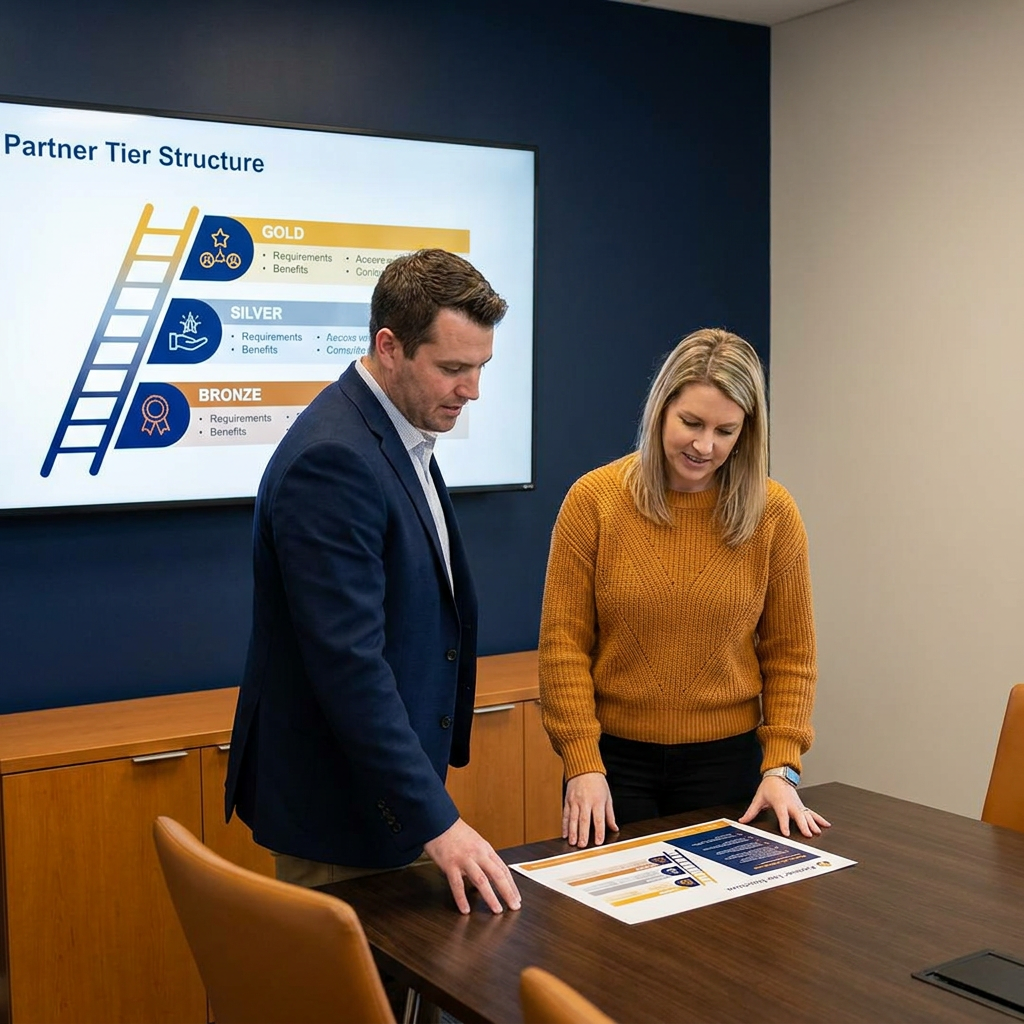
A partnerships leader and a program manager reviewing a partner tier structure on a wall monitor that shows a ladder of tiers with the requirements and benefits at each level, a printed tier criteria sheet on the table, deep navy and warm amber palette

What is a partner tier structure?

Short answer: A partner tier structure is the system of ranked levels, often named something like registered, silver, gold, and elite, that sorts partners by their commitment and performance and ties each level to a defined set of requirements and benefits. It is the mechanism a program uses to invest more in the partners who produce more and to give partners a visible path for earning more support as they grow.

Most programs build tiers as a labeling exercise, a way to sort the roster, and stop there. A tier structure that only sorts partners does nothing; the value comes from what each level requires a partner to do and what it gives them in return, because that is what actually drives behavior.

The frame that matters is that tiers are a contract, not a ranking. Each level should make a clear trade, the partner commits to specific behavior and the program commits to specific support, and a structure that ranks partners without making that trade explicit is decoration.

Why a partner tier structure matters in 2026

A program cannot invest equally in every partner, and tiers are how it allocates finite support to where it pays off. In 2026, with partnerships teams under pressure to show return, a tier structure is the mechanism that concentrates enablement, funding, and attention on the partners actually producing rather than spreading them thin.

The second reason is motivation. A well-designed tier structure gives partners a visible reason to do more, because the next level carries benefits worth earning. Without that, a partner has no structural incentive to deepen the relationship, and the program loses one of its few levers for driving growth from the existing roster.

The third reason is fairness and clarity. Partners notice when support seems arbitrary, and a transparent tier structure makes the basis for investment explicit, this is what each level requires and earns, which removes the politics from who gets what. That clarity is what keeps high performers from feeling overlooked and low performers from expecting more than they have earned.

How a partner tier structure actually works

A tier structure works when each level makes an explicit trade between requirements and benefits, and the value is in calibrating those trades so partners are pulled upward.
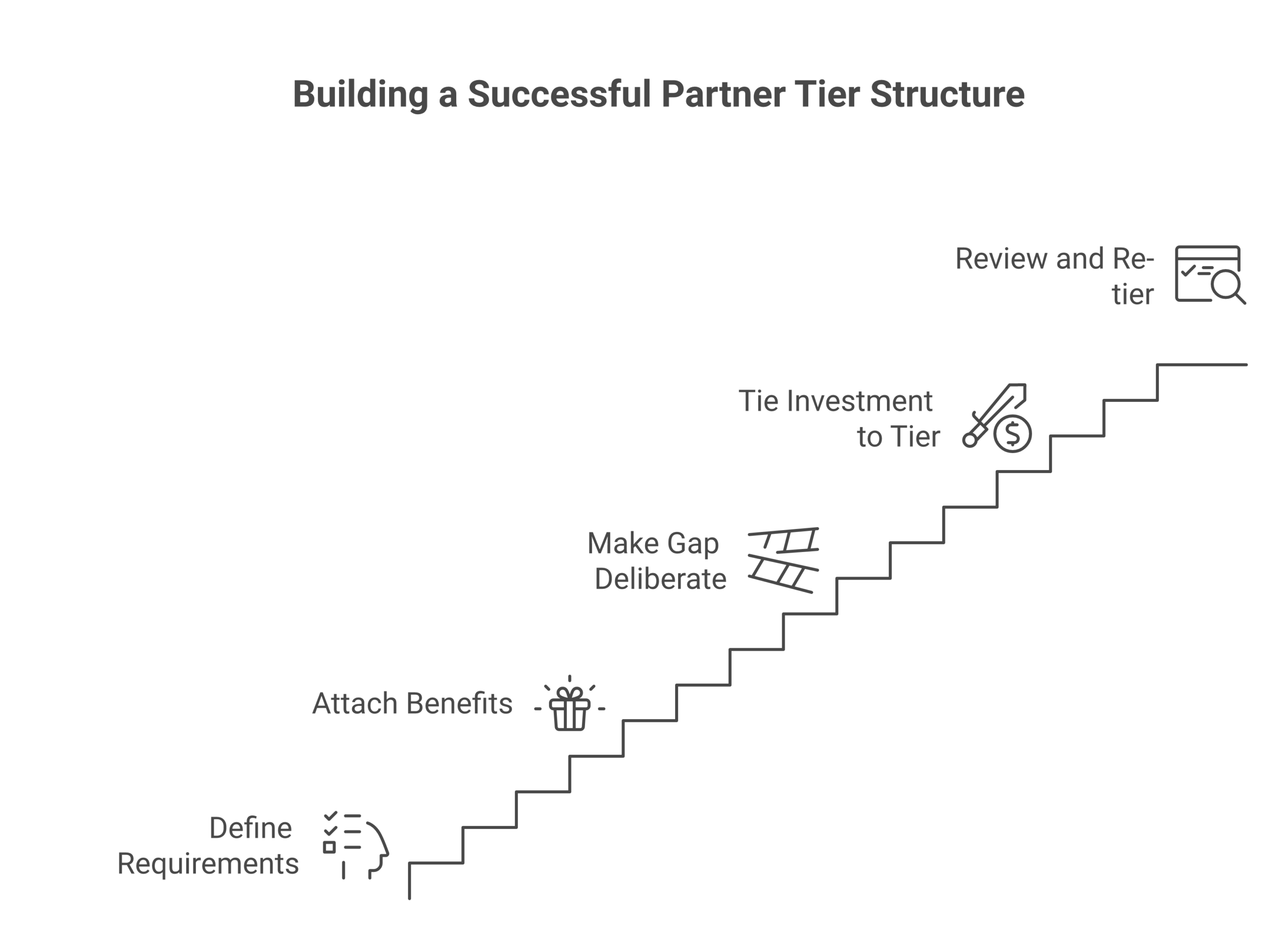
Operating model for how a partner tier structure actually works: Define the requirements that earn each level, Attach benefits worth the climb, Make the gap between levels deliberate, Tie investment to tier, not to relationship, Review...

  1. Define the requirements that earn each level: Set clear, measurable criteria for reaching each tier, revenue, certifications, joint activity, so a partner knows exactly what advancement takes. Vague requirements turn tiers into subjective assignments that partners distrust.
  2. Attach benefits worth the climb: Give each level benefits meaningful enough that the next tier is worth the effort, better margins, more support, co-marketing, leads. A tier with requirements but thin benefits gives partners no reason to advance and the structure stalls.
  3. Make the gap between levels deliberate: Calibrate the distance between tiers so it is reachable but not trivial, because levels too close together carry no weight and levels too far apart discourage the climb. The spacing is what makes the ladder pull.
  4. Tie investment to tier, not to relationship: Allocate the program’s finite support by tier so that the partners producing most get most, replacing favoritism with a rule. This is how the structure concentrates resources where they earn a return instead of where the loudest partner asks.
  5. Review and re-tier on a schedule: Reassess partners against the criteria periodically so the structure reflects current performance, because a partner who has fallen off should not keep elite benefits and a rising one should not be stuck. Static tiers reward yesterday’s results.

The structure is read against whether partners are actually moving up and whether the top tiers are producing the return their benefits cost, so the requirements and benefits get recalibrated rather than set once and forgotten.

Common pitfalls in a partner tier structure

  • Tiers that only sort, never trade: A structure that ranks partners without attaching real requirements and benefits to each level is a label, not an incentive. Partners ignore tiers that do not change what they must do or what they receive.
  • Benefits too thin to motivate: When the jump to the next tier earns little, partners have no reason to make the climb, and the structure fails to drive any behavior. The benefits at each level have to be worth the effort the requirements demand.
  • Requirements that are vague or subjective: Tiers assigned by judgment rather than measurable criteria feel arbitrary and breed resentment, especially among partners who believe they were passed over. Clear, measurable requirements are what make the structure credible.
  • Never re-tiering: A structure that assigns tiers once and never revisits them rewards partners for past performance and lets declining partners keep benefits they no longer earn. Scheduled review keeps the structure honest.
  • Too many tiers: A ladder with six or seven levels dilutes the meaning of each and confuses partners about where they stand and what to aim for. Most programs are better served by three or four well-differentiated tiers than by a fine-grained ladder no one understands.

What this looks like in practice

A program had four named tiers but assigned them loosely, mostly by how long a partner had been signed and how well the partner manager knew them. Partners treated the tiers as cosmetic because advancing changed nothing, and the program’s best producers grumbled that newer, lower-producing partners got the same support. The partnerships lead rebuilt the structure as a contract. Each tier got measurable requirements, a revenue threshold plus a certification and a minimum of joint activity, and benefits that grew meaningfully at each step, from basic support at the bottom to dedicated co-marketing and priority leads at the top. Investment was reallocated strictly by tier. Within two review cycles, several mid-tier partners had visibly worked to climb because the top tier was now worth reaching, two coasting partners dropped a level and either re-engaged or churned, and the program’s support finally concentrated on the partners producing the most. The tiers stopped being labels and started directing behavior.

Forecastable’s POV on a partner tier structure

A tier is a contract or it is nothing. The most common failure is a structure that sorts partners into named levels and stops, never specifying what each level requires or grants, and partners read that instantly, they ignore tiers that do not change their world. The discipline of writing each level as an explicit trade, this is what you commit and this is what you receive, is the difference between a structure that drives behavior and one that just decorates the roster.

The second conviction is that the benefits, not the requirements, are where programs underinvest. It is easy to write demanding requirements and tempting to keep benefits cheap, but a ladder with steep requirements and thin rewards gives partners no reason to climb. The structure pulls partners upward only when the next rung is visibly worth the effort, which means the benefits have to be real enough to feel like a prize.

The candid limit is that tiers can ossify into a system that rewards tenure over current production if the program never re-tiers. A structure set once becomes a record of who was producing when it was built, and a partner can coast on elite benefits long after the performance that earned them has faded. Scheduled re-tiering is unglamorous and occasionally awkward, and it is the only thing that keeps the structure pointed at present results rather than past ones.

Forecastable is a partnerships operating platform; any third-party tools or platforms referenced here are independent third-party products, and naming them is not an endorsement of one deployment over another. Evaluate each against your own program.

Frequently asked questions

How many tiers should a partner program have?
Usually three or four. Enough to differentiate commitment levels meaningfully, few enough that each tier keeps its meaning. More than four tends to dilute the levels and confuse partners about where they stand and what to aim for.

What should determine a partner’s tier?
Measurable criteria such as revenue, certifications, and joint activity, applied consistently. Tiers assigned by judgment or tenure feel arbitrary and lose credibility. The clearer and more objective the requirements, the more partners trust and engage with the structure.

What benefits belong at higher tiers?
Benefits meaningful enough to justify the climb, better margins, more support, co-marketing investment, priority leads, deeper enablement. The benefits have to grow noticeably at each level, or partners have no structural reason to advance.

How often should you re-tier partners?
On a regular schedule, often annually or semi-annually, so the structure reflects current performance. Without scheduled review, declining partners keep benefits they no longer earn and the structure rewards past rather than present production.

Do partner tiers actually drive behavior?
Only when each tier makes an explicit trade between requirements and benefits and the benefits are worth earning. A structure that merely sorts partners into labels drives nothing; a structure that makes the next level worth reaching pulls partners upward.

Should investment be allocated by tier?
Yes. Allocating finite support by tier is how a structure concentrates resources on the partners producing most and replaces favoritism with a rule. Untying investment from tier undermines the whole point of the structure.

Next step

If your tiers are labels that change nothing, the move this week is to rewrite each level as a contract, the measurable requirement to reach it and the specific benefit it earns, and then reallocate your support strictly by tier.

Start your growth journey now to design a partner tier structure that drives behavior instead of sorting your roster, or read the orientation on the partner program for the broader operating model.

Uncover Your Growth Potential

Whether starting with a single sales team or a single partner, any co-sell motion can be live within 30 days.

Schedule a Discovery Call
Latest Insights
A customer success manager and a partner success counterpart reviewing an account health and expansion plan on a laptop, a printed renewal-and-partner-touch timeline on the desk between them, deep navy and warm amber palette
  • Partnerships Roles & Hiring
Alex Buckles

CSM Partner Enablement: Turning Success Into Pipeline

What is CSM partner enablement? Short answer: CSM partner enablement is the practice of equipping customer success managers to bring partners into the post-sale motion, retention, adoption, and expansion. It makes the CSM a channel for partner value rather than a function that operates as if partners did not exist, which is how most success […]

Read Article
A revenue leader and a head of partnerships at a wall monitor mapping an ecosystem GTM, direct, partner-sourced, and partner-influenced motions shown as overlapping lanes against a target account list printed on the table, deep navy and warm amber palette
  • Partnerships Roles & Hiring
Alex Buckles

Ecosystem GTM: Building a Go-To-Market on Partners

What is ecosystem GTM? Short answer: Ecosystem GTM is a go-to-market model that treats the partner ecosystem as a core route to revenue alongside direct sales, not as a side channel. It organizes the company’s selling around where partners already have trust and presence, so deals come through the ecosystem by design rather than as […]

Read Article
A founder and a fractional channel chief reviewing a partner program build plan at a desk, a printed first-90-days roadmap and a partner target list between them, a laptop showing a pipeline target, deep navy and warm amber palette
  • Partnerships Roles & Hiring
Alex Buckles

Fractional Channel Chief: When It Works and When Not

What is a fractional channel chief? Short answer: A fractional channel chief is a senior partnerships leader who builds and runs a company’s partner program part-time, on a fraction of a full executive’s hours and cost. It gives a company channel leadership at a stage when the partner motion needs direction but cannot yet justify […]

Read Article
A product marketing lead and a partner manager planning a go-to-market with partners on a whiteboard listing segments, partner roles, and a joint launch motion, a printed target account list on the table, deep navy and warm amber palette
  • Partnerships Roles & Hiring
Alex Buckles

Go to Market With Partners: A Practical Playbook

What does it mean to go to market with partners? Short answer: To go to market with partners means building your route to customers around partners who already have the trust, reach, or capability you lack, rather than reaching every buyer directly. It decides where partners carry the selling motion and where your own team […]

Read Article
Logo โ€” Itโ€™s All AboutThe Team

Quick Links

  • Who We Serve
  • Solutions
  • Resources
  • Pricing
  • Our History

Social Media

  • Linkedin

Legal

  • Privacy Policy
  • Terms of Service
Quick Links
  • Who We Serve
  • Solutions
  • Resources
  • Pricing
  • Our History
Social Media
  • Linkedin
Legal
  • Privacy Policy
  • Terms of Service

Stay ahead on ecosystem-led growth

Logo โ€” Itโ€™s All AboutThe Team
ยฉ 2025 Forecastable. All rights reserved.
Book Your Strategy Call
Request Enrollment Details

[contact-form-7 id=”dfbeed3″ title=”Request Enrollment Details”]

Mollie Bodensteiner

Revops Advisory
  Mollie Bodensteiner is an experienced operations professional with a demonstrated track record of utilizing technology to support operational processes that drive performance and innovation. She currently is the Vice President of Operations at Sound and owns go-to-market agency, MB Solutions. Mollie has previously held operations leadership roles at Deel, Syncari, Corteva and Marketo. She has over 14 years of experience in both B2C and B2B operations and technology. When she is not working, Mollie enjoys spending time with her husband, three small children, and two large dogs. Childhood Career/Dream: Growing up in the age of Disney and Nick@Nite I always wanted to be a child actor (good thing that never was actually pursued ๐Ÿ™‚ Favorite Win: I am not sure I have a specific โ€œwinโ€ but I think I get the most joy and excitement from coaching others and watching them hit major milestones in their career. The first time you get to promote someone on your team or watch them lead a major project – are always career highlights! Personal Fun Facts: Favorite Song: If itโ€™s love, Train Favorite Movie: Good Will Hunting Favorite Meme: Disaster Girl
Forecastable resources: Co-Sell Orchestration Platform · All Use Cases · Live in 30 Days · Co-Sell Playbook

Kelsey Buckles

Director of Operations


My journey from Education to Operations has equipped me with a unique perspective and skill set that perfectly aligns with Forecastable’s mission to help businesses improve sales collaboration through partner co-selling strategies.

At Forecastable, I am passionate about empowering teams and organizations to unlock the full potential of strategic partnerships. By leveraging my expertise in communication, leadership, and operational efficiency, I contribute to creating seamless co-selling processes that align with business goals and deliver exceptional results.

The intersection of my educational foundation and operational experience fuels my dedication to fostering alignment, building trust, and enhancing collaboration between partners. I am driven by the opportunity to contribute to a platform that not only optimizes sales strategies but also strengthens relationships that lead to long-term growth.

Paul Jonhson

Chief Technology Officer (Co-founder)


Paul Johnson has 20+ years of software development and consulting experience for a variety of organizations, ranging from startups to large-enterprise organization with highly-complex needs.

Mr. Johnson has a long track record of successful technology deployments.
This, combined with his deep passion for machine learning and exceptional user experience design, allows him to lead our technical direction from the front with confidence.

Alex Buckles

Product, Partnerships, and Value Engineering (Co-founder)


After serving in The United States Marine Corps, Alex Buckles spent the next two decades as a student of revenue production and an advocate for innovation.

Along the way, he has helped numerous companies achieve double and triple-digit growth by crafting and executing high-performing go-to-market strategies, with co-selling at the center of each.

As a once-advanced technical marketer, an expert sales & partner professional, and a strong customer success advocate, Mr. Buckles understands the impact of these functions aligning not only on revenue production, but on the day-to-day execution of the go-to-market strategy. This concept of revenue-team alignment is what quickly became the foundation of Forecastable back in January of 2018.

In his free time, youโ€™ll find him spending quality time with his children, one of whom is on the autism spectrum. 1 in 36 children in the U.S. are on the spectrum and boys are four times more likely to be diagnosed than girls.

With that in mind, Mr. Buckles plans on dedicating the rest of his life serving those living with autism, through his organization Pathways for Autism. From his perspective, there must be a scalable and financially self-sustaining infrastructure established to put as many individuals with autism as possible on a path towards complete independence as adults.