OEM Partnership: What It Is and How It Works

What is an OEM partnership?
Short answer: An OEM partnership is an arrangement where one company embeds another company’s product or technology into its own offering and sells it under its own brand. The original manufacturer supplies the capability, and the partner ships it inside their product, so the end customer often never sees the underlying vendor at all.
OEM stands for original equipment manufacturer, a term that came from hardware but now applies just as much to software and components. The defining feature is embedding: the customer buys one product, and the OEM relationship lives invisibly inside it.
Why an OEM partnership matters in 2026
An OEM partnership matters because it lets a company add a capability to its product without building it. Rather than spending years and engineering budget creating a feature, the company licenses a proven one and embeds it, reaching market faster and focusing its own development where it differentiates. For the supplying vendor, it means distribution at a scale direct sales could never reach, riding inside someone else’s product.
In 2026 it matters more because buyers increasingly expect complete, integrated products rather than assembling capabilities themselves. A platform that bundles in analytics, payments, security, or AI features as part of one offering wins against one that asks the customer to stitch together several vendors. OEM relationships are how companies meet that expectation quickly, and the pace of feature expectations makes building everything in-house less and less viable.
The model also reshapes the economics for both sides. The OEM gets a differentiated product without the full cost of development, and the supplying vendor gets volume and recurring revenue tied to the partner’s success. But that shared fate is also the risk: an OEM relationship binds two companies tightly, and when it goes wrong it is far harder to unwind than a reseller arrangement. The upside and the lock-in are two sides of the same deal.
How an OEM partnership actually works
An OEM partnership runs on a few structural decisions that have to be settled clearly up front. The components below are where these deals succeed or quietly turn sour.
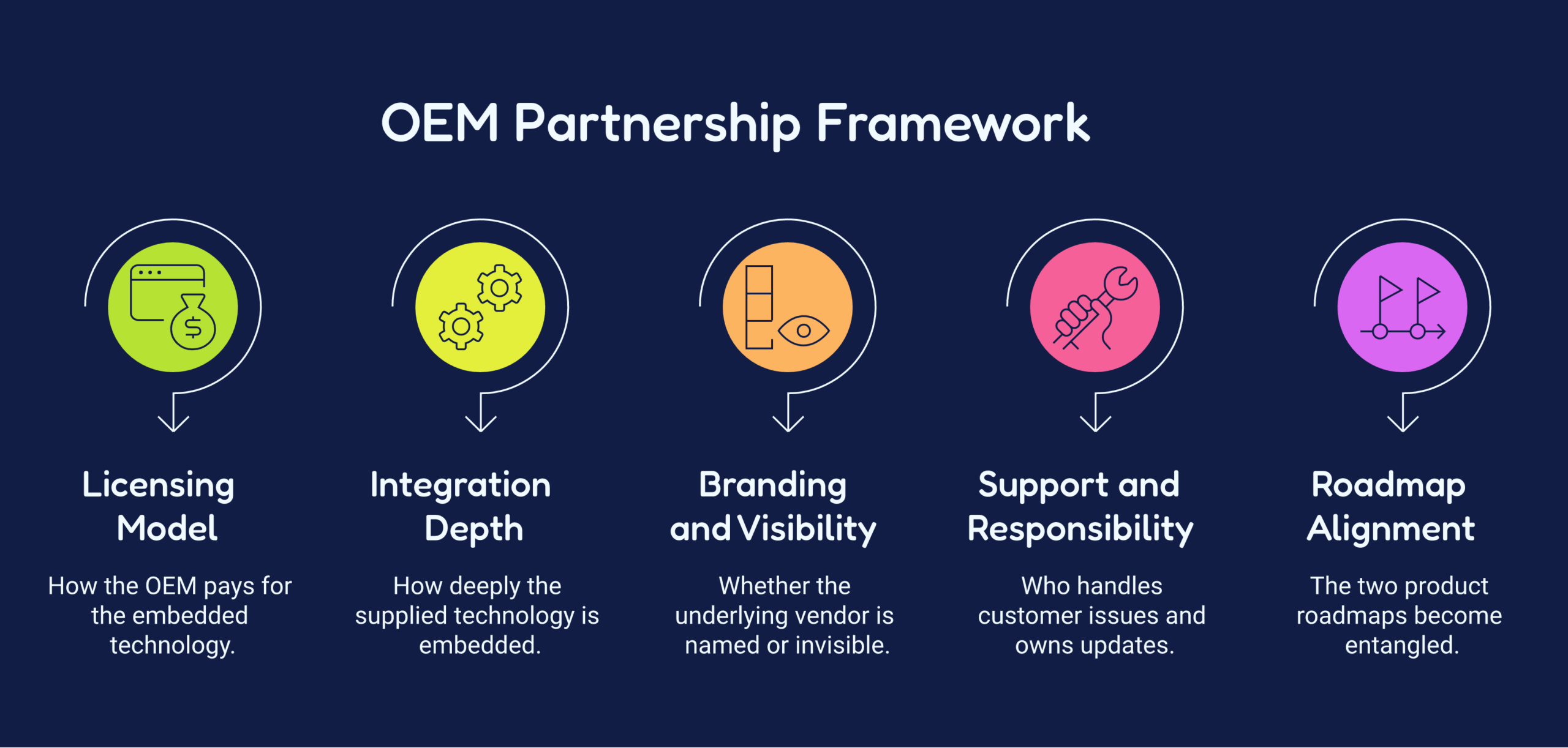
- Licensing and commercial model: How the OEM pays for the embedded technology, whether per unit, per user, on a revenue share, or a flat license. This is the spine of the deal, and ambiguity here is what produces disputes once volume scales.
- Integration depth: How deeply the supplied technology is embedded, from a light bundled add-on to a capability woven into the core product. Deeper integration creates more value and more lock-in, so both sides need to be clear about how far it goes.
- Branding and visibility: Whether the underlying vendor is named, white-labeled, or invisible. Most OEM deals lean toward the partner’s brand, but the supplying vendor has to decide what it gives up by disappearing inside someone else’s product.
- Support and responsibility: Who handles customer issues, who owns updates, and what the service commitments are. The customer sees one product, so the two companies have to agree privately on who does what when something breaks.
- Roadmap alignment: Because the technology is embedded, the two product roadmaps become entangled. A change on either side can affect the other, so the relationship needs a way to coordinate direction rather than surprising each other.
Common pitfalls in an OEM partnership
- Vague commercial terms: When the licensing model is ambiguous, the dispute arrives once volume grows and the money gets real. Settle exactly how the OEM pays, and for what, before scale exposes every gap.
- Underestimating the lock-in: An OEM relationship binds two roadmaps and two customer bases together. Companies that enter it like a simple supplier deal are shocked at how hard it is to unwind. Go in understanding the depth of the commitment.
- Unclear support ownership: The customer sees one product and expects one source of help. If the two companies never agreed who handles what, support failures land on whoever the customer can reach, and trust erodes fast.
- Roadmap drift: When the supplying vendor changes the embedded technology without coordinating, or the OEM evolves the product in ways the technology cannot follow, the integration decays. Entangled roadmaps need active coordination, not occasional check-ins.
- One-sided dependence: If one party becomes far more dependent than the other, the balance of the relationship shifts and the weaker side loses leverage on terms, support, and direction. Understand the dependency before you are deep in it.
What this looks like in practice
A platform company wanted to add a sophisticated capability its customers kept asking for, and building it would have taken a large team most of a year. Instead it struck an OEM partnership with a vendor who already had the technology, embedding it into the product and shipping it under its own brand within a quarter. Customers experienced a single, more complete product, and the platform reached market far faster than building would have allowed.
The relationship nearly came apart eighteen months later, not over the technology but over the terms. The commercial model had been written for the early, low-volume phase and never updated, so when adoption scaled the revenue share felt wrong to one side, and support responsibilities that had been informal started causing customer complaints. They renegotiated the licensing to fit the actual volume, wrote down who owned which support path, and set up a regular roadmap coordination between the two product teams. The deal that almost failed on neglected terms became durable once the structure caught up with the scale. The lesson was that OEM partnerships fail on the commercial and operational structure far more often than on the technology.
Forecastable’s POV on an OEM partnership
Our position is that OEM partnerships are the deepest and least reversible of the partnership models, and they should be entered with that seriousness. A reseller relationship can be wound down; an embedded technology relationship binds two products, two roadmaps, and two customer bases together. The upside is real, a differentiated product without the cost of building it, but the commitment is closer to a partial merger than a vendor agreement, and companies that treat it lightly get hurt.
We also think the failures are almost never technical. The technology usually works; what breaks is the structure around it, vague commercial terms that do not survive scale, support responsibilities nobody wrote down, and roadmaps that drift apart. The discipline that makes an OEM partnership durable is settling the commercial model, the support ownership, and the coordination mechanism before volume exposes every gap, then revisiting them as the relationship grows rather than letting the early terms calcify.
Finally, both sides should be honest about dependence. An OEM relationship rarely stays perfectly balanced, and the party that becomes more dependent loses leverage over time. That is not a reason to avoid the model, but it is a reason to understand the dependency clearly, structure the terms to account for it, and keep the relationship coordinated so the imbalance does not quietly become a vulnerability.
Forecastable is a partnerships operating platform. Any third-party tools or methods named here are independent third-party products, and naming them is not an endorsement. Decide how an OEM partnership should fit your own product, roadmap, and partners.
Frequently asked questions
What is an OEM partnership?
It is an arrangement where one company embeds another’s product or technology into its own offering and sells it under its own brand. The supplying vendor provides the capability, and the partner ships it inside their product, often invisibly to the customer.
What does OEM stand for?
Original equipment manufacturer. The term came from hardware, where one company’s components were built into another’s finished product, and now applies equally to embedded software and technology.
What is the difference between an OEM partnership and a reseller agreement?
A reseller sells your product as your product. An OEM embeds your technology inside their own product and sells it under their brand. OEM relationships are deeper, more integrated, and much harder to unwind.
How do OEM partnerships make money?
Through a licensing model agreed between the two companies, commonly per unit, per user, a revenue share, or a flat license. Settling that model clearly before volume scales is what prevents most OEM disputes.
What are the risks of an OEM partnership?
The main risks are vague commercial terms that fail at scale, unclear support ownership, roadmap drift between entangled products, and one-sided dependence. These structural issues cause far more OEM failures than the technology itself.
Who handles customer support in an OEM partnership?
It must be agreed privately between the two companies, because the customer sees one product. Most deals assign frontline support to the OEM and deeper technical support to the supplying vendor, but the split has to be explicit.
Next step
If you are weighing an OEM partnership, the deal will succeed or fail on structure long before it does on technology, so settle the commercial model, support ownership, and roadmap coordination first. Forecastable helps partnerships teams manage their most strategic partner relationships and connect them to revenue, so deep deals like these stay healthy as they scale. Start your growth journey now to run your strategic partnerships with discipline. The partner program hub frames the wider program, and the co-sell hub covers selling alongside partners once the product is in market.
Uncover Your Growth Potential
Schedule a Discovery Call