Channel Sales Incentive Programs: How to Design

What are channel sales incentive programs?
Short answer: Channel sales incentive programs are the structured rewards a vendor uses to motivate partners and their reps to sell more, spanning rebates, SPIFFs, margin bonuses, tiers, and recognition. They exist because a partner rep chooses where to spend selling time, and incentives tilt that choice toward your product. Designed well, they buy focus you could not get otherwise; designed badly, they pay for behavior partners would have done anyway.
The programs operate at two levels that often get blurred. Company-level incentives reward the partner firm through rebates and better margin; rep-level incentives reward the individual seller through SPIFFs and recognition. The two motivate different people and need different design.
Why channel sales incentive programs matter in 2026
Channel sales incentive programs matter because attention is the scarce resource in a channel, and a partner rep carries many products. The one that is most rewarding to sell, at both the firm and the individual level, gets the rep’s time. Incentives are how a vendor competes for that time against every other line in the rep’s bag, and skipping them means competing on goodwill alone.
In 2026, with partner networks large and selling capacity tight, the ability to direct partner effort toward specific products, segments, or moments is a real lever. A well-timed incentive can accelerate a launch, clear a quarter, or shift focus to a strategic product. That precision is why incentive budgets persist even as other spend gets scrutinized, provided they can be shown to work.
The pressure point is waste. Poorly designed incentives pay partners for deals they would have closed regardless, which is budget spent for no incremental behavior. The programs that survive are the ones that reward incremental production and can prove it, rather than subsidizing the baseline.
How channel sales incentive programs actually work
Channel sales incentive programs work by rewarding the specific behavior a vendor wants more of, at the right level, and measuring whether the reward changed anything. The components below are what a working program includes.
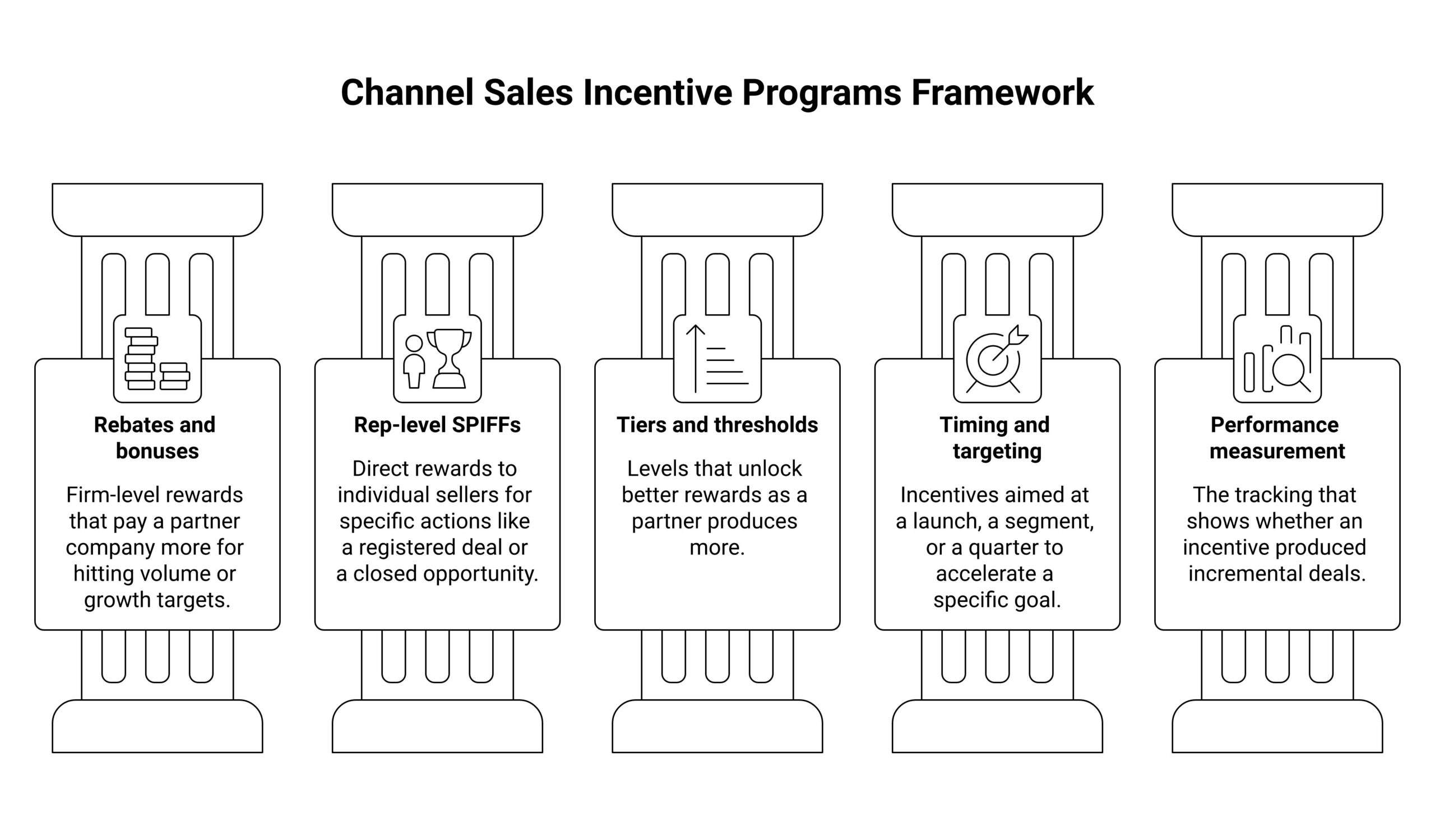
- Rebates and margin bonuses: Firm-level rewards that pay a partner company more for hitting volume or growth targets, motivating the business to invest in your product.
- Rep-level SPIFFs: Direct rewards to individual sellers for specific actions like a registered deal or a closed opportunity, which move the person actually in front of the buyer.
- Tiers and thresholds: Levels that unlock better rewards as a partner produces more, pulling partners upward rather than paying a flat rate regardless of contribution.
- Timing and targeting: Incentives aimed at a launch, a segment, or a quarter, so the budget accelerates a specific goal instead of subsidizing everything evenly.
- Performance measurement: The tracking that shows whether an incentive produced incremental deals, so the program funds what works and cuts what only rewards the baseline.
Common pitfalls in channel sales incentive programs
- Paying for baseline behavior: Rewarding all deals rather than incremental ones spends budget on production that would have happened anyway. Design incentives around the lift, not the baseline.
- Incentivizing the firm but not the rep: A rebate to the partner company rarely reaches the individual seller who decides which product to pitch. Without rep-level incentives, firm rewards move little.
- Too complex to chase: Incentive rules a rep cannot understand at a glance do not change behavior. If a seller cannot see how to earn it, they will ignore it.
- No measurement: Running incentives without tracking whether they produced incremental deals turns the budget into an entitlement nobody can defend when finance asks.
- Always-on incentives: An incentive that never ends becomes an expected discount, not a motivator. Incentives work when they are targeted and time-bound.
What this looks like in practice
A worked example: a vendor ran a standing rebate to partner firms and could not explain why it was not moving more revenue. The rebate reached partner finance, not the reps who chose what to sell, and it rewarded every deal including ones partners would have closed anyway. The team added time-bound rep-level SPIFFs on registered deals for a strategic product, kept the rules simple enough to read on one line, and tracked incremental production against a baseline. The strategic product’s partner pipeline jumped during the SPIFF window, and the team could see the lift was real. The lesson was that incentives move the person in front of the buyer, must be simple and time-bound, and only earn their keep when the incremental lift is measured.
Forecastable’s POV on channel sales incentive programs
Our position is that most incentive budgets are spent one level too high and one degree too broad. Firm-level rebates feel clean and reach the wrong person; the rep deciding which product to pitch never sees them. The programs that move numbers put a simple, time-bound reward in front of the individual seller and aim it at a specific goal. If you want a rep to sell your product this quarter, reward the rep for selling it this quarter, in terms they can read in a sentence.
We also think incentives are only defensible when the lift is measured. It is easy to run a SPIFF and point at revenue that followed; it is hard to prove the revenue was incremental rather than baseline production you paid a premium for. The programs that keep their budget are the ones that compare incentivized behavior against a baseline and can show the reward changed what partners did. Everything else is subsidizing deals you would have won anyway.
Forecastable is a partnerships operating platform focused on connecting partner conversations and actions to CRM pipeline and revenue. We do not administer payouts, but we make partner selling activity and pipeline visible in the forecast, so incentives can be aimed and measured against real behavior rather than assumed. The incentive sets the motivation; we help you see whether it produced anything incremental.
Forecastable is a partnerships operating platform and a category authority, not a PRM vendor. Any third-party tools or firms referenced in this space are independent third-party products, and mentioning them is not an endorsement. Evaluate any incentive approach against your own partner mix, motion, and CRM.
Frequently asked questions
What are channel sales incentive programs?
They are the structured rewards a vendor uses to motivate partners and their reps to sell more, spanning rebates, SPIFFs, margin bonuses, tiers, and recognition.
What is the difference between a rebate and a SPIFF?
A rebate rewards the partner firm, usually for volume or growth. A SPIFF rewards an individual rep for a specific action like a registered or closed deal. The two motivate different people.
Why do channel incentives sometimes fail to move revenue?
Often because they reward the firm but not the rep who chooses what to pitch, or because they pay for baseline deals that would have closed anyway. Aim at the seller and the incremental lift.
How should channel incentives be measured?
By whether they produced incremental deals against a baseline, tracked in CRM, not just by revenue that followed. Measuring the lift is what makes the budget defensible.
Should channel incentives run continuously?
No. An always-on incentive becomes an expected discount rather than a motivator. Incentives work best when targeted at a goal and bounded in time.
Do incentives replace enablement?
No. An incentive motivates a rep who can already sell your product; it does not teach one who cannot. Incentives and enablement work together, not as substitutes.
Next step
If your incentive budget rewards partner firms and baseline deals, it is buying behavior you already had. The fix is simple, time-bound rewards aimed at the reps who choose what to pitch, with the incremental lift measured in the forecast leadership trusts. Forecastable helps partnerships teams see partner selling activity in measured CRM pipeline, so incentives are aimed and proven rather than assumed. Start your growth journey now to make incentive impact measurable. The partner program hub frames how channel sales incentive programs connect to enablement and attribution.
Uncover Your Growth Potential
Schedule a Discovery Call