Partner Onboarding Process: A Step-by-Step Guide

What is the partner onboarding process?
Short answer: The partner onboarding process is the structured sequence that takes a newly signed partner from contract to first productive activity, covering the administrative setup, the training, and the first real deal. It is the bridge between recruiting a partner and getting any value from them, and how well you run it sets the tone for the entire relationship.
Done well, onboarding produces a partner who is set up, oriented, and already working a first opportunity within weeks. Done badly, it produces a signed logo that goes quiet and never comes back, which is the single most common outcome in undermanaged programs.
Why the partner onboarding process matters in 2026
The partner onboarding process matters because the first 90 days decide whether a partner ever becomes active. A partner who closes a first deal early builds momentum and stays engaged; one who stalls in setup or training drifts away, and re-engaging a dormant partner is far harder than onboarding a fresh one. The early window is where the relationship is won or lost.
In 2026 it matters more because partners have more options and less patience. A partner rep evaluating which vendors to invest attention in will read your onboarding as a signal of what working with you will be like. A slow, confusing, paperwork-heavy start tells them you will be hard to sell with, and they quietly prioritize a vendor who made the first weeks easy. First impressions in the channel are sticky.
There is also a cost angle. Every partner you onboard consumes your team’s time, so a process that produces dormant partners is pure waste. A tight, repeatable onboarding lets a partnerships team bring on more partners productively without scaling headcount linearly. The process is what turns recruitment from a cost center into the front end of revenue.
How the partner onboarding process actually works
A good onboarding process moves through clear stages, each with a defined completion point. The components below are what keep a new partner moving toward a first deal instead of stalling between steps.
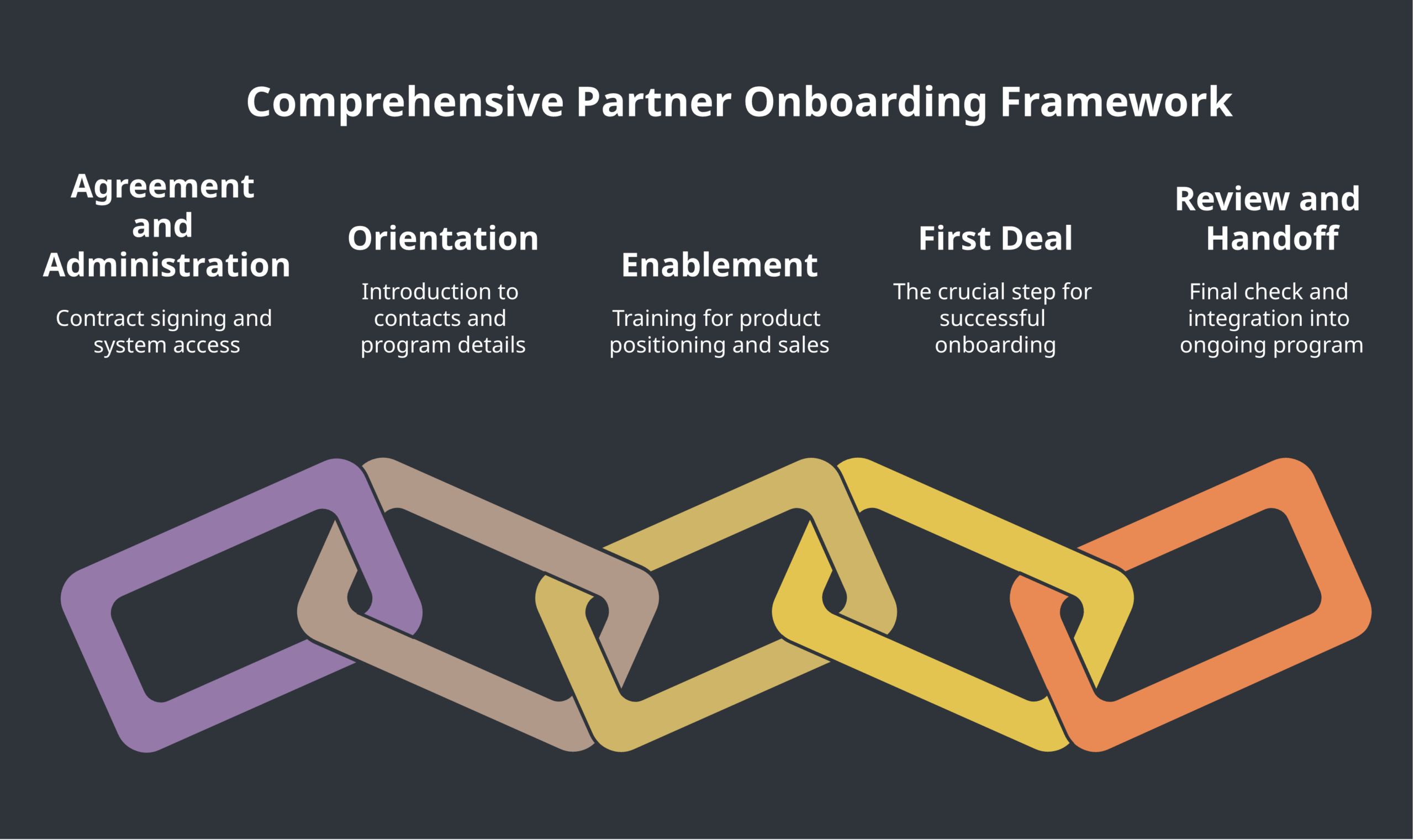
- Agreement and administration: Contract signed, systems access granted, the partner registered in your tools, and the commercial terms confirmed. This step is necessary but should be fast and invisible; if it drags, the partner’s first experience is friction.
- Orientation: Who their main contact is, how the program works, where to find what they need, and what the early milestones are. A partner who knows where to go and who to ask moves; one left to figure it out alone stalls.
- Enablement: The core training that makes the partner able to position and sell your product. Onboarding enablement should be the shortest useful version, focused on getting them to a first deal, with deeper capability built later.
- First deal: The step that separates onboarding that worked from onboarding that did not. Pairing the new partner with your team on a first live opportunity converts setup and training into real activity and proves the relationship can produce.
- Review and handoff: A check at the end of the early window to confirm the partner is active, address gaps, and hand them into the ongoing program. This closes onboarding deliberately rather than letting partners trail off without anyone noticing.
Common pitfalls in the partner onboarding process
- Death by administration: When the first weeks are all paperwork, access requests, and forms, the partner’s energy drains before they ever sell. Front-loading friction is the fastest way to lose a partner’s early enthusiasm.
- No clear owner: If no one on your side owns the new partner’s first 90 days, the partner falls between people and stalls. A named owner is the difference between a managed start and a partner who quietly goes dark.
- Training with no first deal: Onboarding that ends at a completed course produces partners who know your product but never sold it. Without a first real opportunity, the knowledge fades and the partner reverts to what they already sell.
- One-size onboarding: Putting a light referral partner through the same heavy process as a delivery partner wastes everyone’s time and signals you do not understand their role. Match the depth of onboarding to the partner type.
- No defined endpoint: If onboarding never formally ends, partners drift in a permanent halfway state and no one can tell who is actually active. A clear review and handoff closes the loop.
What this looks like in practice
A program signed partners steadily but could never explain why so few of them ever sold. The onboarding, when the team finally mapped it, was three weeks of access requests and a long generic training course, with no first deal and no owner watching whether the partner emerged active. Partners finished the course, received a congratulations email, and were never heard from again. The program was, in effect, recruiting partners and then losing them on purpose.
The fix was to redesign onboarding around the first deal. Administration was compressed and handled by the team rather than dumped on the partner, each new partner got a named owner for their first 90 days, training was cut to the shortest version that supported a first sale, and every partner was paired with the team on a live opportunity before onboarding was considered complete. A short review at the end confirmed the partner was active and handed them into the ongoing program. The share of new partners who reached a first deal rose sharply, because onboarding now ended in selling rather than in a certificate.
Forecastable’s POV on the partner onboarding process
Our position is that onboarding should be designed backward from the first deal, because the first deal is the only proof that onboarding worked. Everything before it, the setup, the orientation, the training, exists to get the partner to that first sale as quickly as possible. When teams design onboarding forward from the contract instead, they optimize the administrative steps and neglect the only step that produces revenue.
We also believe the team should carry the friction, not the partner. The administrative load of getting a partner set up is real, but it should be largely invisible to the partner, handled by your side rather than dumped on them as forms and access requests. A partner’s first experience of you should be momentum toward a deal, not a queue of tasks. The vendors who win the channel are the ones who made the first weeks feel easy.
Finally, onboarding needs an owner and an endpoint. The most common failure is not a bad process but an unmanaged one, where no one is responsible for the partner’s first 90 days and onboarding never formally ends. A named owner and a defined review turn onboarding from a hopeful drift into a managed handoff, which is what keeps partners from going dormant the moment the contract is signed.
Forecastable is a partnerships operating platform. Any third-party tools or methods named here are independent third-party products, and naming them is not an endorsement. Decide how the partner onboarding process should fit your own partners, segments, and program.
Frequently asked questions
What is the partner onboarding process?
It is the structured sequence that takes a newly signed partner from contract to first productive activity, covering administrative setup, training, and a first real deal. It is the bridge between recruiting a partner and getting value from them.
How long should partner onboarding take?
Short enough to keep momentum, usually inside the first 90 days, with a first deal underway before that window closes. The exact length depends on partner type, but a process that drags past a quarter tends to lose the partner.
What are the steps in a partner onboarding process?
Agreement and administration, orientation, enablement, a first deal worked with your team, and a closing review and handoff into the ongoing program. The first deal is the step that proves the rest worked.
Why do partners go dormant after signing?
Usually because onboarding was all paperwork and training with no first deal, or because no one owned their early days. Partners who reach a first sale early stay engaged; those who stall in setup drift away.
Who should own partner onboarding?
A named person on the partnerships team should own each new partner’s first 90 days. An unowned onboarding is the most common reason partners fall between the cracks and go quiet.
How is partner onboarding different from partner enablement?
Onboarding is the first stretch that gets a partner set up and to a first deal. Enablement is the broader, ongoing work of building full selling and delivery capability. Onboarding is the opening phase of enablement.
Next step
If you sign partners steadily but few of them ever sell, the problem is almost always an onboarding process that ends in training rather than a first deal. Forecastable helps partnerships teams design onboarding around that first deal and track which partners actually reach it, so new partners become active instead of dormant. Start your growth journey now to make onboarding end in selling. The partner program hub frames the wider program, and the co-sell hub covers working that first deal alongside a new partner.
Uncover Your Growth Potential
Schedule a Discovery Call