Partner Management Software: What It Is and How to Choose

Short answer
Short answer: Partner management software is the system of record for running a partner program, covering partner onboarding, deal registration, content, and reporting in one place. It matters because a growing program eventually outruns spreadsheets, and the right tool gives partners a portal and gives you visibility, but the software alone will not produce pipeline.
The mistake buyers make is expecting the tool to do the work. A portal organizes a program that already has motion. It does not create the motion. Buy the software to run the operating system, not to be the operating system.
What is partner management software?
Partner management software is a category of tools, usually called a PRM (partner relationship management) platform, that centralizes the administrative work of a partner program. That means a partner portal, deal registration and referral submission, onboarding and certification, content distribution, and a reporting layer that rolls partner activity up for the vendor.
The category exists because partner programs generate a specific kind of operational load. You have partners who are not employees, deals you did not source directly, margins and incentives to track, and content you need in the hands of people outside your company. A CRM handles your direct pipeline well and handles none of that cleanly. Partner management software fills the gap between your CRM and the partners working outside it.
The distinction worth holding onto is between administration and execution. Partner management software is very good at administration: who is registered, which deal belongs to whom, what content went out, what got submitted. It is much weaker at execution, which is the weekly work of getting a specific partner to run a specific play with a specific account. That gap is where most programs stall, and no portal closes it on its own.
Why partner management software matters in 2026
Partner management software matters because partner-sourced revenue has become too large to run informally. Analyst Jay McBain has estimated that roughly 96% of technology deals are partner-surrounded, and a program producing a meaningful share of pipeline cannot track that in a spreadsheet without losing deals at the seams. The tool is what keeps deal registration honest, margins correct, and reporting defensible when a CRO asks where the partner number came from.
The second reason is partner experience. Partners work with several vendors at once and give their attention to the ones that make selling easy. A clean portal, fast deal approval, and content they can actually find are the difference between a partner who registers deals with you and one who forgets you exist. The software is table-level hygiene for being easy to work with.
The recurring failure is buying the platform as a strategy. I have watched teams treat a signed PRM contract as the moment the program becomes real, then wonder six months later why the portal is quiet. When a partnerships leader tells me “we need a PRM,” I usually reframe it: a PRM does not drive pipeline, engagement and execution do. The software is necessary at scale and nowhere near sufficient.
How partner management software actually works
A partner management platform earns its cost through five functions. Evaluate a tool by how well it does these, not by the length of its feature list.
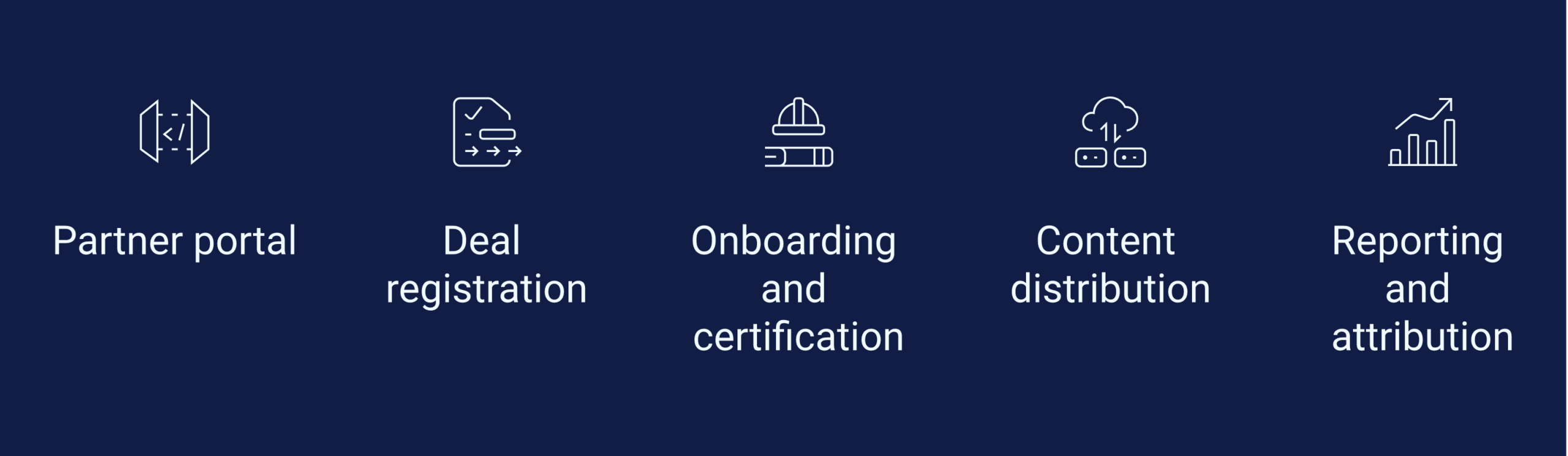
- The partner portal: a single place partners log in to register deals, find content, and see their status. This is the front door, and if partners find it slow or confusing they stop using it, which quietly kills every other function.
- Deal registration and referral tracking: partners submit deals or leads, you approve and de-conflict them, and the record ties to your CRM. This is the function that protects partner margin and gives you attribution you can defend.
- Onboarding and certification: structured steps that take a signed partner to a selling one, with training and content gated by tier. Done well it compresses time-to-first-deal; done as a checkbox it produces certified partners who never sell.
- Content and enablement distribution: getting the right decks, one-pagers, and pricing into partner hands and knowing what they used. The value is not storage, it is putting the asset in front of the partner at the moment they need it.
- Reporting and attribution: rolling partner activity, registered deals, and sourced pipeline into numbers you can take to a forecast review. This is what turns partner activity into a defensible revenue story instead of an anecdote.
The through-line is that these five functions administer a program. They record, route, and report. What they do not do is decide which partner to activate this quarter, run the account-mapping session, or make sure the joint play actually happens. That work stays human, and the software supports it rather than replacing it.
Common pitfalls
- Buying the platform as the strategy: signing a PRM and treating that as the program. The tool organizes work that already exists; it does not generate work that does not.
- Over-buying features: paying for a full enterprise suite when a program with 20 partners needs deal registration and a portal. Feature breadth you do not use is cost and complexity, not capability.
- Under-buying at scale: running 200 partners on spreadsheets and shared drives, losing deals and attribution at every handoff because there is no system of record.
- Ignoring partner experience: choosing the tool that gives the vendor the best dashboard and the partner the worst portal. If partners will not use it, your reporting is measuring an empty room.
- No execution layer: assuming the portal will drive engagement. The software reports what partners did; something or someone still has to make partners do it.
Tools and examples
The market splits into a few groups, and buyers get into trouble by comparing tools across groups as if they did the same job. Group vendors by their primary function first, then compare within the group. Forecastable is an independent third-party here and does not resell any of these; the notes reflect public positioning for your own evaluation.
| Category | Representative tools | What it actually does |
|---|---|---|
| Full-suite PRM | Impartner, Allbound, ZINFI, Introw, Euler | Portal, deal registration, onboarding, content, and reporting in one platform. The core partner management software category. |
| Ecosystem and overlap data | Crossbeam, Pocus, Common Room | Account mapping and overlap between your data and a partner’s. Feeds co-sell; not a partner administration system. |
| Marketplace and cloud GTM | Tackle, Labra, Suger, Clazar | Transacting through AWS, Azure, and Google marketplaces. Solves cloud co-sell and billing, not partner onboarding. |
A worked example. A Series B software company I would model this on had 60 partners on a spreadsheet, a shared drive of decks, and deal conflicts surfacing in Slack. They did not need a full enterprise suite. They needed deal registration that de-conflicts, a portal partners would actually open, and reporting that survived a forecast review. A mid-market PRM covering those three functions, chosen for partner experience over dashboard depth, replaced the spreadsheet and the Slack arguments in a quarter. The expensive suites they demoed would have added modules no one on a six-person team would run.
Every PRM is different and the category changes constantly, so the durable move is to buy against your actual operating load, not the feature matrix. If Introw and Euler belong on your shortlist for a lean, integration-led program and a full suite fits a larger channel, that is a scope decision, not a ranking.
Forecastable’s POV
Partner management software is necessary and oversold. Necessary, because past a certain size you cannot run deal registration, margins, and attribution on spreadsheets without leaking deals. Oversold, because the category markets itself as the thing that makes a partner program produce, and it is not. It administers the program. Producing revenue is a separate, human discipline that sits on top of the tool.
At Forecastable we sit deliberately on that second layer. We are a partnerships operating platform focused on connecting partner conversations and actions to CRM pipeline and revenue, the flywheel that runs from conversations to actions to pipeline to revenue. We are a category authority on execution, not a PRM vendor, and we treat administration tooling as complementary rather than competitive. The PRM answers “is this partner registered and what did they submit.” The work we deliver as part of the service answers “which partners are producing, and what are we running this week to make more of them produce,” using the Forecastable platform to track it.
My bet: the programs that win will own a PRM for administration and refuse to confuse it with strategy. The teams that expect the portal to generate pipeline will keep buying bigger tools to solve a problem the tools were never built to solve.
Forecastable is an independent third-party. Any tools or vendors named here are described from public information for the reader’s own evaluation, not as paid placements, and Forecastable does not resell them.
Frequently asked questions
What is partner management software? Partner management software, usually called a PRM platform, centralizes the operations of a partner program: a partner portal, deal registration, onboarding and certification, content distribution, and reporting. It is the system of record for running a program at scale.
Is partner management software the same as a PRM? Yes. PRM, or partner relationship management, is the common name for the same category. Both describe a platform that administers partner onboarding, deal registration, content, and reporting in one place.
Do I need partner management software or a CRM? Both, for different jobs. A CRM runs your direct pipeline. Partner management software handles the work a CRM does not: partners who are not employees, deals you did not source, margins, and partner-facing content. Most programs integrate the two rather than choosing.
When should a partner program buy partner management software? When spreadsheets start losing deals. If you are tracking deal registration, margins, and attribution by hand and things are slipping through the seams, you have outgrown the manual approach. A program with a handful of partners can usually wait; one with dozens cannot.
What should I look for in partner management software? Deal registration that de-conflicts cleanly, a portal partners will actually use, onboarding that shortens time-to-first-deal, content distribution, and reporting you can defend in a forecast review. Buy against your operating load, not the longest feature list.
Will partner management software grow my partner revenue? Not by itself. The software administers the program: it records, routes, and reports. Growing revenue is execution, which is the weekly work of activating specific partners on specific accounts. The tool supports that work but does not do it.
Next step
List the partner operations you run by hand today: deal registration, margin tracking, content, reporting. If those are leaking at scale, you have a real case for partner management software, and the buying criterion is your operating load, not the feature matrix.
If the harder question is which partners are actually producing and how to make more of them produce, that is execution, and it is exactly what we do. Start your growth journey with Forecastable and we will build the motion the software reports on. Our PRM and partner tech guide covers where administration tooling fits the wider program.
Uncover Your Growth Potential
Schedule a Discovery Call