Channel Management Software: A Practical Buyer’s Guide

Short answer
Short answer: Channel management software is the system a company uses to recruit, onboard, enable, and track its indirect sales partners, covering deal registration, lead distribution, incentives, and partner reporting in one place. It matters because a growing channel drowns in spreadsheets fast, and the right tool turns partner administration from a bottleneck into a workflow.
The trap is buying the software and expecting it to be the strategy. It is not. The tool administers the program; a person still has to run the selling motion.
What is channel management software?
Channel management software, often sold as a partner relationship management or PRM platform, is the operational backbone for a company that sells through partners rather than only direct. It gives partners a place to register deals, get trained, grab assets, and see their pipeline, and it gives the vendor a place to manage the whole partner base without living in email and spreadsheets.
The category overlaps with a few adjacent ones, and the labels get muddy. PRM is the common name for the full suite. “Partner portal” usually refers to the partner-facing front end of that suite. “Through-channel marketing automation” is the marketing slice, letting partners run campaigns on the vendor’s behalf. And overlap or account-mapping tools, which compare customer lists across companies, are a separate category that answers a different question. Channel management software is the umbrella for the administration layer.
What it is not is an ecosystem-data or co-sell tool. Comparing your accounts with a partner’s to find shared customers is account mapping, a different job done by a different set of products. Keeping those two straight saves a lot of wasted budget, because teams often buy a PRM expecting overlap data and get an administration suite instead.
Why channel management software matters in 2026
Channel management software matters because indirect revenue is a large and growing share of how technology gets sold, and a channel you cannot administer at scale caps how big it can get. Once you are past a handful of partners, manual deal registration and email-based enablement break, and the friction shows up as partners who stop registering deals and stop selling. Analyst Jay McBain has estimated the partner-technology market at roughly 12 billion dollars by 2028, which tells you how much money is going into fixing exactly this problem.
The reason it keeps coming up is that channels do not fail loudly. They decay. A partner who cannot easily register a deal or find the current pricing sheet quietly deprioritizes you and sells the vendor who made it easy. Good channel management software removes that friction, so the partner’s path of least resistance is to bring you the deal.
The honest caveat is the same one that runs through this whole category. The software makes the administration efficient. It does not create partner motivation, define the joint value proposition, or work the shared accounts. Those are human jobs, and a company that buys the tool and skips the work ends up with a well-organized channel that still does not produce.
How channel management software actually works
A full channel management platform covers five core jobs. Most buying decisions come down to which of these you actually need and which you are paying for out of habit.
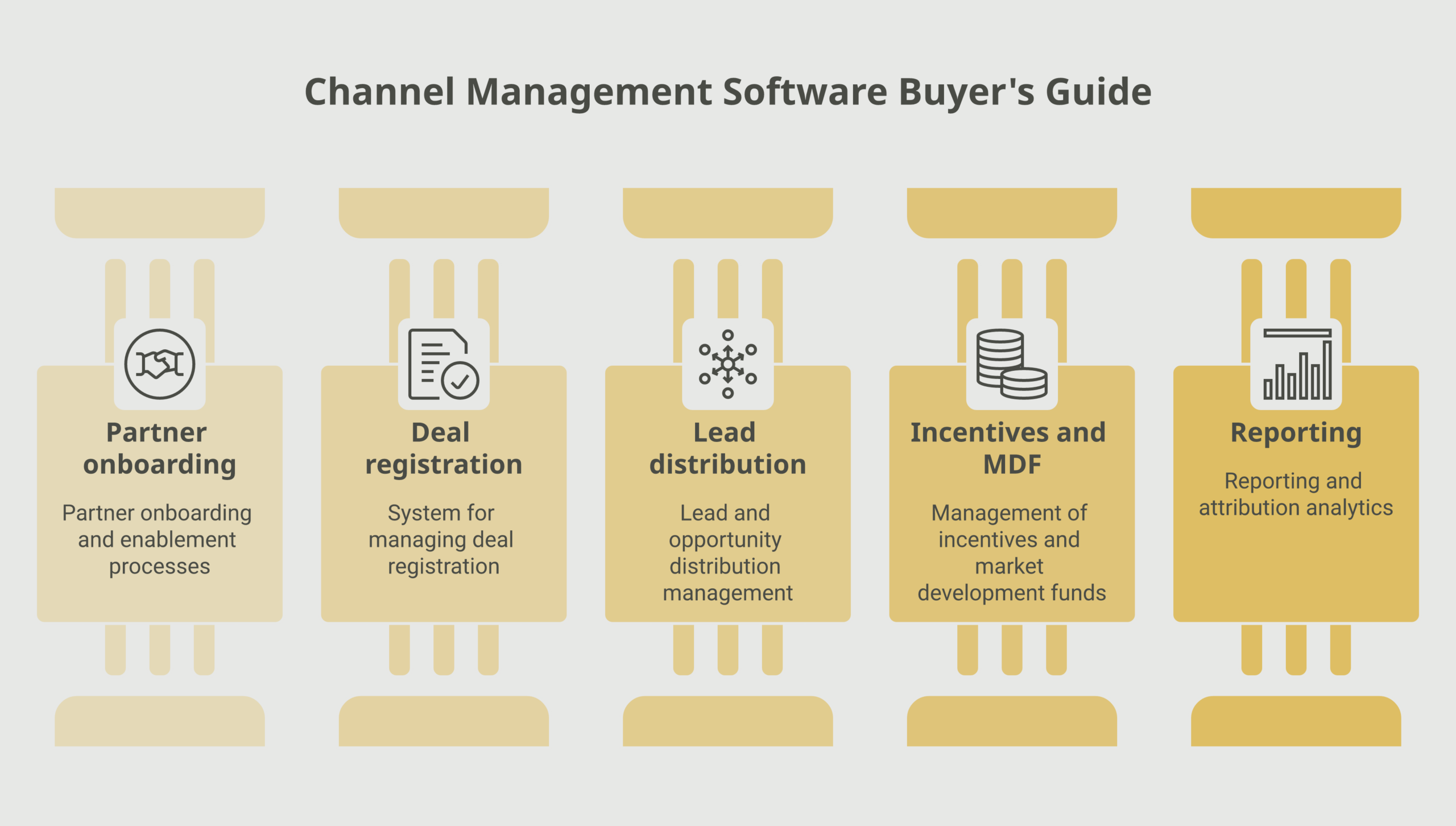
- Partner onboarding and enablement: register new partners, deliver training and assets, and track certification, so a partner can get productive without a series of one-off emails. This is the front door and it sets the tone.
- Deal registration: let partners submit deals, then dedupe against direct pipeline and protect partner margin. This is the single most important feature, because deal registration is how partners trust that bringing you a deal will not get them cut out.
- Lead and opportunity distribution: route inbound leads to the right partners and track what happens to them, so referrals do not vanish into a partner’s inbox.
- Incentives and MDF: manage margins, rebates, and marketing development funds, so the money that motivates partners is administered and auditable rather than negotiated deal by deal.
- Reporting and attribution: show partner-sourced and partner-influenced pipeline, so the channel can be measured and defended. Weak reporting here is why so many channel programs cannot prove their number.
The pattern is that channel management software is an administration engine. It makes running a partner program efficient and auditable, and every capability above is about removing friction, not about generating the demand in the first place.
Common pitfalls
- Buying the suite before you have a motion: a PRM implementation is not a channel strategy. If you do not yet know your partner types, your joint value proposition, and your deal-registration policy, the tool will organize a program you have not designed.
- A portal nobody logs into: onboarding partners into a portal that is not tied to real deals and real money produces a login page and no behavior change.
- Deal registration with no SLA: if partners register deals and hear nothing for two weeks, they stop. Fast, consistent responses are what keep the registration habit alive.
- No attribution back to CRM: a PRM that reports on portal activity but does not connect to sourced pipeline in your CRM measures the wrong thing and cannot defend the channel’s budget.
- Confusing administration with the selling motion: the tool handles registration and enablement. It does not run co-sell, work the overlap, or make the partner want to sell you. Expecting it to is the most expensive mistake in the category.
Tools and examples
The channel management and PRM space has a clear set of full-suite platforms plus specialists. The table below is a practical starting point, not an endorsement, and the right pick depends on your partner types and the maturity of your motion.
| Platform | Best fit | Watch-out |
|---|---|---|
| Introw | Teams that want fast setup and tight CRM sync without a heavy PRM implementation | Newer suite, so validate depth on the specific workflow you need |
| Euler | Programs that want partner administration wired closely to revenue data | Confirm coverage for your incentive and MDF requirements |
| Impartner | Larger, established channel programs that need the full enterprise PRM feature set | Weight and cost can exceed what an early channel needs |
| Allbound | Mid-market programs that prioritize partner enablement and portal usability | Deeper incentive and deal-registration logic may need configuration |
| ZINFI | Programs that want broad module coverage including through-channel marketing | Broad surface means a longer setup to use it well |
Two rules keep a selection honest. First, buy for the motion you run, not the one you aspire to: an early channel with ten partners does not need the enterprise suite a thousand-partner program does. Second, insist on real CRM attribution, because a tool that cannot connect partner activity to sourced pipeline leaves you unable to prove the channel.
Here is the worked example. A company with a growing reseller base is losing deals to registration friction: partners email deals in, someone keys them into the CRM days later, and conflicts blow up when a direct rep is already working the account. They buy a PRM, turn on deal registration with a 24-hour response SLA, and wire it to the CRM. Within a quarter, registration is a habit, conflicts drop because claims are visible, and for the first time the channel’s sourced pipeline is a number on a dashboard rather than a guess. The tool did not create the partners. It removed the friction that was killing the deals the partners already had.
Forecastable’s POV
Channel management software is necessary and oversold. Necessary, because past a certain size you cannot administer a partner program in spreadsheets, and deal registration in particular is the trust mechanism the whole channel rests on. Oversold, because vendors imply the platform is the program, and it is not. The platform is the filing system. The selling motion is separate work that no PRM performs for you.
At Forecastable we sit deliberately on the motion side of that line. We are a partnerships operating platform focused on connecting partner conversations and actions to CRM pipeline and revenue, the flywheel that runs from conversations to actions to pipeline to revenue. A PRM administers the program; the work we deliver as part of the service is running the co-sell plays and the attribution that turn an administered channel into a producing one, on the Forecastable platform. The PRM answers “is the partner enrolled and compliant.” We answer “did the partner sell, and can you prove it.”
My bet: the winning channel programs will own both layers on purpose, an administration tool for the paperwork and an operating discipline for the revenue, and will stop expecting one to do the other’s job. The teams that conflate them keep buying software to fix a problem that was never a software problem.
Forecastable is an independent third-party. The tools named here, including Introw, Euler, Impartner, Allbound, and ZINFI, are described from public information for your own evaluation, not as paid placements, and Forecastable does not resell them.
Frequently asked questions
What is channel management software? It is the system a company uses to recruit, onboard, enable, and track its indirect sales partners. It typically covers deal registration, lead distribution, incentives and MDF, and partner reporting, and it is often sold as a partner relationship management, or PRM, platform.
What is the difference between channel management software and a PRM? There is little practical difference. PRM is the common name for the full channel management suite. “Channel management software” is the broader description of the same administration layer, sometimes including through-channel marketing automation as a module.
Is channel management software the same as account mapping? No. Channel management software administers your partner program. Account mapping compares your customer list against a partner’s to find shared accounts and warm paths. They answer different questions, and buying one expecting the other is a common and costly mistake.
Which channel management software is best? There is no single best. Full-suite options include Introw, Euler, Impartner, Allbound, and ZINFI, and the right pick depends on your partner types, program maturity, and incentive needs. Buy for the motion you actually run, and require real CRM attribution.
What is the most important feature in channel management software? Deal registration. It is the mechanism that lets partners trust that bringing you a deal will not get them cut out, and a slow or unreliable registration process is one of the fastest ways to lose partner engagement.
Does channel management software increase partner revenue on its own? No. It removes administrative friction, which protects the revenue partners already generate, but it does not create partner motivation or run the selling motion. Those are human jobs the software supports rather than replaces.
Next step
Before you shortlist a platform, write down your partner types, your deal-registration policy, and the one number you want the channel to prove. If you cannot fill those in, a tool will organize a program you have not yet designed, and you will pay for modules you never turn on.
If you want help designing the motion the software is supposed to support, that is exactly what we do. Start your growth journey with Forecastable and we will connect your partner activity to real pipeline. Our PRM and partner tech guide goes deeper on where these tools fit.
Uncover Your Growth Potential
Schedule a Discovery Call