Introw PRM: What It Is and Where It Fits

What is Introw PRM?
Short answer: Introw PRM is a partner relationship management platform built to sit close to your CRM, so partner data, deal registration, and partner-sourced pipeline live next to the revenue system your reps already use rather than in a separate portal no one checks. It is one of a newer group of CRM-native PRMs, and its pitch is that keeping partner activity anchored to the CRM makes the program easier to measure and harder to let drift, because the partner data and the revenue data are in the same place.
Like any PRM, Introw administers partners; it does not run the program for you. It handles the deal registration, the portal, and the partner records, and leaves the recruitment, enablement, and co-sell motion to your team.
The useful question about any PRM, Introw included, is whether it fits the motion you are running, not whether its feature list is long.
Why the CRM-native PRM approach matters in 2026
The classic complaint about partner platforms is that they become islands. Partner data lives in a portal, the revenue lives in the CRM, and the two never quite reconcile, so nobody trusts the partner-sourced revenue number. A CRM-native PRM like Introw exists to close that gap by keeping partner activity anchored to the CRM from the start.
That matters more in 2026 because partnership teams are being measured on partner-sourced revenue, and that number only holds up if partner deals and CRM pipeline are the same records rather than two systems someone reconciles by hand. When the PRM lives next to the CRM, the attribution is cleaner, the reps see partner deals in the system they already work in, and the program is less likely to drift into a portal no one opens.
The reframe is that the value of a PRM is not in how much it can do, it is in how little friction it adds. A platform that keeps partner data close to revenue and out of your team’s way is doing its job; one that becomes a second system to maintain is adding cost.
How Introw PRM actually works in a program
A CRM-native PRM like Introw works by keeping the partner lifecycle anchored to the revenue system: it manages partner records next to CRM accounts, runs deal registration inside the pipeline, administers tiers and portal access, surfaces partner-sourced pipeline in CRM terms, and leaves the selling motion to your team. Each function is about reducing the gap between partner activity and revenue data, which is the CRM-native pitch in practice. The parts below are what the platform handles and what it does not.
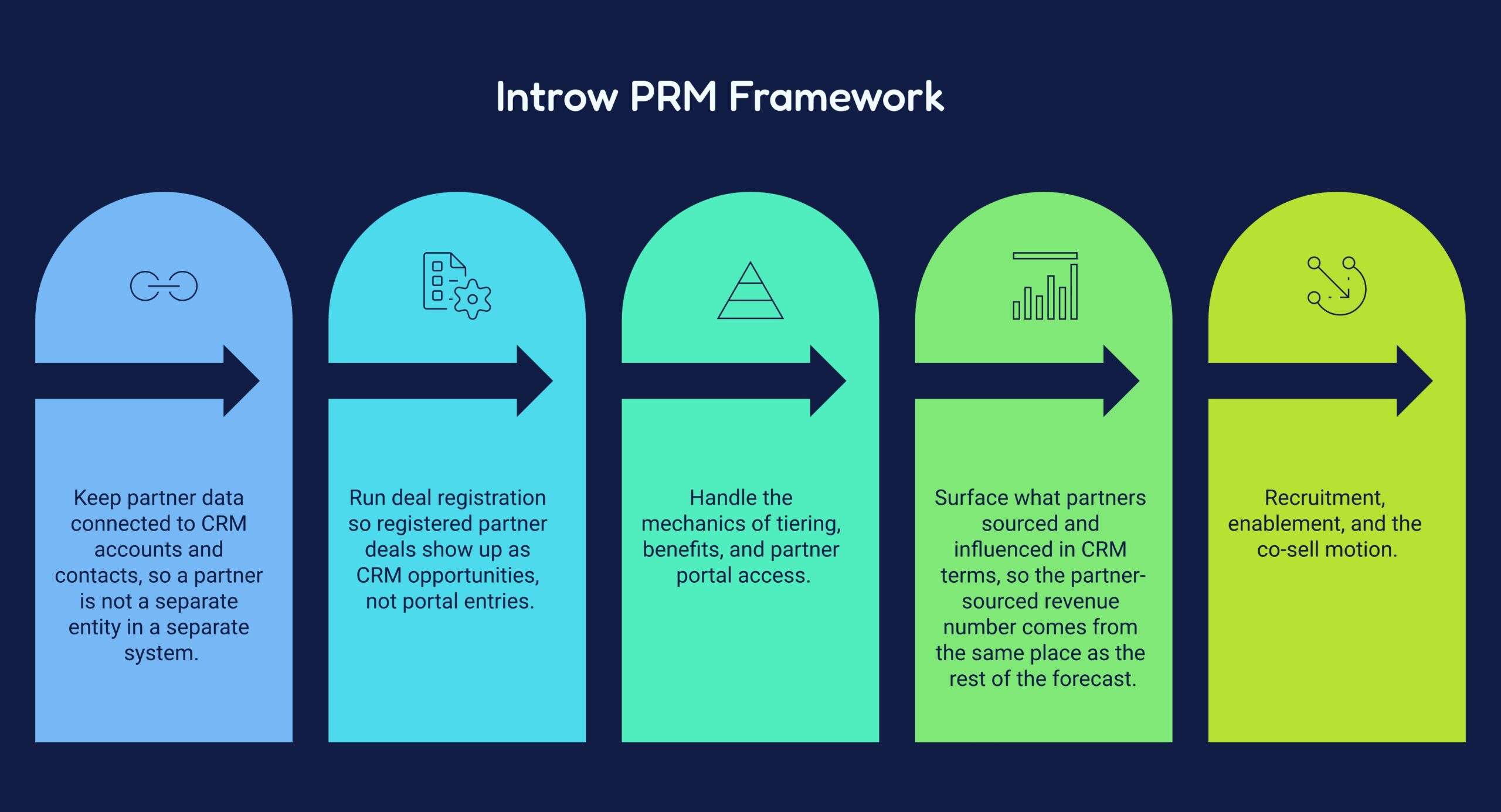
- Partner records next to the CRM: Keep partner data connected to CRM accounts and contacts, so a partner is not a separate entity in a separate system. This is the foundation of the CRM-native approach, and it is what makes the later attribution clean.
- Deal registration in the pipeline: Run deal registration so registered partner deals show up as CRM opportunities, not portal entries. This keeps reps and partners looking at the same pipeline and reduces the conflict that comes from two disconnected views.
- Tier and portal administration: Handle the mechanics of tiering, benefits, and partner portal access. This is standard PRM work, and doing it next to the CRM means tier status and partner activity stay in sync with the revenue picture.
- Partner-sourced pipeline reporting: Surface what partners sourced and influenced in CRM terms, so the partner-sourced revenue number comes from the same place as the rest of the forecast. This is the payoff of the CRM-native design.
- What it leaves to you: Recruitment, enablement, and the co-sell motion. A PRM administers partners and cannot make them produce, so the platform reduces friction while your team runs the motion that actually sources pipeline.
Common pitfalls when evaluating a PRM like Introw
- Expecting the PRM to run the program: A CRM-native PRM makes partner data cleaner and administration lighter; it does not recruit, enable, or co-sell. If you buy it expecting production, you will be disappointed.
- Buying on feature count: The longest feature list is not the best fit. The right PRM is the one that handles deal registration, portal, and tiering cleanly at your scale with the least friction, and CRM-native platforms compete on friction, not breadth.
- Ignoring the CRM fit: The entire value of a CRM-native PRM depends on how cleanly it connects to your specific CRM. Test that integration against your real data before committing, because a shaky connection undoes the whole premise.
- Skipping the motion work: Teams sometimes switch to a cleaner PRM hoping it fixes a program that is not producing. It will not. Fix the co-sell motion; the PRM only makes the administration easier.
- Underestimating migration: Moving partner data and retraining a partner base is real work regardless of how good the new platform is. Weigh the switching cost against the friction you are trying to remove.
Tools and examples
Introw sits in a landscape of PRM options that sort by how close they stay to the CRM and how much of the lifecycle they own. The table below places it among the alternatives worth weighing.
| Platform | Category | What to know |
|---|---|---|
| Introw | CRM-native PRM | Keeps partner data and deal registration next to the CRM; competes on low friction and clean attribution |
| Euler | CRM-native PRM | Also anchored to the CRM; suits teams standardizing partner data next to pipeline |
| Impartner | Enterprise full-suite PRM | Deep tiering, MDF, and portal for large, mature channel programs |
| Channelscaler (formerly Allbound) | Mid-to-large full-suite PRM | Full lifecycle PRM with enablement and portal; the platform formerly known as Allbound |
| ZINFI | Enterprise channel PRM | Deep channel management and through-channel marketing for large programs |
| Kiflo | Lean PRM | Fast to deploy for smaller and mid-market programs that need registration and a portal |
A worked example: a mid-market team measured on partner-sourced revenue could never trust the number, because partner deals lived in a legacy portal and the CRM held the pipeline, and reconciling the two ate a day every month. It shortlisted two CRM-native PRMs, tested each against its real Salesforce data, and picked the one that made registered partner deals appear as CRM opportunities cleanly. The partner-sourced revenue number went from a monthly hand-build to a CRM query, deal-registration conflicts dropped because reps and partners saw the same pipeline, and the team stopped maintaining a portal no one opened. The platform did not produce revenue; it removed the friction that had been hiding it.
Forecastable’s POV on Introw and CRM-native PRM
Our position is that a CRM-native PRM solves a real and specific problem, the gap between partner data and revenue data, and that is worth something, but it is still just administration. Introw and platforms like it make the partner-sourced revenue number cleaner and the deal-registration friction lower, which is genuinely useful, and none of it produces a single deal. The PRM sets the table; your team still has to run the co-sell motion that puts food on it.
That is the frame we would apply to any PRM evaluation, CRM-native or not. Pick the platform that fits your CRM and your scale with the least friction, get the administration cheap and clean, and then spend the time you saved on recruitment, enablement, and co-sell, the work no platform can do for you. The mistake is treating the PRM decision as the program decision. It is not; it is the plumbing decision.
Forecastable is a partnerships operating platform that connects partner conversations and actions to CRM pipeline and revenue, the flywheel of Conversations to Actions to Pipeline to Revenue. We are a category authority on running partner-led growth, not a PRM vendor, so we sit complementary to whichever PRM you choose, Introw included, making it visible which partners actually produce so the program is measured by revenue rather than roster size.
Any third-party tools or firms referenced here are independent third-party products, and mentioning them is not an endorsement. Evaluate Introw or any PRM against your own CRM, program size, and motion before committing to it.
Frequently asked questions
What is Introw PRM? Introw PRM is a partner relationship management platform built to sit close to the CRM, keeping partner data, deal registration, and partner-sourced pipeline next to the revenue system reps already use. It administers partners; it does not run the program’s recruitment, enablement, or co-sell.
What makes Introw a CRM-native PRM? Introw is designed so partner records and registered deals live connected to CRM accounts and opportunities rather than in a separate portal. The aim is cleaner attribution and less friction, because partner activity and revenue data sit in the same place.
How does Introw compare to Impartner or ZINFI? Introw competes on low friction and CRM proximity, while Impartner and ZINFI are enterprise full-suite platforms with deeper channel management, MDF, and through-channel marketing. The right pick depends on whether you need enterprise depth or a lean, CRM-close administration layer.
Does Introw replace the need for a co-sell motion? No. Introw and any PRM administer partners and reduce friction; they do not recruit, enable, or co-sell. The platform makes the program easier to run and measure, but your team still runs the motion that sources pipeline.
What should you test before choosing Introw? The integration with your specific CRM against your real partner data. The entire value of a CRM-native PRM depends on that connection being clean, so validate it before committing, along with the migration effort of moving your partner base.
Is a CRM-native PRM better than a full-suite one? Neither is better in the abstract. CRM-native platforms like Introw and Euler suit teams that want low friction and clean attribution; full-suite platforms suit large channel programs that need depth. Match the category to your program stage.
Next step
If your partner-sourced revenue number is a monthly hand-build because partner data and CRM pipeline live apart, a CRM-native PRM like Introw is built to close that gap. Test the CRM fit, get the administration clean, and put the saved time into co-sell. Start your growth journey now to build the partner motion your PRM is meant to support. The PRM hub frames how partner tech fits the broader program.
Uncover Your Growth Potential
Schedule a Discovery Call