Go to Market Strategy Services: A Buyer’s Guide

Short answer
Short answer: Go to market strategy services are advisory engagements that help you define who you sell to, how you reach them, and how you win, and then stand up the motion to do it. They are worth buying when you have a real decision to make or a motion that will not scale, and they fail when the deliverable is a strategy deck nobody can execute after the engagement ends.
Here is the position. Strategy is rarely the thing that is broken. Execution and transfer are, so buy the service on what it leaves running, not on the quality of the slides.
What are go to market strategy services?
Go to market strategy services are engagements, from management consultancies, boutique firms, fractional executives, or execution partners, that help a company connect its product to revenue. The work usually covers the ideal customer profile, positioning and message, the channel mix, the sales motion, and the measurement that tells you what is working. The output ranges from a pure strategy document to a fully stood-up and instrumented motion.
You are buying outside pattern recognition and capacity: someone who has seen the decision before and can bring a structure to it faster than you can build one internally. The variable that matters is how far into execution the engagement goes, because a plan handed over without a running motion tends to die the week the advisor leaves.
Why go to market strategy services matter in 2026
Go-to-market got more complex and less forgiving. Buyers trust peers over vendors, evaluations run longer, and the efficient channels, including partner introductions, are harder to instrument than a paid campaign. A good service helps a team make the hard targeting and channel decisions and, more important, make them stick.
The failure mode is well known. Most engagements deliver a sound strategy and stop at the handoff, so nothing changes in how deals get worked. In my work with revenue teams, the companies that got value from a strategy engagement are the ones where the advisor stayed through execution and transfer, not the ones with the most polished deck. The 2026 version of this purchase is biased toward services that leave a motion running and a team that can run it.
How go to market strategy services actually work
A go to market strategy engagement works through a four-part arc from diagnosis to a motion your team owns.
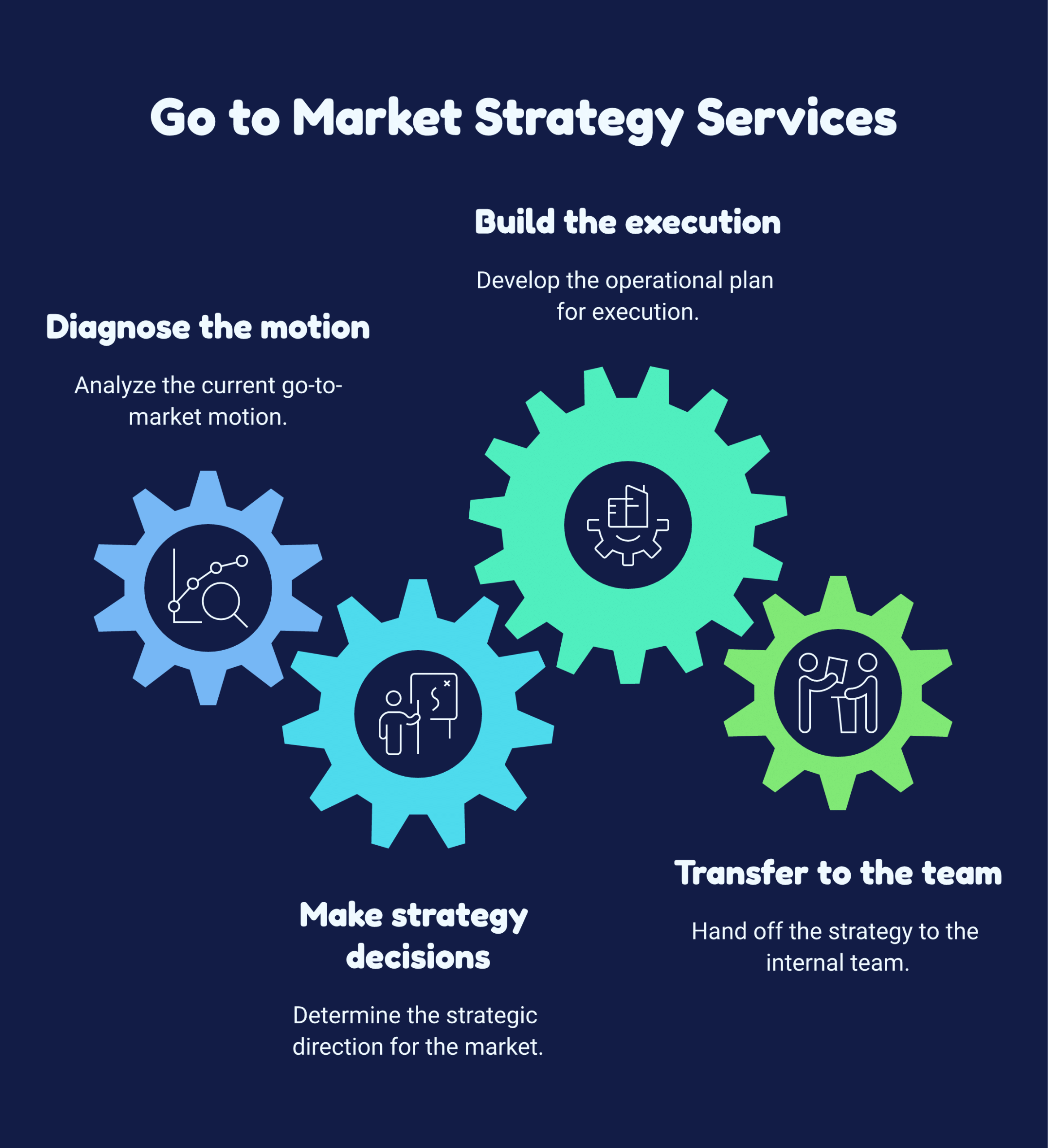
- Diagnose the motion: the service assesses where revenue actually breaks, profile, message, channel, or execution, because the fix depends on the real failure, not the assumed one. A good diagnosis saves you from buying the wrong help.
- Make the strategy decisions: it sharpens the ICP, the message, and the channel mix into decisions, not options. Decisions are what the motion runs on.
- Build the execution: it stands up the sales motion, the stages, and the measurement so the strategy becomes something a team runs. This is the step cheap engagements skip.
- Transfer to the team: it hands the running motion to your people with the instrumentation to keep it honest, so the work survives the engagement. Transfer is the deliverable that matters.
The through-line is that the value is in steps three and four. Any competent firm can do the first two; the ones worth paying finish the arc.
Common pitfalls
- Buying the deck: hiring for a strategy document and getting one, with no running motion and no transfer, so nothing changes.
- No execution scope: scoping the engagement to end at the strategy, which guarantees the plan dies at the handoff.
- Skipping the diagnosis: paying for a new strategy when the real problem was execution, so the second strategy fails the same way.
- Leaving partners out: designing the channel mix around paid and outbound and ignoring the partner channel, which is often the warmest and least instrumented.
- No measurement handoff: transferring a motion with no way to see which channel earns revenue, so the team cannot keep improving it.
Tools and examples
Buyers usually choose among three kinds of provider. Compare them on how far into execution and transfer they go.
| Option | Best for | Watch for |
|---|---|---|
| Management consultancy | Big strategic bets, board-level credibility | Strategy-heavy deliverables; execution and transfer often out of scope |
| Boutique or fractional GTM firm | Focused expertise, hands-on help | Capacity limits; varies widely on how far it carries execution |
| Execution-embedded partner | Standing up and transferring a running motion | Narrower strategic range; best when the gap is execution, not direction |
A quick worked example shows the stakes. A company buys a strategy engagement, gets a strong deck, and six months later the number has not moved, because the motion was never built and the partner channel was named but never instrumented. A second engagement, scoped to execution and transfer, stands up one consistent sales motion and wires partner introductions into the pipeline as a measured source. The strategy barely changed. What changed was that a motion now runs every week and the team owns it. The lesson is to scope for execution and transfer from the start, and to make sure the partner channel is built, not just mentioned.
Forecastable’s POV
Go to market strategy is rarely the bottleneck. Execution and transfer are, so the service you buy should be judged on what it leaves running inside your team, not on the strategy it presents. If the engagement ends at a deck, you bought the easy half.
The piece that gets named in strategy and skipped in execution is almost always the partner channel, because it is the hardest to instrument. At Forecastable we are a partnerships operating platform that connects partner conversations and actions to CRM pipeline and revenue, and our Co-Sell Alignment Specialist is delivered as part of the service, using the platform to stand up and run the partner motion and then keep it measured. We are not a general GTM consultancy; we are the people who make the partner channel a motion your team can actually run.
My bet: the teams that buy go to market services on execution and transfer, and insist the partner channel is built rather than described, are the ones whose number moves.
Forecastable is an independent third-party. Any tools, vendors, or third-party figures referenced here are described from public information for the reader’s own evaluation, not as paid placements.
Frequently asked questions
What are go to market strategy services? They are advisory engagements that help you define who you sell to, how you reach them, and how you win, and ideally stand up the motion to do it. Providers range from management consultancies to boutique firms, fractional executives, and execution partners.
What should go to market strategy services deliver? At minimum, clear decisions on ICP, message, channel mix, and sales motion. The ones worth paying also build the execution and transfer a running motion to your team, because a strategy with no motion rarely survives the handoff.
How much do go to market strategy services cost? It varies widely by provider type and scope, from a fixed strategy project to an ongoing execution engagement. Scope and depth matter more than the headline price, so compare on how far the work carries into execution and transfer.
Why do go to market engagements fail? They usually fail at execution and transfer, not strategy. A sound plan dies when no motion is built and no one on the team can run it after the advisor leaves.
Do go to market strategy services cover the partner channel? Many name it and few build it, because the partner channel is the hardest to instrument. If partners matter to your motion, scope the engagement so the partner channel is stood up and measured, not just mentioned in the plan.
Next step
If you are buying go to market strategy services, scope for execution and transfer before you sign. Ask each provider what motion will be running, and who on your team will own it, when they leave.
If the channel you need built is partners, that is the motion we stand up and transfer. Start your growth journey with Forecastable and we will make the partner channel a motion your team runs. Our go to market consulting guide covers execution and transfer, and the co-sell guide shows how the partner channel becomes measured pipeline.
Uncover Your Growth Potential
Schedule a Discovery Call