Go to Market Strategy for B2B SaaS: A Field Guide

Short answer
Short answer: A go to market strategy for B2B SaaS is the plan for how a subscription software company acquires, converts, and expands customers, built around the fact that the first sale is only the start of the revenue. It differs from generic B2B go-to-market because the economics reward retention and expansion as much as acquisition, so a motion that lands customers it cannot grow fails even when it closes well.
Here is the position. SaaS go-to-market lives or dies on the second year, not the first, and the motions that win are the ones designed to expand accounts, not just sign them.
What is a go to market strategy for B2B SaaS?
A go to market strategy for B2B SaaS is the full plan for turning a software product into recurring revenue: who you sell to, how they discover and try the product, how the sale closes, and how the account grows after it lands. The subscription model changes the math. Revenue arrives over time, the cost of acquiring a customer is recovered over months or years, and a customer who churns early can cost more than they ever paid.
That is why SaaS go-to-market cannot stop at the close. It has to account for onboarding, activation, retention, and expansion as parts of the same motion, because net revenue retention, how much a cohort grows or shrinks over time, often matters more to the business than new logo count.
Why a go to market strategy for B2B SaaS matters in 2026
A go to market strategy for B2B SaaS matters more in 2026 because capital got disciplined and growth-at-all-costs stopped being funded. Efficient growth is the bar now, which means the acquisition motion has to pay back faster and the expansion motion has to carry more of the number. A SaaS strategy that spends heavily to acquire customers it cannot retain or expand is exactly the profile that lost its funding.
The second pressure is motion choice. Product-led, sales-led, and partner-led motions all work for SaaS, and the right answer depends on price point and buyer behavior rather than fashion. A low-price, self-serve product forced through an enterprise sales motion burns margin, and a complex platform sold purely self-serve leaves expansion revenue on the table. Picking and sequencing the motions correctly is most of the strategy.
In my work with SaaS teams, the most expensive mistake is funding acquisition while leaving expansion and partner-sourced growth to chance, because both are harder to instrument than new-logo pipeline and so they get managed last.
How a go to market strategy for B2B SaaS actually works
A SaaS go-to-market strategy works as a lifecycle, where each stage has to pay for the next and expansion carries the economics.
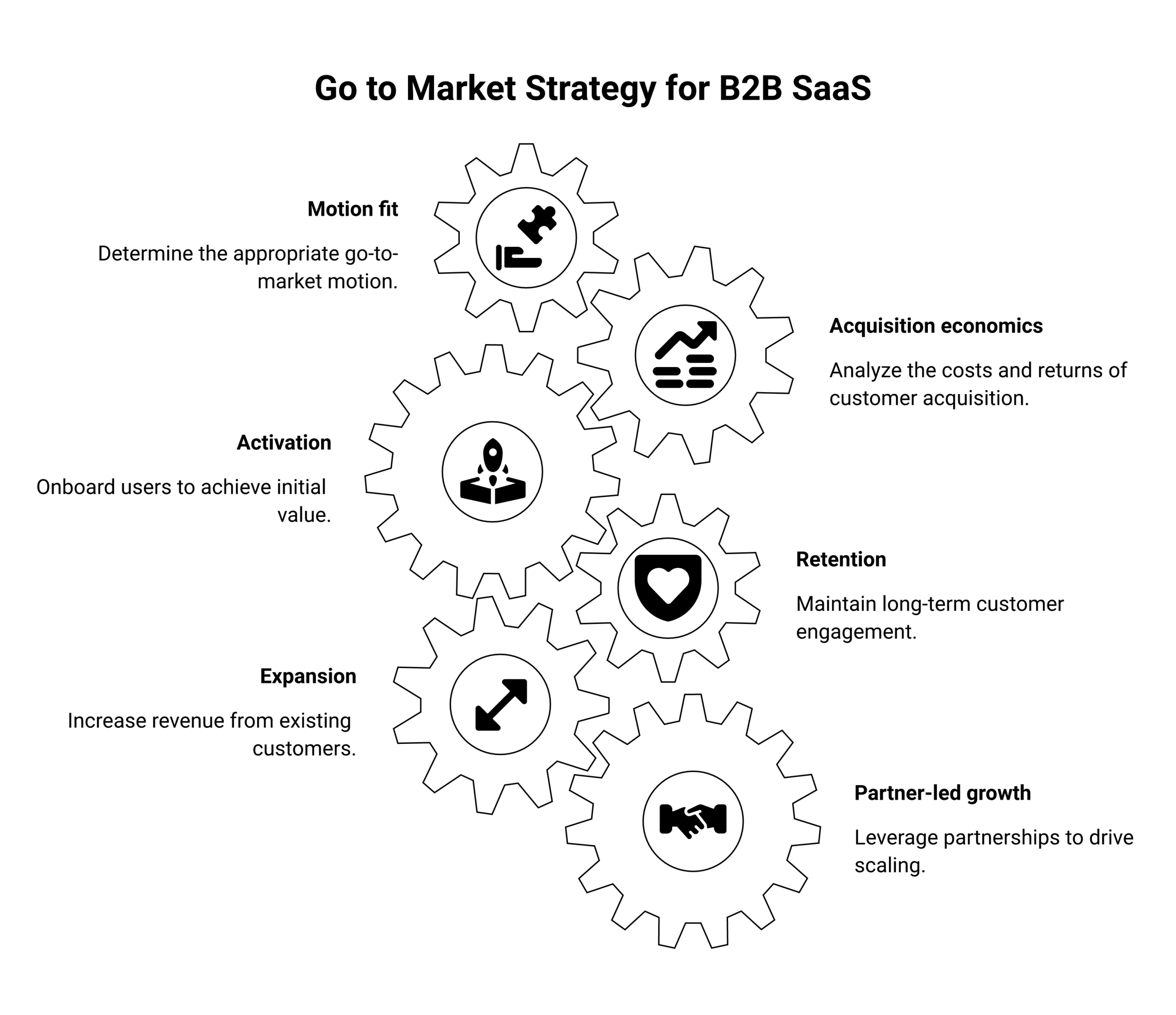
- Motion fit: match the selling motion to the price point and buyer, because product-led suits low-friction adoption, sales-led suits high-consideration deals, and most SaaS companies need a deliberate blend rather than a default.
- Acquisition economics: design the top of the motion to pay back fast, since the subscription model means you carry acquisition cost until retention and expansion recover it.
- Activation: get new customers to real value quickly, because a signed contract that never activates is a churn event with a delay, not a win.
- Retention: build the motion to keep cohorts, since in a recurring model a point of churn compounds against every future quarter.
- Expansion: design the land so it can grow, through seats, usage, or modules, because net revenue retention above 100 percent is what lets a SaaS business grow without acquiring its way out of churn.
- Partner-led growth: use partners to lower acquisition cost and raise expansion, because a partner-sourced customer usually lands warmer and expands faster than a cold-acquired one.
The through-line is that acquisition is the down payment and expansion is the return. A SaaS motion optimized only for new logos ignores the half of the model that actually compounds.
Common pitfalls
- Optimizing for new logos only: funding acquisition while leaving retention and expansion unmanaged, which is the profile capital stopped rewarding.
- Forcing one motion: pushing a self-serve product through enterprise sales or a complex platform through pure self-serve, burning margin on the mismatch.
- Treating onboarding as handoff: signing customers without driving activation, so churn arrives on a delay.
- Ignoring net revenue retention: measuring growth by logos added rather than by whether cohorts expand or shrink.
- Leaving partners to chance: running acquisition cold while the partner channel, which lands warmer and expands faster, goes uninstrumented and unfunded.
What this looks like in practice
A SaaS company reviews its growth and finds the acquisition engine is working and the business still is not. New logos are up, but net revenue retention sits below 100 percent, so the company is acquiring just to stay level. The motion was built entirely around landing customers and nothing around growing them. They rebuild the strategy around the lifecycle: tighten activation so new customers reach value in the first weeks, redesign packaging so the land can expand, and instrument their partner channel, which they discover lands customers that both retain and expand better than cold-acquired ones. The acquisition motion did not change much; adding the retention and expansion halves, and funding the partner channel on evidence, changed the trajectory.
That is the difference between a SaaS strategy and a SaaS acquisition plan. The first sale was never the point; the second year was.
Forecastable’s POV
SaaS go-to-market is an expansion business wearing an acquisition costume. The strategies that win in 2026 are the ones that treat the land as the start of the revenue and build the motion to grow it, and most of the gain sits in the two stages that are hardest to instrument: retention and partner-led growth.
The partner channel is where I see the biggest unclaimed gain. A partner-sourced SaaS customer tends to land warmer, activate faster, and expand more, because the partner understood the fit before the sale. And it is the channel most SaaS teams cannot measure, because the partner introduction gets logged as direct and the expansion gets credited to account management with no memory of how the account arrived. At Forecastable we are a partnerships operating platform that connects partner conversations and actions to CRM pipeline and revenue, so partner-sourced acquisition and the expansion that follows it show up as measurable lines instead of vanishing into direct and renewal.
My bet: the SaaS teams that build their go-to-market around expansion, and instrument the partner channel that feeds it, are the ones that grow efficiently instead of acquiring their way out of churn.
Forecastable is an independent third-party. Any tools, vendors, or third-party figures referenced here are described from public information for the reader’s own evaluation, not as paid placements.
Frequently asked questions
What is a go to market strategy for B2B SaaS? It is the full plan for acquiring, converting, retaining, and expanding subscription software customers. Because revenue is recurring, the strategy has to account for the whole lifecycle, not just the first sale, since retention and expansion often carry the economics.
How is SaaS go-to-market different from general B2B go-to-market? The recurring model means the first sale only starts the revenue, so retention and expansion matter as much as acquisition. A SaaS motion that lands customers it cannot grow fails even when it closes well, which is not true of one-time-sale businesses.
Which go-to-market motion is best for B2B SaaS? It depends on price point and buyer behavior. Product-led suits low-friction, self-serve adoption; sales-led suits high-consideration deals; partner-led lowers acquisition cost and raises expansion. Most SaaS companies run a deliberate blend.
What is net revenue retention and why does it matter? Net revenue retention measures how much a cohort of customers grows or shrinks over time including expansion and churn. Above 100 percent means existing customers grow faster than they leave, which lets a SaaS business grow without acquiring its way out of churn.
How do partners fit a SaaS go-to-market strategy? Partners lower acquisition cost and raise expansion, because a partner-sourced customer usually lands warmer and expands faster. The channel is often underused because it is harder to instrument than cold acquisition, not because it works worse.
What is the most common SaaS go-to-market mistake? Optimizing only for new logos while leaving retention and expansion unmanaged. It is the exact profile that stopped getting funded, because the business has to keep acquiring just to offset the churn it never addressed.
Next step
Pull your net revenue retention by cohort this week. If it sits below 100 percent, your go-to-market problem is expansion, not acquisition, and more new logos will not fix it.
If the cohorts that retain and expand best turn out to be partner-sourced, that is what we instrument. Start your growth journey with Forecastable and we will make partner-sourced acquisition and expansion measurable. Our B2B go-to-market strategy guide covers the build process, and the partner-sourced pipeline guide covers the channel that lands and expands warmer.
Uncover Your Growth Potential
Schedule a Discovery Call