Cost Per Lead Formula: What It Is and How to Use It

Short answer
Short answer: The cost per lead formula divides your total spend on a channel or campaign by the number of leads it produced, giving the average price you paid per lead. It looks trivial, and that is exactly where teams get misled, because the blended average hides the channel that is quietly carrying the result.
Here is the position. The formula is one line of arithmetic, but reading it correctly is where the money is, and the single number you report is almost never the number you should act on.
What is the cost per lead formula?
The cost per lead formula is total spend divided by total leads, over a defined period and a defined channel. If you spent 10,000 dollars on a paid search campaign and it produced 50 leads, your cost per lead is 200 dollars. That is the whole calculation.
The trouble starts with the word total. Spend has to include the parts people forget: media, agency fees, tooling, and the loaded cost of the people running it. Leads has to count only those that met a real qualification bar, not every form fill. Change either input and the number moves, which is why two teams reporting the same metric are often measuring different things.
Why the cost per lead formula matters in 2026
The cost per lead formula matters because budgets are under harder scrutiny and most teams still report one blended figure that hides which channel is bleeding and which is subsidizing it. The deeper reason is that cost per lead is a leading number for a lagging one: a cheap lead on a channel that never converts costs more than a pricey lead on a channel that closes, because the real question is cost per customer.
How the cost per lead formula actually works
The cost per lead formula works as a sequence, where each step corrects a distortion the raw average hides.
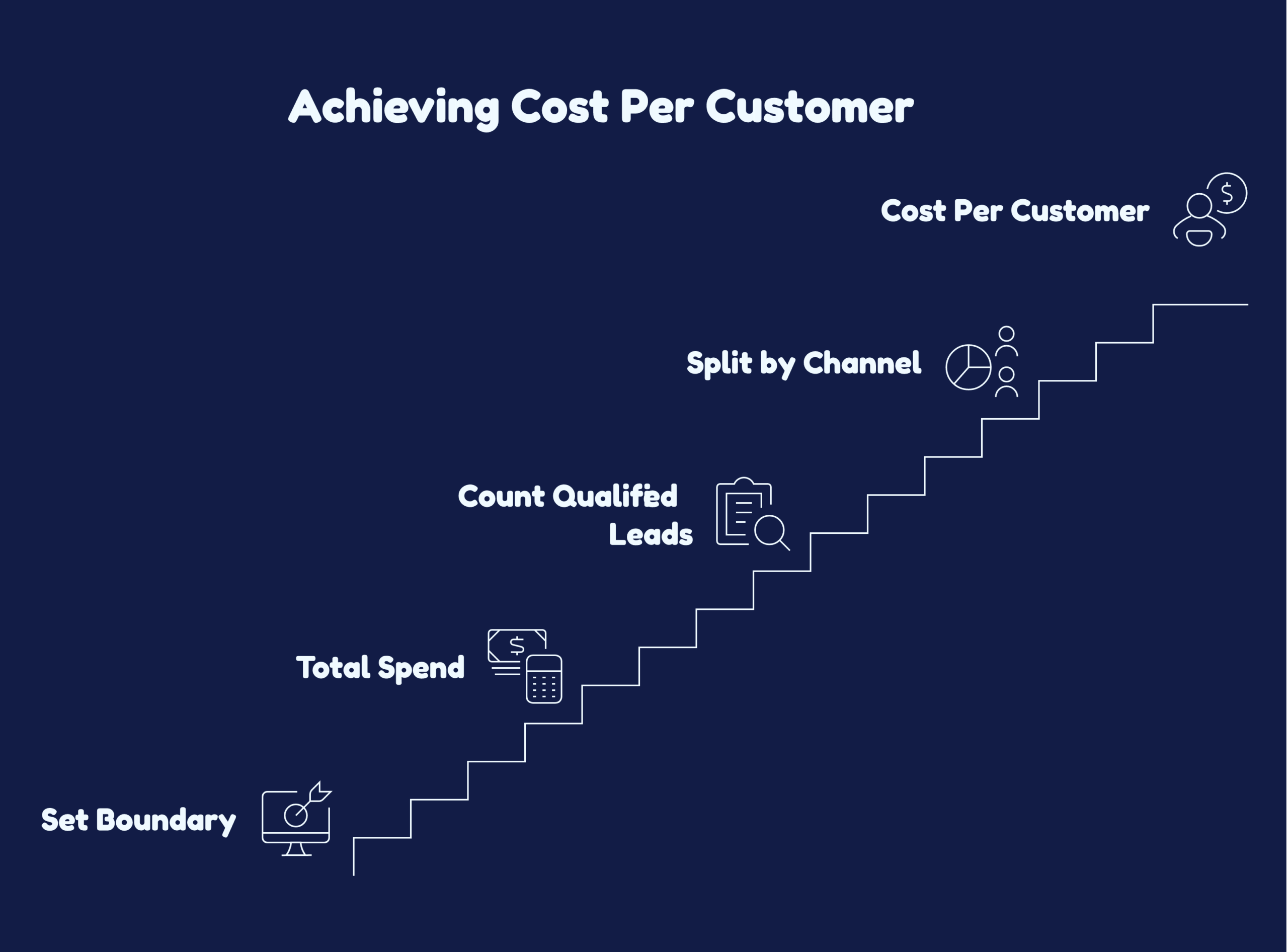
- Set the boundary: fix the period and the channel before you divide, because a quarter of spend over a month of leads produces a number you cannot act on.
- Total the real spend: add media, tools, agency fees, and the loaded cost of the people, so the denominator reflects what the channel actually costs rather than just the ad budget.
- Count only qualified leads: divide by leads that cleared a real bar, not raw form fills, because a cheap cost per lead built on junk is the most expensive number on the dashboard.
- Split by channel: run the formula per source instead of once across everything, so you can see which channel is cheap and converting and which is cheap and worthless.
- Carry it to cost per customer: multiply cost per lead by the inverse of each channel’s close rate, because the channel with the lowest cost per lead and the lowest close rate usually has the highest cost per customer.
The through-line is that the formula is only honest when it is split and carried forward. Blended cost per lead is a vanity number; cost per customer by source is the one that decides the budget.
Common pitfalls
- Reporting one blended number: averaging every channel into a single cost per lead that hides the cheap-and-converting source and the cheap-and-dead one.
- Counting raw form fills: dividing by unqualified leads so the number looks efficient while sales throws most of them away.
- Underloading the spend: leaving out tooling, agency, and people cost so the denominator understates what the channel actually costs.
- Stopping at the lead: optimizing to the cheapest lead instead of the cheapest customer, which rewards the worst-converting channels.
- Ignoring partner-sourced leads: treating a partner introduction as free or crediting it to the next rep, so the lowest-cost, highest-converting source never shows up in the math.
What this looks like in practice
A team reviews two channels. Paid search shows a cost per lead of 120 dollars and converts at 4 percent, so each customer costs 3,000 dollars in lead spend. A partner-sourced channel shows a 400 dollar cost per lead, which looks expensive, but converts at 30 percent, so each customer costs roughly 1,333 dollars. On cost per lead alone the team cuts the partner channel; on cost per customer the partner channel is less than half the price of the customer it produces.
That is the difference between a number you report and a number you run the budget on. Same arithmetic, split by source and carried to the customer, pointing the opposite direction.
Forecastable’s POV
Cost per lead is the most quoted and least trusted number in B2B, because almost everyone stops at the lead and almost no one splits it by source. The fix is not a better formula. It is the discipline to carry the same arithmetic through to cost per customer, per channel, every time.
The source split is where I watch teams lose the plot. Partner-sourced leads are usually the cheapest customers in the mix once you carry the math forward, and they are also the worst-instrumented, because a partner introduction gets logged as a direct lead or credited to whichever rep touched it next. At Forecastable we are a partnerships operating platform that connects partner conversations and actions to CRM pipeline and revenue, so partner-sourced leads show up as their own measurable line with their own cost per customer instead of hiding inside direct.
My bet: the teams that stop optimizing to the cheapest lead and start optimizing to the cheapest customer by source are the ones whose demand budget stops surprising them.
Forecastable is an independent third-party. Any tools, vendors, or third-party figures referenced here are described from public information for the reader’s own evaluation, not as paid placements.
Frequently asked questions
What is the cost per lead formula? It is total spend divided by total leads over a defined period and channel. Spend 10,000 dollars, get 50 leads, and your cost per lead is 200 dollars. The hard part is deciding what counts as spend and what counts as a lead.
What should be included in the spend? Everything the channel consumes: media or ad budget, tooling, agency or contractor fees, and the loaded cost of the people running it. Leaving any of these out understates the denominator and flatters the number.
What is a good cost per lead in B2B? There is no universal figure, because it depends on close rate and deal size. A 400 dollar lead converting at 30 percent is cheaper per customer than a 100 dollar lead converting at 3 percent, so judge it only next to the cost per customer it produces.
How is cost per lead different from cost per acquisition? Cost per lead measures the price of a lead; cost per acquisition measures the price of a closed customer. Cost per acquisition is cost per lead divided by the lead-to-customer conversion rate, so a low cost per lead can still produce a high cost per acquisition.
Why should I calculate cost per lead by channel? Because channels convert at widely different rates. A single blended cost per lead averages a strong source and a weak one into a figure that describes neither and hides which channel to fund.
Why do partner-sourced leads break the formula? Because they are often logged as direct or credited to the next rep, so their true cost and their high close rate never enter the calculation. Measured on their own line, they usually turn out to be the lowest cost per customer in the mix.
Next step
Run the formula once per channel this week, then carry each one forward to cost per customer and watch which channel changes rank. The cheapest lead and the cheapest customer are rarely the same source.
If the cheapest customer turns out to be partner-sourced, that is the channel we instrument. Start your growth journey with Forecastable and we will put partner-sourced leads in the same cost math as the rest of your demand. Our cost per lead guide covers the benchmarks, and the partner-sourced pipeline guide shows why a partner introduction converts warmer than a cold lead.
Uncover Your Growth Potential
Schedule a Discovery Call