Close Plan vs Mutual Action Plan: The Difference

What is the difference: close plan vs mutual action plan?
Short answer: The difference in close plan vs mutual action plan is scope: a mutual action plan maps the whole pursuit from evaluation to a decision, while a close plan maps the final segment of dated steps that get an agreed deal to signature. They are not competing formats; the close plan is effectively the closing portion of the broader mutual action plan, run as its own sharper checklist.
Both are joint, dated, owned documents agreed between buyer and seller. The distinction is how much of the deal they cover and at what resolution, which is why teams often run both rather than choosing one.
Why the distinction matters in 2026
The distinction matters because using one where the other belongs produces a document that does its job badly. A mutual action plan stretched to also drive the final week of a deal is too diffuse to run as a closing checklist; a close plan expanded to cover the whole evaluation is too detailed to maintain across months. Knowing close plan vs mutual action plan keeps each at the resolution it works best.
In 2026 it matters more because longer evaluations and larger buying committees mean deals need both a long-horizon roadmap and a sharp closing sequence. Teams that conflate the two tend to have one document that is good at neither, and the cost shows up as evaluations that drift early and closes that slip late. Treating them as distinct, complementary tools is what covers both ends of the deal.
How a close plan and a mutual action plan differ
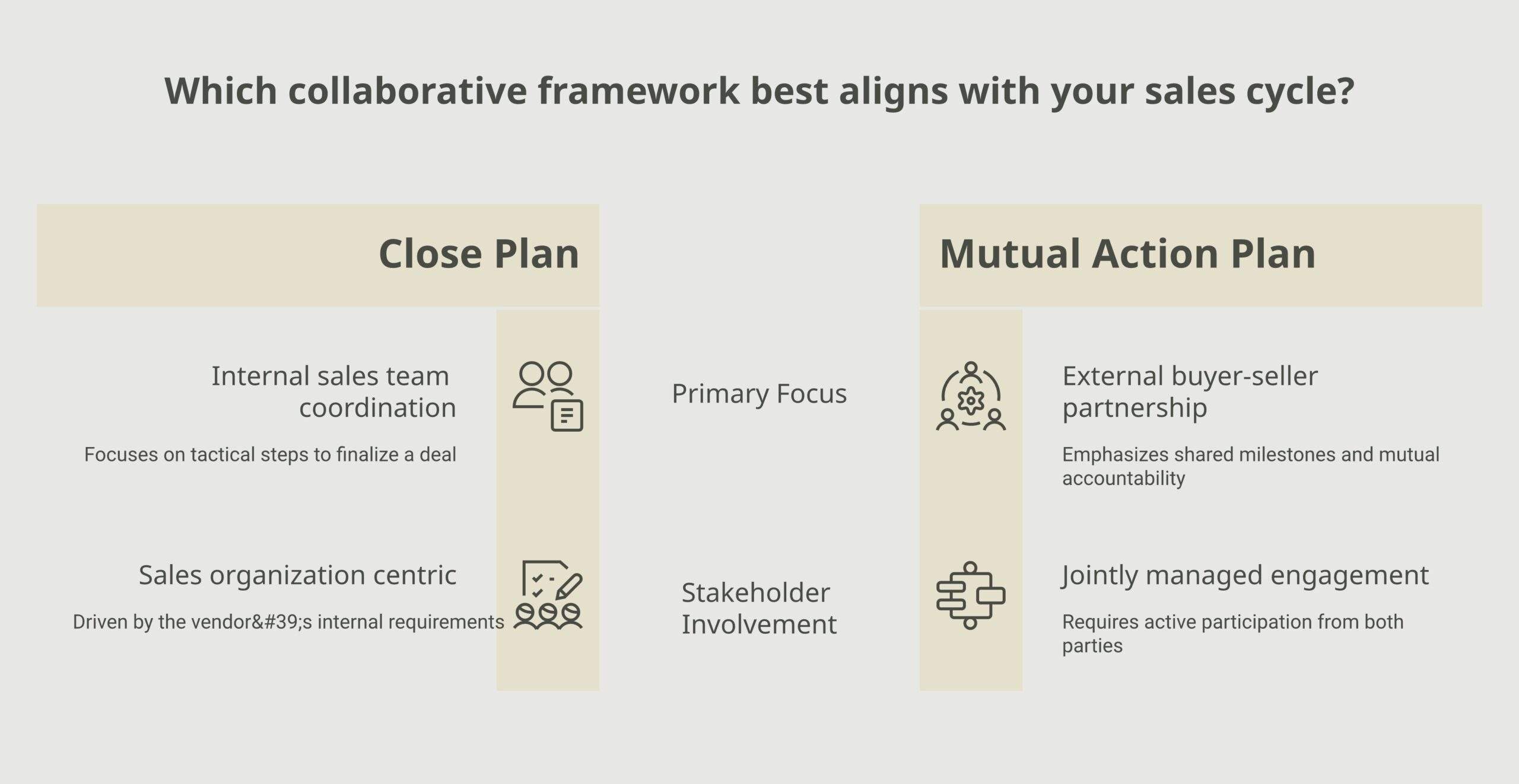
The clearest way to hold close plan vs mutual action plan is by scope, horizon, and resolution: the mutual action plan is the wide-angle roadmap of the entire pursuit, and the close plan is the zoomed-in sequence for getting to signature once the decision is essentially made.
| Dimension | Close plan | Mutual action plan |
|---|---|---|
| Scope | Final steps to signature | Whole pursuit, evaluation to decision |
| Horizon | Weeks before close | The full deal, often months |
| Resolution | High detail per step | Milestone level across phases |
| Primary purpose | Get an agreed deal signed on date | Run the evaluation to a decision |
| Typical owners | Procurement, legal, AE, partner | Committee, finance, SE, AE, partner |
| Relationship | The closing segment of the action plan | The roadmap the close plan sits inside |
Read across the table, the two are the same instinct, a joint, dated, owned plan, applied at different scopes. The mutual action plan answers how the deal reaches a decision; the close plan answers how an agreed decision becomes a signature.
Common pitfalls in close plan vs mutual action plan
- Running only a mutual action plan: Relying on the broad roadmap to also drive the final week leaves the closing steps too diffuse, so security and procurement slip late. Add a sharp close plan for the end.
- Running only a close plan: A closing checklist with no broader roadmap means the early evaluation drifts before the close plan ever starts. The action plan covers the months the close plan does not.
- Merging them into one document: Combining the two produces a plan too detailed to maintain over months and too diffuse to run in the final week. Keep them as linked but separate documents.
- Different owners on each: If the action plan and close plan name different owners for the same step, the handoff between phases drops the step. The close plan should inherit and sharpen the relevant action-plan owners.
What this looks like in practice
A team ran a single combined document for a complex co-sell deal. It was thorough about the early evaluation and vague about the final steps, so when the deal reached the decision, the closing sequence, security, legal, procurement, was a few high-level lines that promptly slipped. On the next deal they ran both: a mutual action plan across the evaluation, and when the buyer signaled a decision was near, a close plan that took the action plan’s closing milestones and broke them into dated, owned steps at higher resolution. The early phase had a roadmap and the final phase had a checklist, and the deal closed on date. The work was the same instinct applied twice, at the resolution each phase needed.
Forecastable’s POV on close plan vs mutual action plan
Our position is that this is not a versus question, it is a nesting question, and framing it as a choice causes the damage. The close plan is the closing segment of the mutual action plan, so asking which one to use is like asking whether to use a map or the final turn-by-turn directions; you use the roadmap for the journey and the detailed directions for the last mile. Teams that pick one end up missing whichever end of the deal the chosen tool does not cover.
The second conviction is that the handoff between the two is where the value is realized or lost. When a deal moves from broad evaluation toward a decision, the relevant milestones in the mutual action plan should be lifted into a close plan and sharpened, with the same owners carried forward at higher resolution. Done well, the buyer and partner experience one continuous plan that simply gets more detailed as signature approaches. Done badly, the action plan and close plan are two disconnected documents with different owners, and the steps fall into the gap between them. Run both, and connect them deliberately at the handoff.
Forecastable is a partnerships operating platform; any third-party tools or methods referenced here are independent and naming them is not an endorsement of one approach over another. Decide how the close plan and mutual action plan fit your own deals, partners, and buying committees.
Frequently asked questions
What is the difference between a close plan and a mutual action plan?
Scope. A mutual action plan maps the whole pursuit from evaluation to decision; a close plan maps the final dated steps to signature, which are the closing segment of the broader plan.
Should you use a close plan or a mutual action plan?
Usually both. The mutual action plan runs the evaluation to a decision; the close plan sharpens the final steps to signature. They are complementary, not alternatives.
Is a close plan part of a mutual action plan?
Effectively yes. The close plan is the high-resolution version of the action plan’s closing milestones, run as its own checklist when a decision is near.
Can you merge a close plan and a mutual action plan?
You can, but it tends to produce a document too detailed to maintain over months and too diffuse to drive the final week. Keeping them linked but separate works better.
When do you move from the mutual action plan to the close plan?
When the buyer signals a decision is near, lift the closing milestones from the action plan into a dated, owned close plan at higher resolution, carrying the same owners forward.
Next step
If your evaluations drift early or your closes slip late, the fix is usually running both a mutual action plan and a close plan, connected at the handoff. Forecastable helps partnerships and revenue teams keep the joint roadmap and the closing sequence visible and owned, so neither end of the deal is left uncovered. Start your growth journey now to run both ends with discipline. The co-sell hub frames how joint deals progress, and the related mutual action plan and close plan cover each document in depth.
Uncover Your Growth Potential
Schedule a Discovery Call