Mutual Action Plan Template: Structure and Example

What is a mutual action plan template?
Short answer: A mutual action plan template is a reusable structure, a set of fields for milestones, owners, dates, and dependencies, that a buyer and seller fill in to produce the joint roadmap for a specific deal, so they are not designing the format from scratch each time. It standardizes what a good plan contains while leaving the content to the deal in front of you.
The template is the skeleton; the plan is the skeleton filled in. A good template captures the fields that make a mutual action plan work, the buyer-side milestones, the agreed owners, the dependencies, so that filling it in produces a real plan rather than a list of demos.
Why a mutual action plan template matters in 2026
A mutual action plan template matters because the quality of a plan depends on having the right fields, and a team improvising the format each time tends to omit the fields that matter most, usually the buyer’s internal milestones and the dependencies. A template encodes those fields once, so every deal gets a plan that maps the buyer’s process rather than only the seller’s activity. It turns a good practice into a repeatable default.
In 2026 it matters more because revenue teams are scaling co-sell and complex evaluations across more reps and partners, and consistency is what makes the practice survive scale. A template means a new rep or a partner can produce a plan that includes the buyer’s milestones, agreed owners, and dependencies without having internalized why each field is there. It carries the discipline that an experienced seller would apply, into every deal regardless of who runs it.
How a mutual action plan template actually works
A mutual action plan template works by providing a fixed set of fields per milestone and a fixed set of milestone categories, which the buyer and seller populate for the specific deal. The structure stays constant; the content changes per deal.
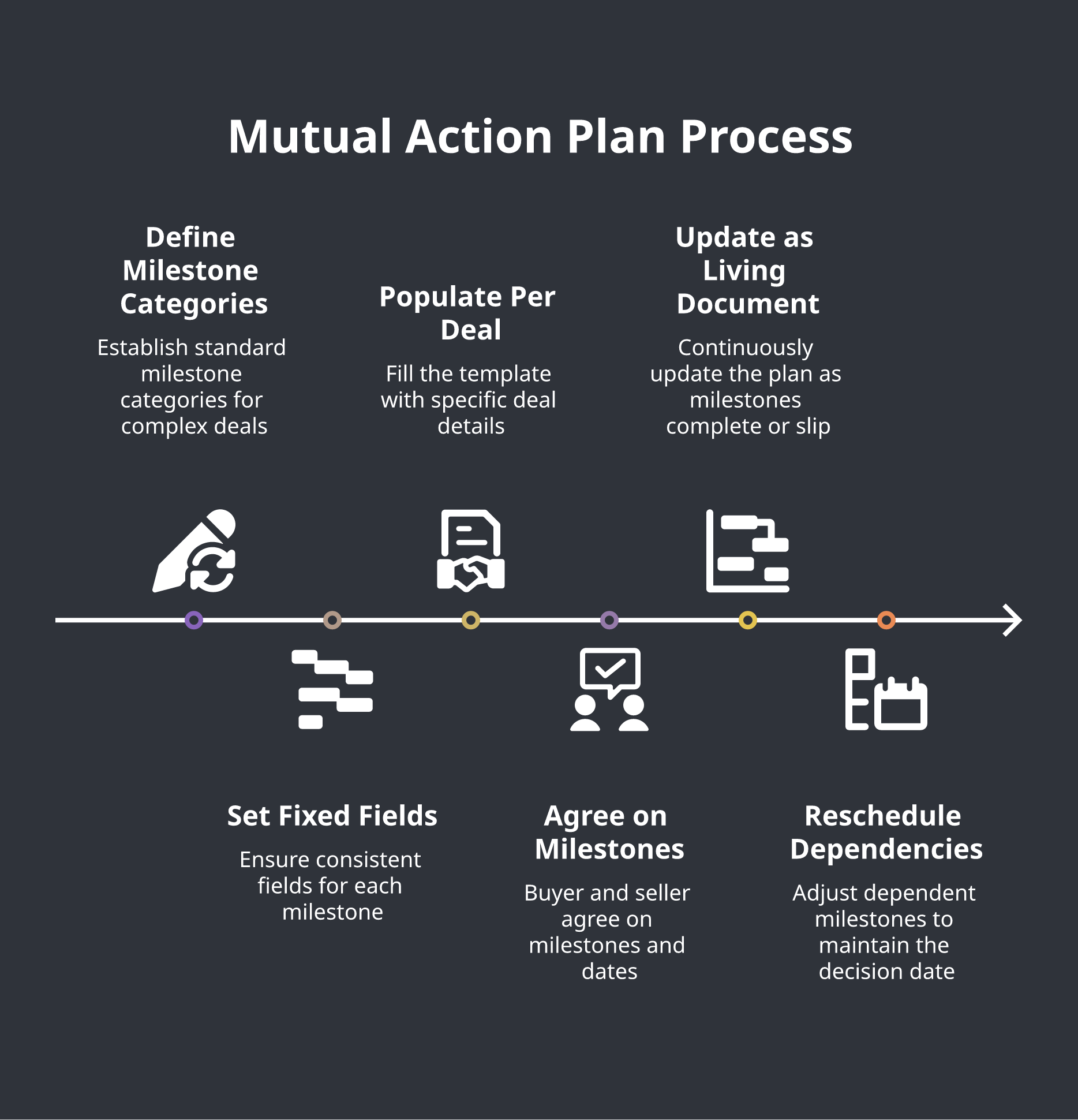
- Fixed milestone categories: The template lists the standard milestone categories a complex deal moves through, evaluation, validation, business case, approvals, signature, onboarding, so no major phase is forgotten.
- Fixed fields per milestone: Each milestone row carries the same fields, owner, side, due date, dependency, and status, so every milestone is specified the same way.
- Populated per deal: The buyer and seller fill the categories and fields with the specific milestones, names, and dates for the deal in front of them, agreeing each as they go.
- Run as a living document: The populated template becomes the shared plan, updated as milestones complete and slip, with dependent rows rescheduled so the decision date stays honest.
The template is working when filling it in reliably produces a plan that maps the buyer’s process with agreed owners and dates, and failing when it is so generic that teams fill it with seller activities and skip the fields that make a plan real.
The fields a mutual action plan template should include
A useful template carries a small, fixed set of fields on every milestone row. The milestone name states what has to happen in plain language. The owner names the person responsible, and a separate side field marks whether that owner is on the buyer, seller, or partner side, which makes it visible at a glance how much of the plan the buyer actually owns. The due date is the agreed date the milestone completes. The dependency field names the milestone, if any, that must finish before this one can start. The status field tracks whether the milestone is not started, in progress, complete, or slipped.
Those fields are deliberately few, because a template with too many fields gets filled in partially or not at all. The five that earn their place, name, owner, side, date, dependency, plus a status, are enough to make the plan a schedule rather than a list, and few enough that a busy rep and a busier buyer will actually keep them current. Resist adding fields that look thorough but go stale, like effort estimates or risk scores, which add maintenance without changing whether the deal moves.
The template should also group milestones by category so the full path is visible. A reader scanning the populated template should see the deal move from evaluation through validation, business case, approvals, and signature, with the buyer-side milestones clearly present in each phase. The categories are prompts that stop a team from filling the plan with only the steps the seller controls.
A worked example of the template filled in
Consider a deal targeting a decision date at the end of a quarter. Filled into the template, the business case milestone names the buyer’s finance lead as owner on the buyer side, due four weeks before the decision, depending on the completed technical validation. The technical validation names the seller’s solutions engineer and the buyer’s IT lead as joint owners, due six weeks out, depending on the demo. The security review names the buyer’s security analyst, due five weeks out, depending on the technical validation. The signature milestone names the buyer’s procurement lead and the seller’s account executive, due on the decision date, depending on legal sign-off.
Read down the filled-in template, the plan tells a clear story: the decision date is anchored, the milestones run backward from it, most of the owners are on the buyer side as they should be, and the dependencies show what moves if any one milestone slips. In a co-sell deal, a partner-side row, an executive sponsor introduction owned by the partner rep and due early, sits among them, scheduling the partner’s contribution rather than leaving it to goodwill. That filled-in structure is what the template exists to produce reliably, on every deal, without the team reinventing the format.
Common pitfalls with a mutual action plan template
- Too generic to be useful: A template that is just a blank table invites teams to fill it with seller activities. Build in milestone categories and a side field so the buyer’s process is prompted for.
- Too many fields: A template with effort estimates, risk scores, and other extras gets filled in partially and goes stale. Keep the fields to the few that make the plan a schedule.
- Filled in by the seller alone: A template completed without the buyer produces a seller’s plan in a tidy format. The owners and dates have to be agreed with the people who hold them.
- Treated as a one-time form: A template populated once and never updated becomes a snapshot. The populated template is a living document, not a form filed at the start of the deal.
- No partner rows in co-sell: A template used in a co-sell deal that has no place for partner-owned milestones loses the partner’s scheduled contribution. Include the side field so partner steps are explicit.
What this looks like in practice
A revenue team had a few strong reps who ran excellent mutual action plans and many who ran none, so plan quality depended entirely on who held the deal. They standardized a template with fixed milestone categories, a side field, and the five core fields, and made filling it in part of how every complex deal was run. Plan quality stopped depending on the individual rep, because the template prompted for the buyer-side milestones and dependencies that the weaker plans had been missing. A new rep’s first plan now included the buyer’s business case and security milestones because the template asked for them. The template did not make anyone a better seller; it carried the discipline of the best sellers into every deal.
Forecastable’s POV on the mutual action plan template
Our position is that a template is only worth using if its structure forces the fields that weak plans omit, namely the buyer’s milestones and the dependencies. A blank grid is not a template; it is permission to keep doing what the team already does, which is map the seller’s activity. The value of a good template is that its categories and its side field make the absence of buyer-owned milestones visible, so a plan that is all seller activity looks obviously incomplete. Design the template to expose the gap, not just to hold the content.
The second conviction is that fewer fields kept current beats more fields gone stale. The temptation with any template is to add fields that look rigorous, but a plan is only useful if it is maintained, and every extra field is a reason it will not be. The few fields that make a plan a schedule, name, owner, side, date, dependency, and a status, are worth keeping current; the rest are worth leaving out. A lean template that the buyer and seller actually update is worth more than a comprehensive one that is filled in once and abandoned.
Forecastable is a partnerships operating platform; any third-party tools or methods referenced here are independent and naming them is not an endorsement of one approach over another. Adapt the template to your own deals, partners, and buying committees.
Frequently asked questions
What is a mutual action plan template?
A reusable structure of fields, milestones, owners, side, dates, dependencies, and status, that a buyer and seller fill in to produce the joint roadmap for a specific deal.
What fields should a mutual action plan template include?
Milestone name, owner, the side that owner is on, due date, dependency, and status. Those few fields make the plan a schedule while staying maintainable.
How is the template different from the plan?
The template is the reusable structure; the plan is the template filled in for a specific deal, with its actual milestones, owners, and dates.
Why include a side field for buyer, seller, or partner?
Because it makes visible at a glance how much of the plan the buyer actually owns, which is the most common gap, and it gives co-sell partner milestones a place in the structure.
How many fields should the template have?
Few. The handful that make the plan a schedule are worth keeping current; extra fields like risk scores tend to go stale and reduce the chance the plan is maintained.
Can the same template be used for co-sell deals?
Yes, as long as it includes a side field so partner-owned milestones can be named and dated alongside the buyer’s and seller’s, scheduling the partner’s contribution.
Next step
If your plan quality depends on which rep holds the deal, a mutual action plan template is how you carry the best practice into every pursuit. Forecastable helps partnerships and revenue teams standardize the joint roadmap so every deal maps the buyer’s process with agreed owners and dates. Start your growth journey now to make the disciplined plan your default. The co-sell hub frames how joint deals progress, and the related mutual action plan explains the practice the template operationalizes.
Uncover Your Growth Potential
Schedule a Discovery Call