Co-Sell Programs: How They Actually Produce

What is a co-sell program?
Short answer: Co-sell programs are the structured systems companies use to run joint selling across many partners at once. They are the layer above an individual co-sell motion, governing partner selection, the operating model, enablement, attribution, and review, so co-sell becomes a predictable revenue source rather than a set of one-off deals.
A program is broader than a motion and broader than a playbook. A motion is how one partnership works deals. A playbook is how one joint deal runs. A program is how a company runs co-sell as a whole: which partners are in, how they are supported, and how the results are measured and improved.
The word program implies management. A company can have ten co-sell partnerships and no program, which means ten motions running at ten different quality levels with no shared standard. A program is what makes co-sell something a company manages rather than something that happens.
This post lays out the co-sell program as five parts, the order they build in, and why a program missing any one of them produces unevenly.
Why co-sell programs matter in 2026
Three forces have made the program, not the partnership, the unit that matters. Ecosystem-led growth has made co-sell a primary pipeline source, so a company now runs co-sell at portfolio scale and needs a program to manage it. Buying committees have grown past seven stakeholders, and consistent program standards are what keep every partnership coordinated. And finance now expects partner revenue forecast with direct-sales rigor, which only a managed program can deliver.
The case for treating co-sell as a program has three layers. At the strategy layer, a program decides which partners are worth co-selling with, so effort goes where revenue is. At the operating layer, a program gives every partnership the same operating model, so quality does not depend on which partner manager runs it. At the financial layer, a program produces consistent attribution and forecasting, which is what lets co-sell be funded and grown.
The reality most teams live is partnerships without a program. Agreements get signed, partner managers each run things their own way, and results vary wildly with no shared explanation. A co-sell program imposes a standard so the variance has a cause a leader can fix.
How a co-sell program actually works
A co-sell program has five parts. They build in order, and each part depends on the one before it.
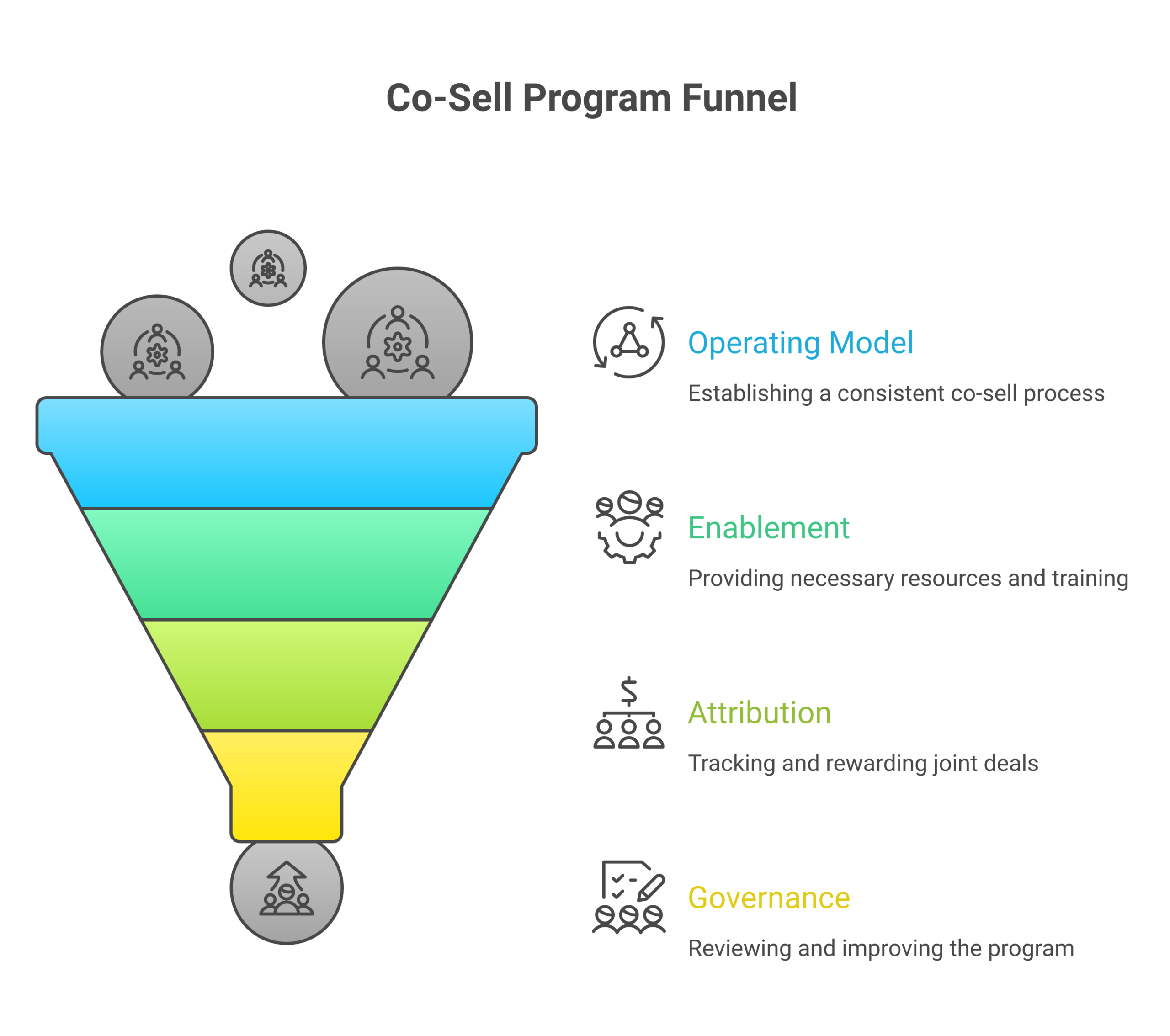
- Partner selection and tiering: The program decides which partners to co-sell with and how much to invest in each. Overlap data and historical results sort partners into tiers, so the program concentrates effort on the partnerships likely to produce.
- The operating model: The program defines the co-sell motion every partnership runs, the account mapping, the deal-review cadence, the joint customer engagement. This part is the engine; it is what makes co-sell happen rather than wait.
- Enablement: The program equips both sides to sell together, with joint messaging, a pursuit playbook, and the training that lets partner sellers position the combined solution. Without enablement the operating model runs on improvisation.
- Attribution and incentives: The program tags joint deals sourced or influenced and aligns incentives so both companies’ sellers are paid to co-sell. This part makes the program measurable and makes the field actually participate.
- Governance and review: The program reviews joint pipeline and partner-tier performance on a fixed cadence, reallocates investment, and improves the operating model. This part keeps the program from drifting.
The closing point is that the five parts are a sequence, not a menu. Partner tiering with no operating model is a ranked list nobody acts on. An operating model with no enablement runs badly. Attribution with no governance produces numbers nobody uses. A co-sell program produces predictably only when all five parts run together.
Common pitfalls
Co-sell programs fail in consistent ways, and every failure is a program part skipped or run weakly.
- No partner tiering: The program treats every partnership equally. Effort spreads thin and the partnerships likely to produce get the same attention as the ones that never will.
- No shared operating model: Each partner manager runs co-sell their own way. Results vary and a leader cannot tell whether a weak partnership is a partner problem or a method problem.
- Skipping enablement: The program assumes sellers know how to co-sell. They do not, and the operating model runs on guesswork.
- Misaligned incentives: The program asks sellers to co-sell but pays them only on solo deals. The field does the math and stops.
- No governance: The program launches and is never reviewed. Tiers go stale, the operating model drifts, and the program quietly decays.
What this looks like in practice
A co-sell program runs on a three-layer stack. Each layer supports specific parts of the program.
A software company builds a co-sell program across twenty partnerships. It tiers the partners using overlap data, putting six in a top tier with weekly support and the rest in a lighter tier. It defines one operating model every partnership runs. It builds joint enablement, one pitch, one pursuit playbook, one training session. It tags every joint deal and adds a co-sell accelerator to seller compensation. It reviews tier performance monthly and reallocates support. A year in, the top tier produces predictably and two lighter-tier partners have earned promotion on results.
The contrast is a company with twenty partnerships and no program. Each partner manager improvises, no two partnerships run the same way, results swing quarter to quarter, and the leader cannot forecast or explain any of it. The partnerships exist; the program does not.
Forecastable’s POV
The most expensive gap in partnerships is the gap between having partners and having a co-sell program. A company can sign twenty partnerships and still have no program, which means twenty unmanaged motions and a revenue line nobody can forecast. A program is not more partnerships; it is management applied to the partnerships you already have.
Across our client base, the part of the program that most separates predictable from unpredictable is partner tiering. Co-sell effort is finite, and a program that spreads it evenly across every partner gets even, mediocre results. A program that concentrates effort on the partnerships overlap data says will produce, and lets partners earn their way up a tier on results, gets a top tier that forecasts cleanly. Tiering is not bureaucracy; it is how a program decides where its scarce attention goes.
The contrarian point is that most companies should run fewer co-sell partnerships, not more. The instinct when co-sell underperforms is to sign more partners. The fix is almost always to run the program properly on fewer. A co-sell program with six well-run partnerships beats one with twenty unmanaged ones, every time.
If your partnerships produce unevenly and you cannot say why, the missing layer is a program. Tier the partners, standardize the operating model, enable both sides, align the incentives, and govern it.
Forecastable is an independent third-party professional services company. Our evaluations of co-sell programs and tooling are based on publicly-available information as of May 2026 and our own client experience.
Frequently asked questions
What is a co-sell program?
The structured system a company uses to run joint selling across many partners. It governs partner selection, the operating model, enablement, attribution, and review.
What is the difference between a co-sell program and a co-sell motion?
A motion is how one partnership works deals. A program is how a company runs co-sell across its whole partner portfolio, with shared standards and management.
What are the parts of a co-sell program?
Five: partner selection and tiering, the operating model, enablement, attribution and incentives, and governance and review.
Which part of a co-sell program matters most?
Partner tiering. Co-sell effort is finite, and concentrating it on the partnerships likely to produce is what makes a program forecastable.
Why do co-sell programs fail?
Most often because there is no shared operating model or because incentives reward solo deals only. Without a standard and aligned pay, the field will not co-sell.
How many partnerships should a co-sell program run?
Fewer than most companies think. A program that runs six partnerships well beats one that runs twenty without management.
Next step
If your partnerships produce unevenly, the missing layer is not more partners. It is a program. Tier the partners you have, standardize one operating model, enable both sides, align incentives, and govern the whole thing on a cadence.
Talk to our team about your co-sell program →
The co-sell hub holds the broader operating context, and the co-sell playbook write-up covers the deal structure the program standardize
Uncover Your Growth Potential
Schedule a Discovery Call