Co-Sell Metrics: Leading and Lagging Signals

What are co-sell metrics?
Short answer: Co-sell metrics are the full set of measurements that show whether a joint selling motion is healthy, spanning leading signals that predict outcomes and lagging signals that confirm them. They are the instrument panel for a co-sell program, the layer beneath the headline scorecard.
Co-sell metrics and co-sell KPIs are often used interchangeably, and that conflation causes real damage. KPIs are the four or five headline numbers a leader commits to. Metrics are the wider system that explains those numbers. A leader reports KPIs; a leader diagnoses with metrics.
The distinction is the difference between knowing the program missed and knowing why. Partner-sourced pipeline came in low: that is a KPI telling you the outcome. Cadence adherence dropped, overlap data went stale, and first-deal-review time slipped: those are metrics telling you the cause.
This post covers the full measurement system, how leading and lagging metrics divide the work, and how to wire the instrumentation so the metrics are trustworthy rather than decorative.
Why co-sell metrics matter in 2026
Three forces have made a real metrics system worth building. Co-sell is now a primary pipeline source, so a program that can only see lagging outcomes is flying a quarter behind. Co-sell programs have grown to manage more partners each, so a leader cannot diagnose by gut and needs instrumentation. And finance scrutiny means the program must not only report results but explain them, which requires metrics, not just KPIs.
The case for a layered metrics system has three layers of its own. At the strategy layer, leading metrics give a program the chance to correct a motion before the quarter is lost, which a lagging-only view never allows. At the operating layer, metrics tell a co-sell alignment specialist exactly which partnership is drifting and why, so attention goes where it pays. At the financial layer, a program that can explain a miss with a clear causal metric keeps credibility with finance; a program that can only report the miss loses it.
The reality most programs live is a metrics setup that is all lagging and all late. They see sourced pipeline and closed revenue, both of which arrive after the period they describe. By the time the number is bad, the quarter that produced it is over.
How co-sell metrics actually work
A working co-sell metrics system splits into leading and lagging signals, with attribution as the spine that connects them. Five components carry the system.
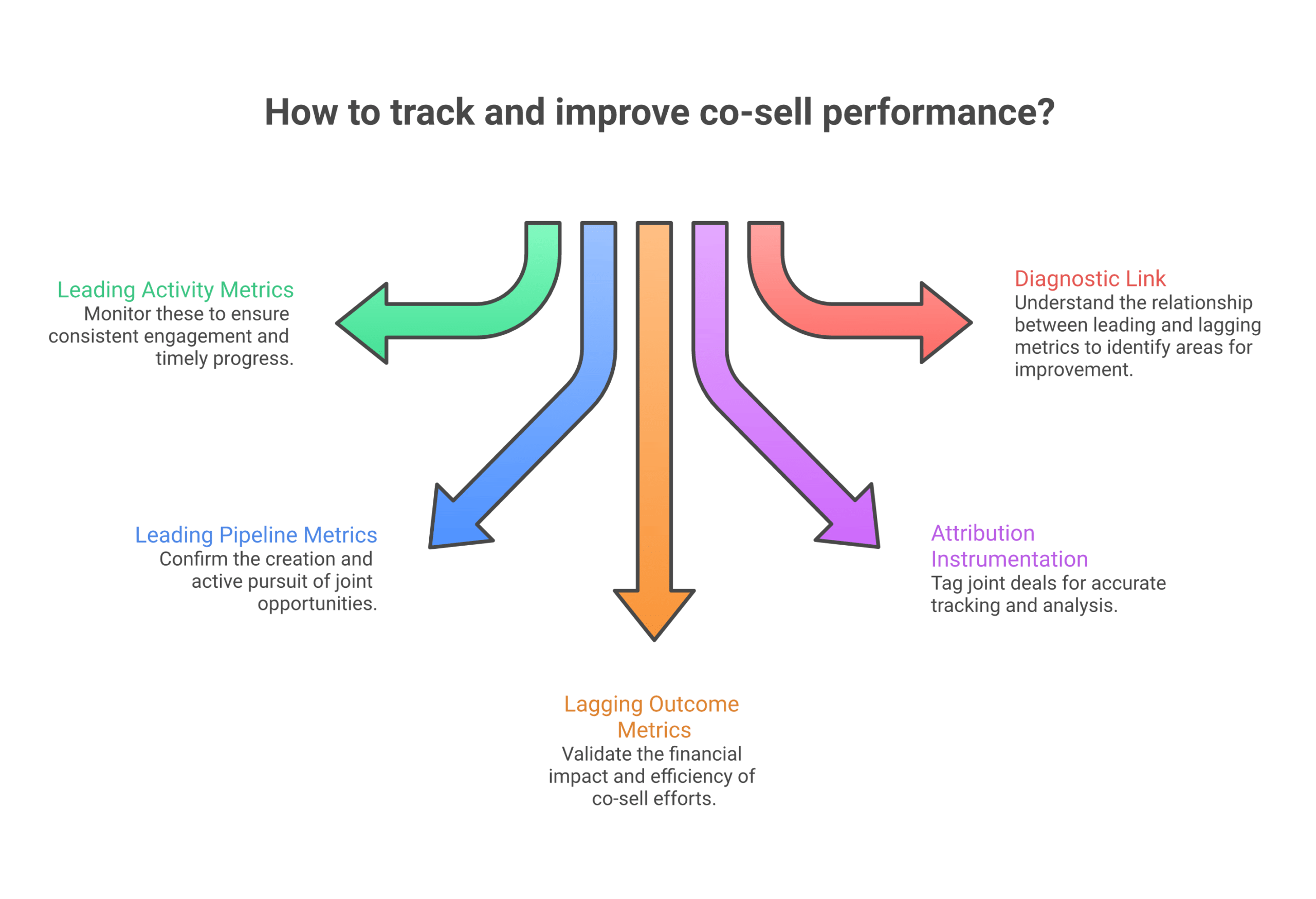
- Leading activity metrics: Cadence adherence, deal-review attendance, first-deal-review time after signature, and overlap-data freshness. These move first and predict whether the motion will produce. A drop here shows up in pipeline two months later.
- Leading pipeline metrics: Joint opportunities created, overlap accounts moved to active pursuit, and partner-engaged accounts. These confirm the activity is turning into deals while there is still time to act.
- Lagging outcome metrics: Partner-sourced pipeline value, partner-influenced revenue, co-sell win rate, and joint-deal cycle time. These confirm the result and feed the KPI scorecard.
- Attribution instrumentation: The CRM fields, deal-registration data, and marketplace records that tag every joint deal as sourced or influenced. Without clean attribution, every other metric is an estimate.
- The diagnostic link: The defined relationships between leading and lagging metrics, so when a lagging number misses, the program can trace it to a specific leading metric. A metrics system with no diagnostic link is just two disconnected reports.
The closing point is that the value of the system is the diagnostic link. Leading metrics without lagging ones cannot prove the program produces revenue. Lagging metrics without leading ones cannot be corrected in time. The link between them, the explicit statement that cadence adherence predicts sourced pipeline, is what makes the system a management tool rather than a dashboard.
Common pitfalls
Co-sell metrics systems fail in consistent ways, and most failures are structural rather than a matter of effort.
- Lagging-only measurement: The program tracks sourced pipeline and revenue and nothing that precedes them. Every problem is visible only after the quarter that caused it has closed.
- Leading metrics with no link to outcomes: Activity is tracked but never tied to whether it produced pipeline. The program measures motion and cannot tell if the motion matters.
- Broken attribution: Joint deals close untagged or tagged inconsistently. Every downstream metric is then an estimate nobody fully trusts.
- Dashboard sprawl: Forty metrics on a screen nobody reads. A metrics system that is not curated becomes wallpaper.
- Vanity disguised as a metric: Total partner emails sent, portal logins, asset downloads. They are measurable and meaningless, and they crowd out the metrics that predict revenue.
What this looks like in practice
Co-sell metrics are produced across the standard stack. The instrumentation matters more than the dashboard; a clean attribution layer is what makes every metric trustworthy.
of the diagnostic link in use. A co-sell program reports a lagging metric miss: partner-sourced pipeline is 30% below target for the quarter. With a leading-and-lagging system wired, the alignment specialist traces it. Cadence adherence had dropped from 85% to 50% in weeks four through eight, first-deal-review time had slipped from ten days to over a month on the newest partnerships, and overlap data had not been refreshed in six weeks. The miss is explained, the cause is specific, and the fix is operational: reinstate the cadence and refresh the data.
The contrast is a program with lagging-only metrics. It reports the same 30% miss and has nothing to say about why. The conversation with finance becomes a guess, and the fix is a guess too.
Forecastable’s POV
The core mistake in co-sell measurement is building the system from the outcomes backward and stopping there. Sourced pipeline and revenue are the numbers everyone wants, so those are the numbers programs instrument first and often only. The problem is that both are lagging. A program that can only see lagging metrics is permanently a quarter late, reacting to misses it could not see coming.
Across our client base, the programs that run well instrument the leading metrics with as much care as the lagging ones, and they make the diagnostic link explicit. They can say, on the record, that cadence adherence below 70% predicts a sourced-pipeline miss two months out. That single stated relationship turns a dashboard into a steering wheel. The programs that struggle have plenty of metrics and no link between them, so they can describe their situation but never get ahead of it.
The contrarian point is that the most valuable co-sell metric is the least glamorous one: cadence adherence. It is a simple attendance number, it sounds administrative, and it is the earliest reliable predictor of whether the program will produce. A program that watches cadence adherence weekly knows its next quarter before the quarter starts. A program that watches only revenue learns its quarter after it ends.
If you are building co-sell metrics, instrument the leading signals first, fix attribution before anything else, and write down the diagnostic links between leading and lagging numbers.
Forecastable is an independent third-party professional services company. Our evaluations of co-sell measurement and tooling are based on publicly-available information as of May 2026 and our own client experience.
Frequently asked questions
What is the difference between co-sell metrics and co-sell KPIs?
KPIs are the four or five headline numbers a leader commits to. Metrics are the full measurement system that explains those numbers, including the leading signals KPIs usually leave out.
What are leading co-sell metrics?
Signals that move before outcomes: cadence adherence, deal-review attendance, first-deal-review time, overlap-data freshness, and joint opportunities created. They predict the lagging results.
What are lagging co-sell metrics?
Signals that confirm outcomes after the fact: partner-sourced pipeline, partner-influenced revenue, co-sell win rate, and joint-deal cycle time.
Which co-sell metric predicts results earliest?
Cadence adherence. A drop in deal-review attendance shows up in sourced pipeline roughly two months later, so it is the earliest reliable warning.
Why is attribution called the spine of the system?
Because every pipeline and revenue metric depends on joint deals being tagged correctly. Broken attribution turns every downstream metric into an estimate.
How many co-sell metrics should a program track?
Enough to cover leading activity, leading pipeline, and lagging outcomes, roughly ten to fifteen, curated. Sprawl past that and the system becomes wallpaper.
Next step
If your co-sell measurement is all lagging, you are managing a quarter behind. Instrument the leading signals, fix attribution first, and write down which leading metric predicts which outcome so a miss can always be diagnosed.
Talk to our team about your co-sell measurement →
The co-sell hub holds the broader operating context, and the co-sell KPIs write-up covers the headline scorecard this metrics system feeds.
Uncover Your Growth Potential
Schedule a Discovery Call