Mutual Close Plan: What It Is and How to Run One

What is a mutual close plan?
Short answer: A mutual close plan is the dated sequence of steps to signature that the buyer and the seller agree and own together, rather than a plan the seller writes alone, naming each step, its owner on either side, and its due date. The word mutual is the point: both parties commit to the steps, so the plan is a shared agreement about how the deal closes, not a seller’s prediction of it.
In a co-sell deal the mutual close plan often spans three sides, the vendor, the partner co-selling the deal, and the buyer, because the steps to signature involve all of them. That makes the mutual agreement even more important, since a step owned by the wrong party is a step that quietly stalls.
Why a mutual close plan matters in 2026
A mutual close plan matters because the steps that slip deals live mostly inside the buyer’s organization, and a plan the seller owns alone has no purchase on them. When procurement, security, or budget approval stalls, a one-sided plan can only watch; a mutual plan has a buyer-side owner already committed to moving it. The mutuality is what converts a list of steps into accountability.
In 2026 it matters more because deals increasingly involve partners as well as buyers, so the number of parties whose steps have to align has grown. A co-sell deal where the vendor, the partner, and the buyer each track a private version of the closing steps produces three timelines that only reconcile at the end. A mutual close plan gives all sides one dated sequence to work from.
There is also a forecasting argument. A forecasted close date is only as good as the steps behind it, and a mutual close plan is the strongest version of those steps because the people who own them have agreed to them. When the buyer and partner have committed to the dates, the forecast rests on commitments rather than on the seller’s optimism.
How a mutual close plan actually works
A mutual close plan is built by agreeing the target date across all parties, mapping the steps backward, and assigning a committed owner to each, then run as a shared surface every side updates. The mutuality has to be real at each step, not just on the cover page.
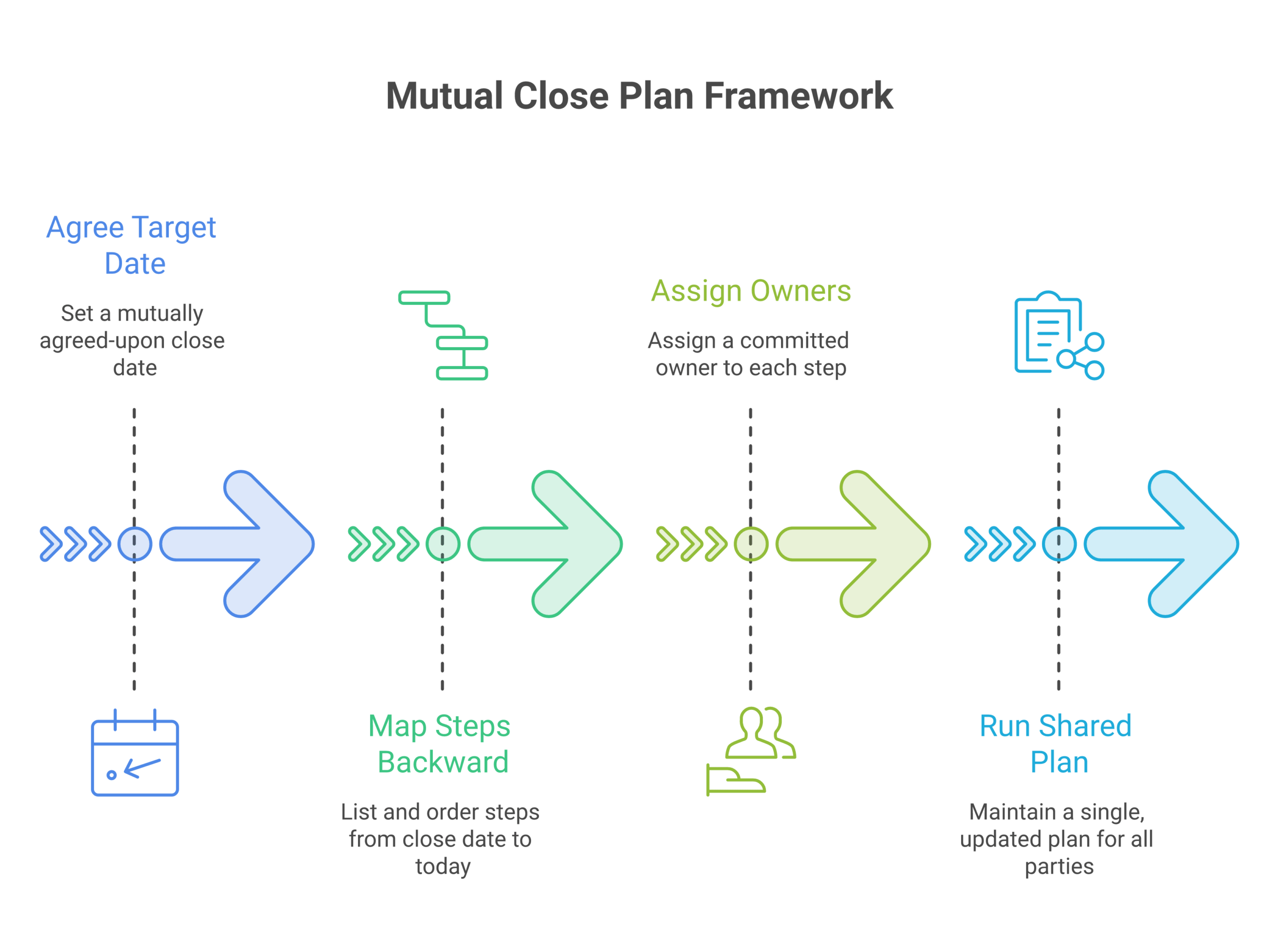
- Agree the target date across all parties: Set the close date with the buyer and, in a co-sell deal, the partner, so every side is scheduling against a date all of them believe and will work toward.
- Map the steps backward together: List every step to signature, technical validation, security, legal, budget, procurement, partner-side approvals, and order them from the close date back to today with all parties in the room.
- Assign a committed owner to each step: Give every step a named owner on the side that actually controls it, buyer, seller, or partner, with a due date, so each step has someone who has agreed to move it.
- Run one shared plan to signature: Keep a single version all sides see and update, reschedule dependent steps when one slips, and review the plan in the joint deal cadence so the close date stays honest.
A mutual close plan is working when all parties track the same dated steps and a slip in one visibly moves the others, and failing when each side keeps a private version and the plan is mutual in name only.
Making the plan genuinely mutual
The difference between a mutual close plan and an ordinary one is whether the buyer, and in co-sell the partner, actually own their steps rather than having them assigned to them. A plan where the seller fills in everyone’s steps and dates is a seller’s plan with other names attached; it predicts what those parties will do rather than capturing what they have committed to. Genuine mutuality means each party agreed to its steps and dates in the conversation, not after the fact.
The practical test is whether a buyer-side owner can describe their step without prompting. If the buyer’s procurement lead knows the deal needs a signed order by a date and has agreed to start the paperwork by an earlier date, the plan is mutual at that step. If only the seller knows that, the step is in the plan but not owned, and an unowned step is the one that slips. Making the plan mutual is mostly the work of getting each owner to say the date out loud and agree to it.
In co-sell, the partner is a third owner whose steps are easy to leave implicit. The partner rep may control a relationship-level step, an introduction, an executive sponsor, a reference, that the buyer-side approvals depend on. A mutual close plan names those partner steps explicitly and gives them dates, so the partner’s contribution is scheduled rather than assumed.
Where the mutual close plan fits in a co-sell deal
In a co-sell motion the mutual close plan sits inside the broader joint pursuit and focuses specifically on the path to signature. The vendor and partner may run a wider joint plan covering positioning, the joint value proposition, and account strategy; the mutual close plan is the closing segment of that work, the dated steps that turn an agreed deal into a signed one. Keeping it distinct keeps it sharp, because a closing plan diluted with strategy stops being a checklist anyone runs.
The mutual close plan also clarifies who carries which closing step between the vendor and partner. In many co-sell deals the partner has the stronger relationship and the vendor has the contract, so the buyer-facing closing steps and the paperwork steps live on different sides. Mapping them mutually prevents the common failure where both sides assume the other is driving a step and neither is, which surfaces as a stall nobody owns.
Common pitfalls with a mutual close plan
- Mutual in name only: A plan where the seller fills in every party’s steps is not mutual; it is a seller’s plan with names attached. Each owner has to agree their own steps and dates.
- Leaving the partner’s steps implicit: In co-sell, the partner often controls relationship steps the buyer-side approvals depend on. A plan that does not name those steps assumes work that may not happen.
- Three private versions: When the vendor, partner, and buyer each keep their own copy, the plan stops being mutual and the timelines drift apart. One shared version is the point.
- Diluting the closing plan with strategy: A mutual close plan crowded with positioning and account strategy stops being a runnable checklist. Keep it to the dated steps to signature.
- No buyer owner on buyer steps: Procurement, security, and budget steps that have no committed buyer-side owner are the steps that slip. Every buyer step needs a buyer who has agreed to it.
What this looks like in practice
A vendor and a co-selling partner were both forecasting a deal to close in the quarter, but each was tracking the closing steps separately. The partner assumed the vendor was driving procurement; the vendor assumed the partner’s executive sponsor would unblock budget. Neither step moved, and the deal slipped. On the next joint deal they built a mutual close plan in one room: target date agreed by buyer, vendor, and partner; every step mapped backward; an owner committed on the side that actually controlled each step, including the partner’s executive sponsor introduction with a date. The steps moved because each had an owner who had agreed to it, and the deal closed on the forecast. The pursuit had not been harder; the closing steps had simply never been mutual before.
Forecastable’s POV on the mutual close plan
Our position is that mutuality is the entire value, and most close plans labeled mutual are not. The reason to make a close plan mutual is that the steps which slip deals are owned by parties other than the seller, the buyer’s procurement, the partner’s sponsor, and a plan only has purchase on those steps if their owners have agreed to them. A plan where the seller fills in everyone’s dates is a prediction wearing the word mutual; it captures what the seller hopes the buyer and partner will do, which is exactly the information a close plan is supposed to replace.
The second conviction is that in co-sell the partner is a first-class owner, not a bystander to the buyer-seller plan. Partners frequently control the relationship steps the formal approvals depend on, so a mutual close plan that maps only buyer and seller steps leaves out the party that can unblock the others. Naming the partner’s steps and dating them is what turns a co-sell relationship into closing leverage rather than a warm introduction that fades once the paperwork starts.
The third conviction is that the mutual close plan is where a co-sell forecast becomes credible. A joint pipeline number is only as reliable as the closing steps behind each deal, and those steps are strongest when the buyer and partner have committed to them. When the mutual close plan is real, the forecasted close date rests on agreements from the people who control the steps, which is the difference between a co-sell forecast finance will commit to and one it discounts.
Forecastable is a partnerships operating platform; any third-party tools or methods referenced here are independent and naming them is not an endorsement of one approach over another. Build the mutual close plan around your own deal, partner, and buying committee.
Frequently asked questions
What is a mutual close plan?
The dated steps to signature that the buyer and seller, and in co-sell the partner, agree and own together, with a committed owner and due date on each step, rather than a plan the seller writes alone.
How is a mutual close plan different from a close plan?
A close plan can be one-sided; a mutual close plan requires that each party own and agree its own steps and dates, which is what gives the plan purchase on the steps the seller does not control.
Where does the partner fit in a co-sell mutual close plan?
As a third owner. The partner often controls relationship steps the buyer-side approvals depend on, so those steps are named and dated explicitly rather than assumed.
What makes a close plan genuinely mutual?
Each owner agreeing their own steps and dates in the conversation. The test is whether a buyer-side or partner-side owner can describe their step and its date without prompting.
How does a mutual close plan help the forecast?
It grounds the forecasted close date in commitments from the people who control the closing steps, so the date rests on agreements rather than on the seller’s optimism.
What is the most common failure in a mutual close plan?
Being mutual in name only, where the seller fills in every party’s steps and dates, so the unowned steps, usually the buyer’s approvals, slip exactly as they would without a plan.
Next step
If your co-sell deals slip because the closing steps were never truly shared, a mutual close plan is how all sides commit to one dated path to signature. Forecastable helps partnerships and revenue teams keep the joint steps to signature visible and owned, so co-sell forecasts rest on commitments. Start your growth journey now to make your joint close dates defensible. The co-sell hub frames how joint deals reach signature, and the related mutual action plan covers the broader joint roadmap a close plan sits inside.
Uncover Your Growth Potential
Schedule a Discovery Call