Close Plan: What It Is and How to Build One

What is a close plan?
Short answer: A close plan is the dated, step-by-step sequence that a seller and a buyer agree to follow to get from the current stage of a deal to a signed contract, naming each step, who owns it, and when it is due. It replaces the vague hope that a deal will close this quarter with an explicit map of what has to happen first.
The point is reverse engineering the signature. Instead of forecasting a close date and hoping, a close plan starts from the target date and works backward through every step, approval, security review, legal redline, budget sign-off, that has to clear before then.
Why a close plan matters in 2026
A close plan matters because deals stall in the steps nobody mapped, and an unmapped step is a slip waiting to happen. When a security review or a procurement approval surfaces in the last week of the quarter, it was always going to be required; the close plan is what would have surfaced it in week one while there was still time to work it.
In 2026 it matters more because buying committees are larger and approval chains are longer, so the number of steps between verbal agreement and signature has grown. A deal with five approvers and no close plan does not have a forecast; it has a guess. The plan is what makes the forecasted close date defensible.
How a close plan actually works
A close plan is built by working backward from the target close date and then run forward as a shared checklist, where each step has an owner and a date. The plan is the artifact; the discipline is keeping it current as the deal moves.
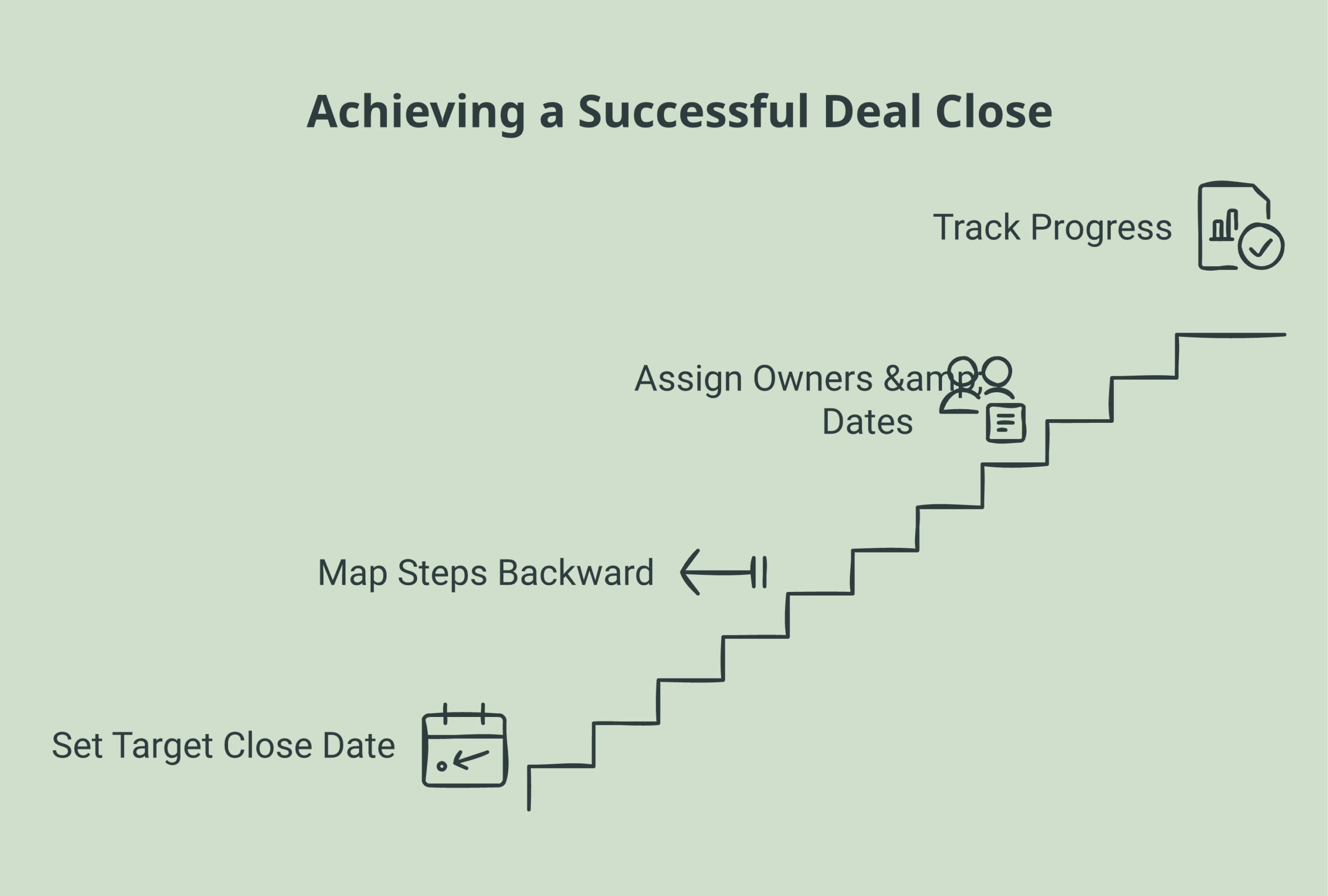
- Set the target close date: Anchor the plan on the date the deal needs to close, agreed with the buyer rather than imposed, so every step is scheduled against a real deadline.
- Map the steps backward: List every step that has to clear before signature, technical validation, security review, legal, budget approval, procurement, and order them from the close date back to today.
- Assign an owner and a date to each step: Give every step a named owner on both sides and a due date, so the plan shows who is doing what by when rather than a list of things that should happen.
- Track each step to signature: Update the plan as steps complete or slip, and when one slips, reschedule the dependent steps so the close date stays honest rather than quietly drifting.
A close plan is working when both the seller and the buyer can see the same steps and dates and a slip in one step visibly moves the others, and failing when it is a document built once and never opened again.
Common pitfalls with a close plan
- Building it without the buyer: A close plan the seller writes alone is a wish list. The steps and dates have to be agreed with the buyer, because the buyer owns most of the internal approvals.
- Listing tasks without owners and dates: A plan that says what has to happen but not who does it or by when is not a plan, it is a reminder. Every step needs a named owner and a due date.
- Never updating it: A close plan built at one stage and never revisited drifts immediately. The value is in keeping it current as steps complete and slip.
- Mapping only the seller’s steps: Most of what stalls a deal happens inside the buyer’s organization. A plan that maps the seller’s actions but not the buyer’s approvals misses where deals actually slip.
What this looks like in practice
A rep had a deal forecast to close by quarter end on verbal agreement from the champion. With three weeks left, a security review nobody had scheduled surfaced and pushed the signature into the next quarter. On the next deal the rep built a close plan with the buyer in the first week: target date, every approval mapped backward, an owner and date on each. The security review showed up on the plan in week one, got scheduled immediately, and cleared in time. The deal closed on the forecast date. Nothing about the second deal was easier; the plan surfaced the slow step early enough to work it.
Forecastable’s POV on close plans
Our position is that a close plan is only real if the buyer owns half of it. The steps that slip deals, security, legal, procurement, budget, almost all live inside the buyer’s organization, so a plan the seller fills in alone maps the wrong half of the deal. The discipline that makes a close plan work is getting the buyer to agree the steps and dates, because that agreement is both a map and a commitment.
The second conviction is that the close plan is where forecasting and selling meet. A forecasted close date with no close plan behind it is a guess dressed as a commitment, and the plan is what makes the date defensible to a manager or a finance team. When a deal is on the forecast, the close plan is the evidence that the date is grounded in steps rather than optimism.
Forecastable is a partnerships operating platform; any third-party tools or methods referenced here are independent and naming them is not an endorsement of one approach over another. Build the close plan around your own deal, buying committee, and timeline.
Frequently asked questions
What is a close plan?
The dated, step-by-step sequence a seller and buyer agree to follow to get from the current stage of a deal to signature, naming each step, its owner, and its due date.
What goes in a close plan?
A target close date, every step that has to clear before signature, an owner on both sides for each step, and a due date, kept current as the deal moves.
Who should build the close plan?
The seller and the buyer together. The buyer owns most of the internal approvals, so a plan built without them maps only half the deal.
When should you build a close plan?
As early as the deal is real, ideally when there is genuine buying intent, so slow steps like security and procurement surface while there is still time to work them.
What is the difference between a close plan and a sales forecast?
A forecast states when a deal will close; a close plan shows the steps that have to happen for that date to hold. The plan is the evidence behind the forecasted date.
Next step
If your deals slip in the steps nobody mapped, a close plan is how you surface them early enough to act. Forecastable helps revenue and partnerships teams keep the steps to signature visible, so forecasted close dates are grounded in a plan rather than optimism. Start your growth journey now to make your close dates defensible. The co-sell hub frames how joint deals reach signature, and the related what is a close plan walks through the definition in more depth
Uncover Your Growth Potential
Schedule a Discovery Call