AI Outbound Sales: What Works and What Just Scales

Short answer
Short answer: AI outbound sales is the use of machine learning to research accounts, draft and personalize messages, sequence outreach, and prioritize who to contact in a seller-initiated motion. It makes the cost of volume collapse, and volume was never the thing holding most outbound back, so the gains are real but narrower than the hype suggests.
Here is the position. AI compresses the cost of doing outbound, not the cost of being relevant, and a cold motion run faster is still a cold motion. The teams that win with AI use it to earn back time for the parts that cannot be automated.
What is AI outbound sales?
AI outbound sales is outbound prospecting where models do the heavy, repeatable parts of the work. In practice that means a handful of jobs: researching an account and summarizing why it might buy, drafting a first message tuned to a persona, generating sequence variants, detecting buying signals in public data, and scoring which accounts to work first.
None of this changes what outbound is. It is still a seller reaching a buyer who did not ask to be reached. AI changes the unit economics of that motion by making research and drafting nearly free. What it does not change is whether the message is relevant, whether the timing is right, or whether the seller has any reason to be trusted.
Why AI outbound sales matters in 2026
AI outbound sales matters because it reset the cost curve of cold outreach and, in doing so, flooded every inbox faster. When drafting a personalized-looking email costs nothing, everyone sends more, response rates fall, and the advantage of raw volume disappears within a quarter of everyone having the same tools.
The real shift in 2026 is that AI raised the floor and lowered the ceiling at once. The floor rose because bad, untargeted outbound now looks superficially personalized. The ceiling lowered because the things that used to make outbound work, genuine relevance and a reason to trust the sender, are exactly the things AI cannot fake at scale. Buyers adapted. They now pattern-match AI-generated outreach and delete it faster than they ever deleted a human template.
In my work with revenue teams, the pattern is consistent: AI pays off when it gives a rep back the hours to do real research and warm introductions, and it backfires when it is used to send more cold volume into a channel that was already saturated.
How AI outbound sales actually works
AI outbound sales works as a stack of jobs, where the automatable layers should fund the human ones, not replace them.
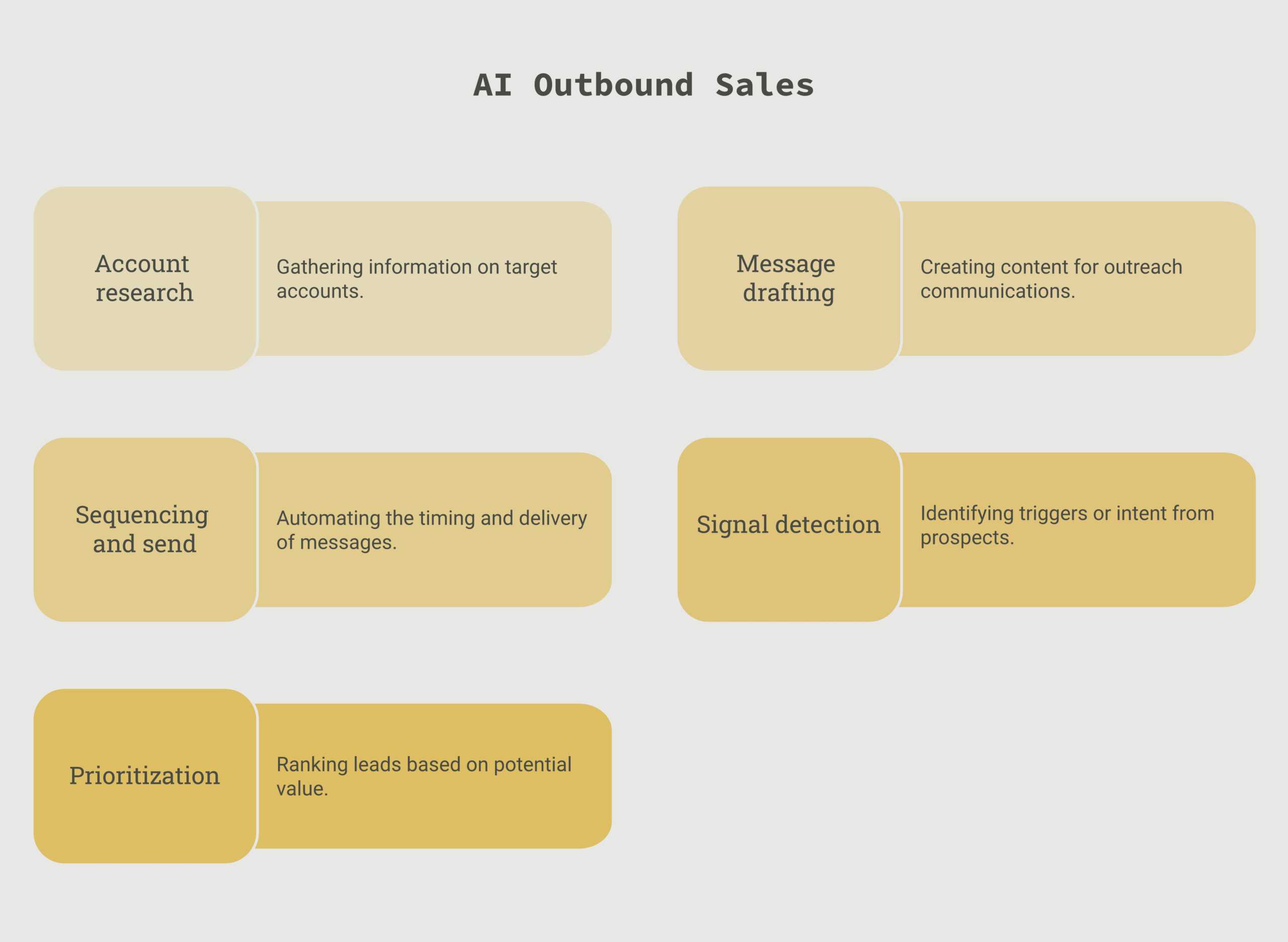
- Account research: let models gather and summarize public signals about an account, because this is genuinely tedious work where AI saves hours and makes almost no judgment errors that matter.
- Message drafting: use AI for a first draft tuned to persona and context, then have a human rewrite the opening and the ask, since the parts a buyer actually reads are the parts AI makes generic.
- Sequencing and send: automate the mechanics of cadence and follow-up, where consistency beats creativity, so no lead goes cold because a rep forgot a step.
- Signal detection: have models watch for triggers like funding, hiring, or tooling changes, because timing is a large share of why outbound lands, and AI reads signals at a scale no rep can.
- Prioritization: score accounts by fit and intent so reps spend their scarce human hours on the accounts most likely to convert, instead of working an alphabetical list.
The through-line is that AI should buy back time, and that time should go into the two things it cannot do: genuine relevance and warm access. A team that pockets the time savings as more cold volume has used the technology to make its worst channel bigger.
Common pitfalls
- Scaling volume, not relevance: using AI to send more cold messages, which accelerates inbox fatigue and trains buyers to ignore you faster.
- Shipping the first draft: sending AI-generated openers and asks unedited, so every message carries the same detectable cadence and the buyer pattern-matches it to spam.
- Automating a broken motion: layering AI onto outbound that was not working, which just produces bad outbound at a lower cost per send.
- Trusting the fit score blindly: treating an AI account score as truth rather than a prior, so reps stop applying the judgment the score was meant to support.
- Ignoring the warm alternative: investing in AI to make cold outreach cheaper while leaving partner introductions, the warmest access you have, completely un-instrumented.
What this looks like in practice
A team adopts AI across its outbound motion and measures the result honestly. Research time per account drops from twenty minutes to two, which is a real gain. Send volume doubles, which feels like a win until reply rate halves and cost per qualified meeting barely moves, because the extra sends were cold and generic. Then the team changes how it spends the reclaimed time. Reps use the saved research hours to map which of their target accounts already have a relationship with an existing partner, and route those through a warm introduction instead of a cold sequence. The AI did its best work not by sending more, but by freeing the time to find the warm path in.
That is the difference between using AI to scale a cold motion and using it to fund a warmer one. The tool was the same; where the saved time went decided the outcome.
Forecastable’s POV
AI is the best thing to happen to the boring half of outbound and a trap for the important half. It should eliminate the research grind and the cadence-management overhead, and it should never be the thing writing the sentence a buyer decides on. Used well, it is a time machine that gives reps back the hours cold outreach used to eat.
Where I watch teams go wrong is spending those hours on more cold volume. The highest-return use of reclaimed time is finding the warm path that no model can manufacture: the account where a current partner already has trust and can make an introduction. At Forecastable we are a partnerships operating platform that connects partner conversations and actions to CRM pipeline and revenue, so the warm paths hiding in your partners’ relationships become visible and measurable, and a partner-sourced meeting is tracked in the same system as the rest of the motion. I will not pitch an AI agent that is not generally available; the point here is simpler. Point the time AI saves at warm access, not colder volume.
My bet: the teams that treat AI as a way to afford warm outbound, not scale cold outbound, are the ones whose reply rates stop falling.
Forecastable is an independent third-party. Any tools, vendors, or third-party figures referenced here are described from public information for the reader’s own evaluation, not as paid placements.
Frequently asked questions
What is AI outbound sales? It is outbound prospecting where models handle the repeatable work: researching accounts, drafting and personalizing messages, managing sequences, detecting buying signals, and scoring which accounts to work first. It changes the cost of outbound, not the nature of it.
Does AI make outbound more effective? It makes outbound cheaper and faster, which is not the same as more effective. AI improves research and timing genuinely, but if the saved time goes into more cold volume, reply rates fall and effectiveness drops.
What parts of outbound should AI handle? The tedious, repeatable layers: account research, cadence mechanics, signal detection, and prioritization. The parts a buyer actually reads, the opening line and the ask, still need a human rewrite.
Why are AI-generated emails getting ignored? Because buyers learned to recognize the cadence and phrasing that models default to. When everyone sends superficially personalized AI outreach, it reads as spam and gets deleted faster than a human template would.
Is AI outbound better than warm introductions? No. AI can make cold outreach cheaper, but a warm introduction carries trust that no model can manufacture. The best use of AI is often to free the time to find and work those warm paths.
How should I measure AI outbound sales? With the same outcome metrics as any outbound: cost per qualified meeting and win rate by source. If AI only moved activity and reply volume without improving those, it scaled effort rather than results.
Next step
Before you buy more AI to send more, measure what your current outbound costs per qualified meeting and what a warm introduction costs instead. Then decide where the reclaimed time should go.
If the warm path runs through your partners, that is what we make visible. Start your growth journey with Forecastable and we will surface the partner relationships hiding in your target accounts. Our B2B outbound sales guide covers the core motion, and the partner-sourced pipeline guide covers the warm channel AI cannot replace.
Uncover Your Growth Potential
Schedule a Discovery Call