Sales Funnel vs Pipeline: What Is the Difference

Short answer
Short answer: Sales funnel vs pipeline is best understood as two models of the same revenue motion, where the funnel measures how a wide pool of interest narrows toward a buyer and the pipeline measures how a named deal moves toward a close. They are not rivals, and treating them as one thing is how teams end up with a forecast nobody trusts.
Here is the position. The funnel is a volume model owned by marketing and demand gen; the pipeline is a deal model owned by sales. The handoff between them is where most revenue leaks, and neither model shows the leak on its own.
What is a sales funnel?
A sales funnel describes the stages a large audience passes through as interest narrows: awareness, interest, consideration, intent, and the point where a contact becomes a qualified lead. It is a volume and conversion model. You pour many at the top, a fraction convert at each stage, and a smaller number reach the bottom.
The funnel answers demand questions. How much interest did we generate, where does it drop off, and what does it cost to move a cohort from one stage to the next. It is measured in rates and volumes across anonymous and semi-anonymous contacts, not in named deals with close dates.
What is a sales pipeline?
A sales pipeline describes the stages a specific opportunity moves through after a lead becomes a deal: qualification, discovery, proposal, negotiation, and closed won or lost. It is a deal-management model. Every item in it is a named account with an owner, a value, and an expected close date.
The pipeline answers forecast questions. How much is in play, how likely is each deal to close, how fast is it moving, and will the quarter land. It is measured in coverage, stage conversion, velocity, and win rate, deal by deal, not cohort by cohort.
Why sales funnel vs pipeline matters in 2026
The distinction between sales funnel vs pipeline matters because the two models are owned by different teams and reconciled by almost no one. Marketing optimizes the funnel, sales manages the pipeline, and the join between them, the point where a lead becomes a deal, is where definitions diverge and numbers stop adding up.
In 2026 the stakes rose because go-to-market motions multiplied. Product-led signups, outbound, inbound, and partner-sourced deals each enter the funnel and the pipeline at different points, and some skip stages entirely. A partner-sourced deal often arrives already qualified, entering mid-pipeline without ever passing through the top of the funnel. Report the two models without reconciling them and you double-count some deals and lose others at the seam.
How sales funnel vs pipeline actually works together
The funnel and the pipeline work as a single chain, where the funnel feeds the pipeline and the pipeline validates the funnel.
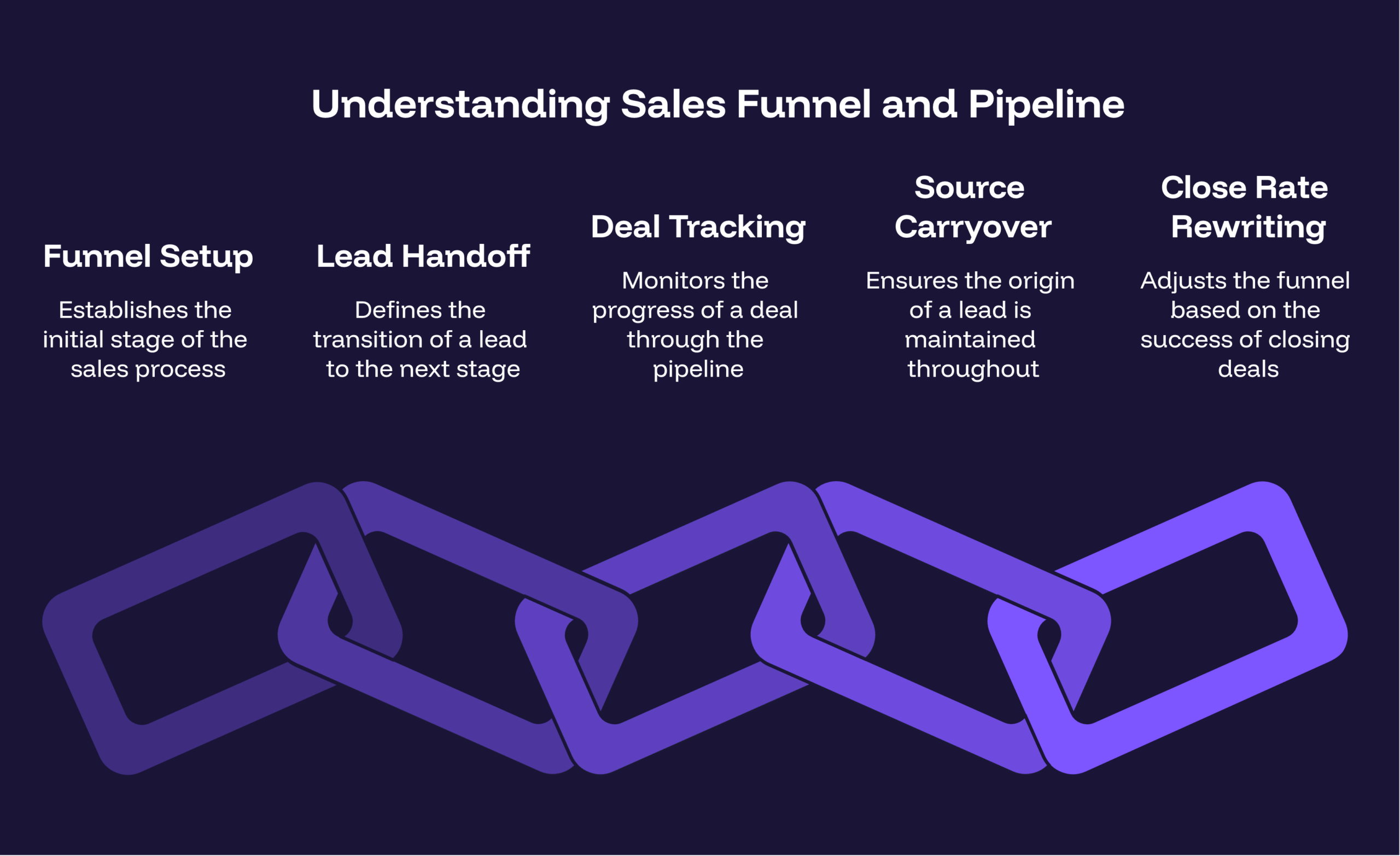
- The funnel sets the top: it measures how much interest enters and how it narrows, so a thin pipeline later traces back to a funnel problem rather than a sales one.
- The handoff defines the lead: the single most contested point is what counts as a qualified lead, because that definition is the funnel’s exit and the pipeline’s entrance, and if the two teams disagree the numbers never reconcile.
- The pipeline tracks the deal: once a lead becomes an opportunity, the model switches from cohorts to named deals, from rates to coverage and velocity, because you forecast deals, not interest.
- Source carries across both: the channel that created a contact in the funnel should follow it into the pipeline, so you can see which source produces interest that actually closes rather than interest that merely fills the top.
- The close rate rewrites the funnel: win rate by source feeds back up, so marketing optimizes the funnel toward the channels that convert in the pipeline, not the channels that are cheapest to fill.
The through-line is that the funnel without the pipeline is interest you cannot bank, and the pipeline without the funnel is a forecast with no explanation for where its deals come from.
Funnel and pipeline compared
| Dimension | Sales funnel | Sales pipeline |
|---|---|---|
| What it models | A pool of interest narrowing to a buyer | A named deal moving to a close |
| Unit | Cohorts and rates | Individual opportunities |
| Owner | Marketing and demand gen | Sales |
| Key measures | Stage conversion, volume, cost per stage | Coverage, velocity, win rate, close date |
| Question it answers | How much interest, and where it drops | How much will close, and when |
| Where partner deals enter | Often skip the top entirely | Often enter mid-stage, already qualified |
Common pitfalls
- Treating them as a versus: picking one model and ignoring the other, which leaves either unbanked interest or an unexplained forecast.
- Disagreeing on the lead definition: letting marketing and sales use different bars for a qualified lead, so the funnel’s exit never matches the pipeline’s entrance.
- Dropping source at the handoff: losing the channel tag when a lead becomes a deal, so you can never tell which funnel source actually closes.
- Forcing every deal through the top: assuming all pipeline must pass through the full funnel, which mismeasures partner-sourced and product-led deals that enter mid-pipeline.
- Optimizing the funnel to volume: filling the top with the cheapest interest instead of the interest that converts in the pipeline.
Forecastable’s POV
The funnel-versus-pipeline debate is a false fight. They are two instruments reading the same motion at different resolutions, and the only interesting question is whether the handoff between them is clean. It usually is not.
The seam is where I watch partner-sourced revenue vanish. A partner introduction enters already warm, skips the top of the funnel, and lands mid-pipeline, so the funnel model does not see it and the pipeline model credits it to whichever rep logged the next activity. At Forecastable we are a partnerships operating platform that connects partner conversations and actions to CRM pipeline and revenue, so a partner-sourced deal keeps its source from the moment it enters the pipeline through to closed revenue, instead of being absorbed into direct.
My bet: the teams that stop arguing funnel versus pipeline and start auditing the handoff between them are the ones whose marketing and sales numbers finally reconcile.
Forecastable is an independent third-party. Any tools, vendors, or third-party figures referenced here are described from public information for the reader’s own evaluation, not as paid placements.
Frequently asked questions
What is the difference between a sales funnel and a pipeline? The funnel models a pool of interest narrowing toward a buyer and is measured in cohorts and rates. The pipeline models a named deal moving toward a close and is measured in coverage, velocity, and win rate. The funnel feeds the pipeline.
Are the sales funnel and pipeline the same thing? No. They describe the same revenue motion at different resolutions. The funnel is a volume model owned by marketing; the pipeline is a deal model owned by sales. Confusing them is why many teams cannot reconcile their numbers.
Which comes first, the funnel or the pipeline? The funnel comes first for most deals: interest narrows until a contact becomes a qualified lead, which then enters the pipeline as an opportunity. Partner-sourced and product-led deals often skip the top and enter the pipeline directly.
Who owns the funnel and who owns the pipeline? Marketing and demand gen own the funnel; sales owns the pipeline. The handoff between them, the definition of a qualified lead, is where the two teams most often disagree and where revenue leaks.
How do partner-sourced deals fit the funnel and pipeline? They usually enter mid-pipeline already qualified, skipping the top of the funnel. That makes them easy to mismeasure, because the funnel never counted them and the pipeline often credits them to the wrong source.
Should I report the funnel and pipeline separately? Report them as a connected chain, not two isolated dashboards. Keep the source tag on a contact from funnel to pipeline so you can see which channel produces interest that actually closes.
Next step
Audit your handoff this week. Write down how marketing defines a qualified lead and how sales defines a pipeline entry, and see whether they match. If they do not, that gap is your real leak.
If the deals slipping through the seam turn out to be partner-sourced, that is what we instrument. Start your growth journey with Forecastable and we will keep source clean from funnel to closed revenue. Our sales pipeline management guide covers the deal model, and the partner-sourced pipeline guide covers the channel that enters mid-pipeline.
Uncover Your Growth Potential
Schedule a Discovery Call