Outbound Sales Metrics: The Few That Predict Revenue

Short answer
Short answer: Outbound sales metrics are the measures that track how an outbound team performs, from activity counts like calls and emails sent through to outcomes like reply rate, meetings booked, and cost per qualified meeting. Most of them measure effort, and the few that matter measure whether that effort turns into pipeline you can bank.
Here is the position. An outbound dashboard full of activity is easy to hit and easy to fake. The metrics that predict revenue are the handful downstream of the send button, and they almost always expose a channel that outbound is competing with and losing to.
What are outbound sales metrics?
Outbound sales metrics are the quantities a team tracks to understand how a proactive, seller-initiated motion is working. They sort into three families. Activity metrics count effort: dials, emails sent, sequences started, social touches. Response metrics measure engagement: open rate, reply rate, positive reply rate, connect rate. Outcome metrics measure results: meetings booked, meetings held, qualified opportunities created, and the cost of each.
The three families are not equal. Activity is the easiest to produce and the easiest to game, so a team optimizing to activity can look busy and book nothing. Response metrics are a better signal but still describe interest, not revenue. Outcome metrics are the ones that tie to the forecast, and they are the ones most teams review last.
Why outbound sales metrics matter in 2026
Outbound sales metrics matter because the economics of cold outreach got worse and the scrutiny got sharper. Reply rates fell as inboxes filled, sending tools made volume cheap, and buyers learned to ignore the obvious template. A team can now send more than ever and convert less, and only the outcome metrics will show it.
The deeper shift is that volume stopped being a moat. When anyone can send ten thousand emails, the number that matters is not how many you sent but what each booked meeting cost and whether those meetings became pipeline. In 2026 the outbound teams that survive are the ones measuring cost per qualified meeting and outbound win rate, then comparing both against the other channels fighting for the same budget.
In my work with revenue teams, the most common outbound failure is a team hitting every activity target while cost per qualified meeting climbs quarter over quarter, invisible because nobody divides spend by meetings that actually converted.
How outbound sales metrics actually work
Outbound sales metrics work as a funnel of their own, where each stage multiplies against the next and only the bottom stages touch revenue.
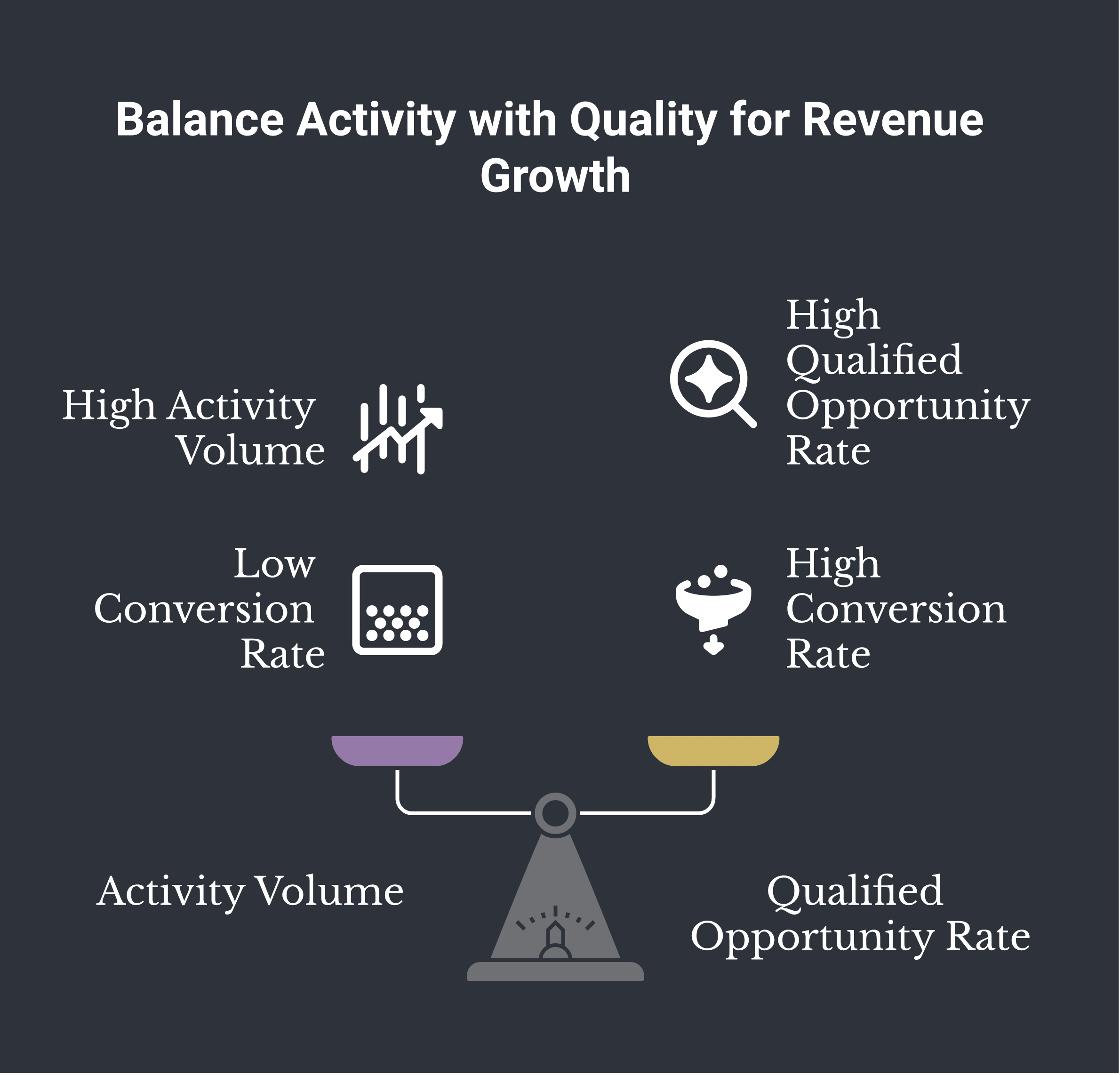
- Activity volume: count dials, emails, and touches as the input, but treat it as a cost line, not an achievement, because activity with no downstream conversion is money spent to look busy.
- Reply and positive reply rate: measure not just replies but positive replies, because a high reply rate full of unsubscribes and objections is a relevance problem dressed up as engagement.
- Meeting booked and held rate: track the gap between booked and held, since no-shows are where optimistic outbound numbers quietly deflate, and a held meeting is the first metric that means anything.
- Qualified opportunity rate: measure how many held meetings become real pipeline, because a team can book meetings all day with prospects who were never going to buy.
- Cost per qualified meeting: divide fully loaded outbound spend by qualified meetings, then compare it against every other channel, because this is the one number that tells you whether outbound is the right place for the next dollar.
The through-line is that you read from the bottom up. Activity is a cost, replies are a signal, and only cost per qualified meeting and outbound win rate tell you whether the motion earns its budget against the alternatives.
Common pitfalls
- Rewarding activity: comping and celebrating dials and emails sent, which guarantees more volume and worse targeting, because the team optimizes to the metric you pay for.
- Stopping at reply rate: treating any reply as a win, so objections and unsubscribes inflate a number that has nothing to do with pipeline.
- Ignoring the held gap: reporting meetings booked without meetings held, which hides the no-show rate where outbound forecasts go to die.
- Never computing cost per meeting: tracking outcomes in raw counts without dividing by loaded spend, so the team cannot tell when outbound got too expensive to justify.
- Measuring outbound in isolation: reviewing outbound metrics on their own instead of against partner-sourced and inbound, so the channel keeps getting funded even when a warmer source converts several times better for less.
What this looks like in practice
A team reviews its outbound quarter. Activity is up 20 percent, reply rate holds at 4 percent, and meetings booked look healthy. The surface reads like a strong quarter. Then they compute two numbers they had skipped. Cost per qualified meeting rose from 900 to 1,400 dollars as reps sent more to hit activity targets. Outbound win rate on those meetings sits at 7 percent. In the same period, partner-sourced meetings cost almost nothing to generate and converted at 30 percent, because the introduction carried trust that no sequence can manufacture. On the activity view, outbound is thriving. On the cost-per-qualified-meeting view, the team is paying more each quarter to compete with a channel it is ignoring.
That is the difference between measuring outbound and managing it. The activity metrics said push harder. The outcome metrics, read against the other channels, said rebalance.
Forecastable’s POV
Most outbound dashboards measure the wrong end of the motion. They are built around activity because activity is easy to count and easy to hit, and the metrics that actually predict revenue, cost per qualified meeting and outbound win rate by source, sit at the bottom where fewer people look. The fix is to invert the dashboard and lead with the outcome numbers.
The comparison against other channels is where I see teams change their minds. Outbound is the coldest, most expensive way to start a conversation, and it is often funded as if it were the only way. Partner-sourced pipeline is the warmest and usually the cheapest per qualified meeting, and it is the worst-instrumented, because a partner introduction gets logged as a rep’s outbound win. At Forecastable we are a partnerships operating platform that connects partner conversations and actions to CRM pipeline and revenue, so partner-sourced meetings show up in the same metrics as outbound, measured the same way, instead of being absorbed into a rep’s activity numbers.
My bet: the teams that put cost per qualified meeting by source at the top of the outbound review are the ones that stop overfunding the coldest channel they own.
Forecastable is an independent third-party. Any tools, vendors, or third-party figures referenced here are described from public information for the reader’s own evaluation, not as paid placements.
Frequently asked questions
What are the most important outbound sales metrics? Cost per qualified meeting and outbound win rate by source are the two that predict revenue. Reply rate and meetings held are useful signals, and raw activity counts are a cost line to control, not an achievement to celebrate.
What is a good outbound reply rate? Positive reply rates in cold B2B outbound are usually low single digits, and the exact number matters less than the trend and what the replies become. A high reply rate full of objections and unsubscribes is worse than a lower rate that produces held meetings.
How do I calculate cost per qualified meeting? Add the fully loaded cost of the outbound motion, including tooling, data, and the loaded cost of the reps, then divide by the number of meetings that became qualified opportunities. Compare the result against every other channel competing for the budget.
Why is activity a bad primary metric? Because it is the easiest number to produce and to game. A team paid on dials and emails sent will generate more of both and target worse, so activity rises while pipeline does not.
How should outbound metrics be compared across channels? Measure cost per qualified meeting and win rate for outbound the same way you measure them for inbound and partner-sourced, then fund the channel that produces qualified pipeline most efficiently rather than the one that is loudest.
Why does partner-sourced pipeline distort outbound numbers? Because a partner introduction often gets logged as a rep’s outbound win, inflating outbound results and hiding the fact that the warmest, cheapest meetings came from a channel the dashboard never credited.
Next step
Add two lines to your outbound report this week: cost per qualified meeting and outbound win rate, both split by source. Then compare them against your other channels and see whether outbound still earns the next dollar.
If a warmer, cheaper channel turns out to be partner-sourced, that is the one we instrument. Start your growth journey with Forecastable and we will put partner-sourced meetings in the same metrics as your outbound. Our B2B outbound sales guide covers the motion, and the partner-sourced pipeline guide covers why a warm introduction converts better than a cold sequence.
Uncover Your Growth Potential
Schedule a Discovery Call