B2B Go-To-Market: The Anatomy of a Modern Motion

Short answer
Short answer: B2B go-to-market is the complete motion a company uses to get a product in front of the right buyers and turn their interest into revenue, spanning who you target, how you position, which channels you use, and how you measure it. It is not a launch plan or a marketing campaign, and treating it as either is why so many GTM motions have a strong top and a weak middle.
Here is the position. A go-to-market motion is a system with parts that have to fit together, and the part most B2B teams underbuild is the channel that produces their warmest pipeline.
What is B2B go-to-market?
B2B go-to-market is the coordinated set of decisions and activities that connect a product to the businesses that should buy it. It covers the whole arc: deciding who the customer is, framing why the product matters to them, choosing how you reach and sell to them, pricing and packaging the offer, and measuring whether the motion produces revenue efficiently.
The word motion matters. A go-to-market is not a one-time event, it is a repeatable system that runs every quarter. People confuse it with a product launch or a demand gen campaign, both of which are pieces of a motion, not the motion itself. The useful mental model is a machine with several parts, where a weakness in any one part caps the output of the whole.
Why B2B go-to-market matters in 2026
B2B go-to-market matters because the cost of getting it wrong rose sharply. Paid channels got more expensive, cold outbound got less effective, and buyers do more of their evaluation before they ever talk to a seller. A motion tuned for 2019 economics quietly loses money in 2026, and the loss shows up as a pipeline that costs more each quarter to fill.
The other change is that the number of viable motions multiplied. Sales-led, product-led, partner-led, and community-led motions each work for different products and segments, and most companies now run a blend. The hard part is no longer picking one channel, it is assembling the right mix and measuring each part honestly, because the blend hides which channel is actually earning its budget.
In my work with revenue teams, the most common go-to-market failure is a motion that overinvests in the coldest, most expensive channel and underinvests in the warmest one, because the warm channel is harder to instrument and so it looks smaller than it is.
How B2B go-to-market actually works
A B2B go-to-market motion works as six interlocking parts, where the output is capped by the weakest one.
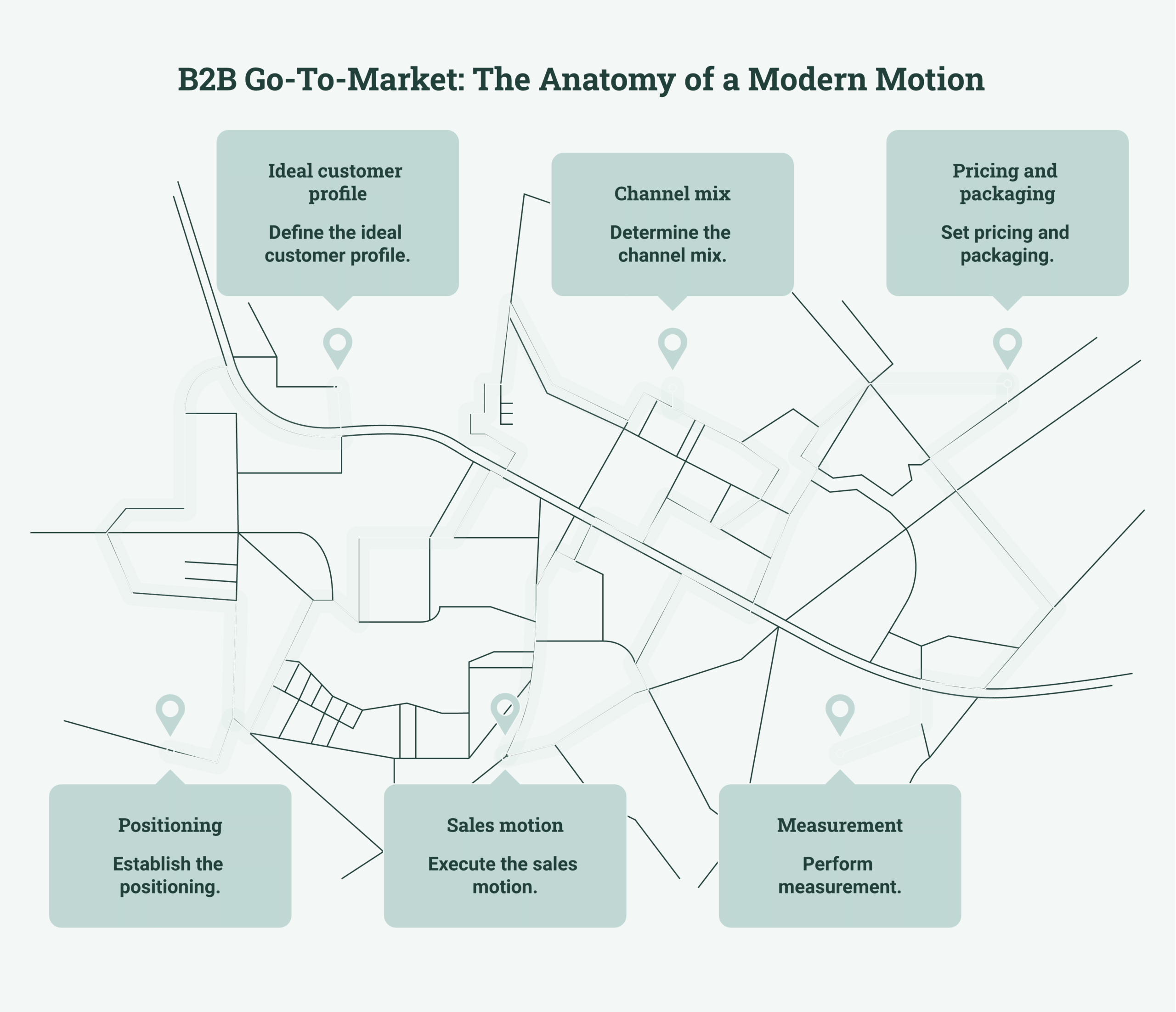
- Ideal customer profile: define precisely who the motion is for, because every downstream decision, from message to channel to price, degrades when it is aimed at everyone instead of someone.
- Positioning: frame why this product matters to that buyer against their alternatives, since a motion with great targeting and weak positioning just reaches the right people with the wrong reason.
- Channel mix: choose the routes to the buyer, outbound, inbound, product-led, and partner-sourced, as a deliberate portfolio rather than whatever the team already knows how to run.
- Sales motion: match how you sell to how the buyer buys, because a self-serve product sold through an enterprise motion, or the reverse, burns money on the mismatch.
- Pricing and packaging: structure the offer so it is easy to buy and easy to expand, since a motion that lands customers it cannot grow leaks revenue out the back.
- Measurement: instrument the whole motion by source, so you can see which part produces efficient revenue and which is quietly subsidized by the others.
The through-line is that the parts are a system, not a menu. A motion with a sharp ICP, strong positioning, and no measurement by source is a machine running blind, and the first thing that disappears in the dark is the channel that is hardest to track.
Common pitfalls
- Confusing launch with motion: treating go-to-market as a one-time product launch instead of a repeatable quarterly system.
- A fuzzy ICP: aiming the motion at a broad market so every downstream decision loses its edge.
- A single-channel reflex: running the one channel the team knows rather than building the mix the product and segment need.
- Measuring the blend: reporting the motion as one number so the weak channel and the subsidizing channel are invisible.
- Underbuilding the partner channel: leaving partner-sourced pipeline uninstrumented, so the warmest, highest-converting route looks too small to fund.
What this looks like in practice
A company maps its go-to-market on one sheet and finds the parts are not balanced. The ICP is sharp and the positioning is strong, but the channel mix is 80 percent outbound by spend, and measurement is a single blended pipeline number. When they finally split the motion by source, outbound is expensive and converting at single digits, inbound is steady, and a small, un-owned partner channel is converting several times better than anything else. The motion was not broken at the top, it was unbalanced in the middle, overfunding the coldest channel and starving the warmest because only the cold one was easy to count. Rebalancing the mix, and instrumenting the partner channel so it could be funded on evidence, changed the economics of the whole motion without touching the product.
That is the point of treating go-to-market as a system. The fix was not a new campaign, it was reading the machine part by part and feeding the part that was starving.
Forecastable’s POV
A go-to-market motion is only as strong as its weakest instrumented part, and for most B2B companies the weakest instrumented part is the partner channel. It is not that partners produce little pipeline, it is that partner-sourced pipeline is the hardest to measure, so it loses every budget argument to channels that are easier to count even when they convert worse.
That is the correction I push on. Partner-sourced deals are usually the warmest and highest-converting in the mix, and they disappear because the introduction gets credited to whichever rep logged the next activity. At Forecastable we are a partnerships operating platform that connects partner conversations and actions to CRM pipeline and revenue, so the partner part of the motion shows up as its own measurable line and can be funded on the same evidence as every other channel. Our Co-Sell Alignment Specialist is delivered as part of the service and uses the platform to keep that motion running week over week.
My bet: the teams that instrument their go-to-market by source, and stop letting the easy-to-count channels crowd out the warm ones, build motions that get cheaper to run instead of more expensive.
Forecastable is an independent third-party. Any tools, vendors, or third-party figures referenced here are described from public information for the reader’s own evaluation, not as paid placements.
Frequently asked questions
What is B2B go-to-market? It is the complete, repeatable motion a company uses to reach the right business buyers and turn their interest into revenue. It spans the ideal customer profile, positioning, channel mix, sales motion, pricing, and measurement, working together as one system.
What is the difference between go-to-market and a product launch? A launch is a one-time event that introduces a product; go-to-market is the ongoing motion that sells it quarter after quarter. A launch is one moment inside a motion, not the motion itself.
What are the parts of a go-to-market motion? Six interlocking parts: the ideal customer profile, positioning, the channel mix, the sales motion, pricing and packaging, and measurement. The output of the whole motion is capped by its weakest part.
What are the main go-to-market channels in B2B? Outbound, inbound and content, product-led, and partner-sourced, usually run as a blend rather than one channel. The right mix depends on the product, the price point, and how the buyer prefers to buy.
How do I know if my go-to-market is working? Measure the motion by source, not as a single blended number. Efficient revenue and improving conversion in each channel signal a healthy motion; a blended number that looks fine while costs rise signals a weak part hiding inside the average.
Why is the partner channel often underbuilt? Because partner-sourced pipeline is the hardest to instrument, so it loses budget arguments to channels that are easier to count, even when it converts better. Measured on its own line, it usually turns out to be the strongest part of the motion.
Next step
Map your go-to-market on one sheet this week, split spend and conversion by channel, and find the part that is starving. The weakest instrumented part is usually where the next dollar should go.
If that part turns out to be partner-sourced pipeline, that is what we instrument. Start your growth journey with Forecastable and we will make the partner channel a measurable part of your motion. Our B2B go-to-market strategy guide covers how to build the motion, and the partner-sourced pipeline guide covers the channel most motions underbuild.
Uncover Your Growth Potential
Schedule a Discovery Call