B2B Go to Market Strategy: How to Build One

Short answer
Short answer: A B2B go to market strategy is the sequenced set of decisions a company makes to bring a product to business buyers and win them profitably, built in a specific order so each choice constrains the next. It is a build, not a document, and the teams that treat it as a slide deck rather than a sequence end up with a plan that reads well and produces nothing.
Here is the position. The order of the decisions is the strategy. Get the sequence right and the channels fall out of it; get it wrong and you are picking tactics before you know who you are selling to.
What is a B2B go to market strategy?
A B2B go to market strategy is the plan for how a company reaches its market and converts it to revenue, expressed as an ordered series of decisions rather than a static artifact. The order runs from the most constraining choice to the least: who the customer is, why they should care, how you reach them, how you sell, and how you measure it. Each decision narrows the options for the ones that follow.
The common error is starting in the middle. Teams pick a channel, outbound or paid or events, before they have defined the customer sharply enough for the channel choice to be right. A strategy built from the middle out produces activity that looks like a plan but is actually a set of disconnected tactics, each optimized on its own.
Why a B2B go to market strategy matters in 2026
A B2B go to market strategy matters in 2026 because the margin for a sloppy one disappeared. Channels got more expensive, buyers got harder to reach, and capital rewards efficient growth over fast growth. A strategy that skips the sequencing, that funds channels before defining the customer, now loses money visibly and fast.
The second reason is that the number of channels grew, which makes sequencing harder and more important. With outbound, inbound, product-led, and partner-led all viable, the strategy is less about discovering a channel and more about choosing and ordering the mix deliberately. The teams that win decide the sequence on purpose. The teams that struggle run whatever channel they already know and call the result a strategy.
In my work with revenue teams, the most common strategic error is sequencing the partner channel last, as an afterthought once the cold channels are built, when it is usually the warmest and most efficient route and should be sequenced early.
How to build a B2B go to market strategy
Building a B2B go to market strategy works as an ordered sequence, where each step constrains the next and skipping one breaks the ones after it.
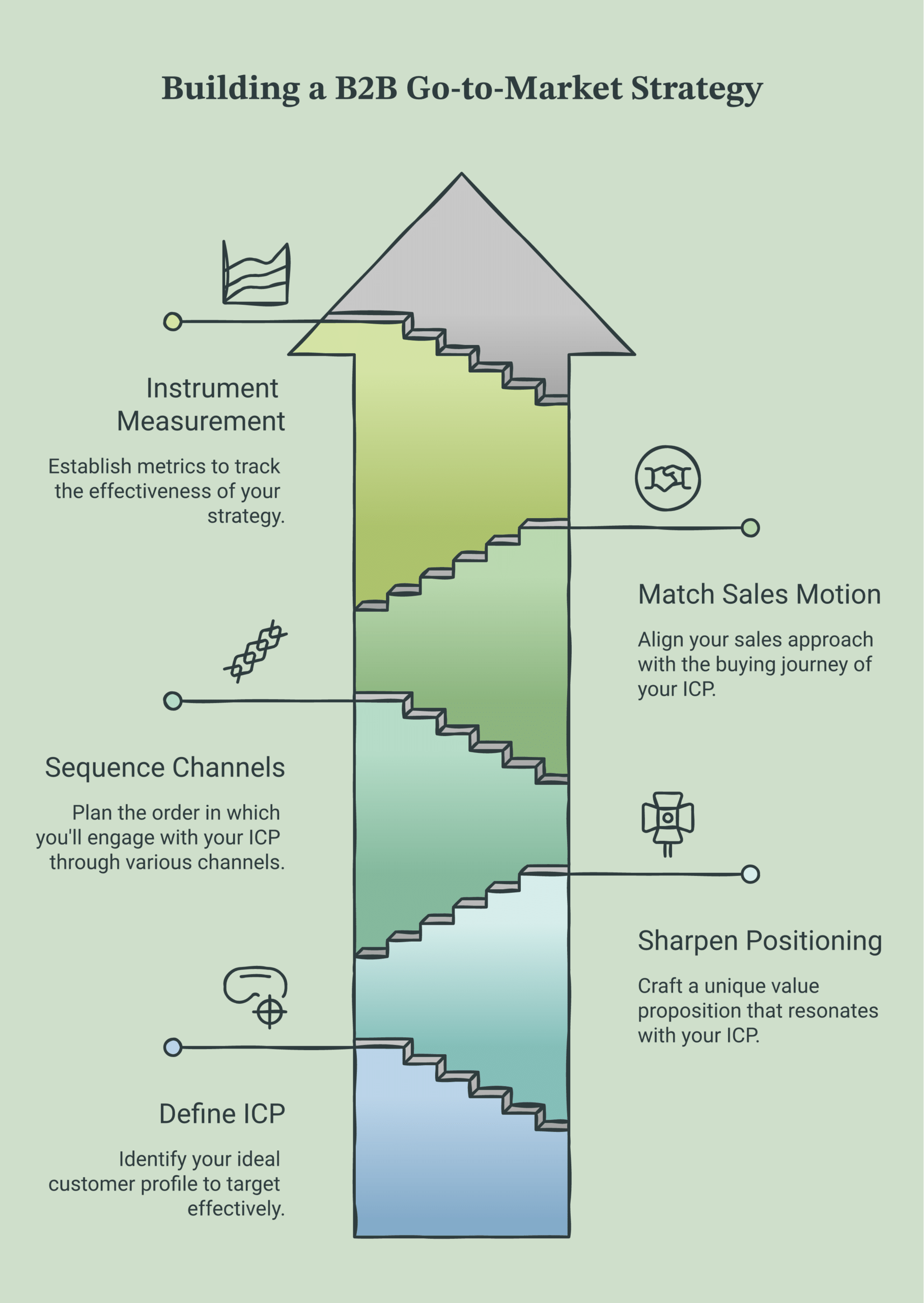
- Define the ICP first: decide precisely who you are selling to before anything else, because the customer definition constrains every later choice, and a channel picked before the ICP is a guess.
- Sharpen the positioning: frame why this product wins for that buyer against their real alternatives, since positioning is what makes a channel land and a weak frame wastes even a well-chosen channel.
- Sequence the channels: choose and order the routes to the buyer deliberately, warmest and most efficient first, instead of defaulting to the channel the team already runs.
- Match the sales motion: fit how you sell to how the buyer buys, because a motion mismatched to the deal size and buying process burns money on friction.
- Instrument measurement by source: decide how you will measure each channel before you turn it on, so you can tell within a quarter which part of the strategy is working and which is being subsidized.
The through-line is that the sequence is load-bearing. An ICP without positioning is a target with no reason to buy, channels without an ICP are tactics without aim, and measurement added last is a strategy you cannot steer.
Common pitfalls
- Starting from a channel: picking outbound or paid before defining the customer, so the channel choice is a guess the rest of the plan inherits.
- A document, not a build: producing a strategy deck that reads well and sequences nothing, so execution reverts to whatever the team already does.
- Vague positioning: reaching the right buyer with a reason to care that is indistinguishable from competitors.
- Measurement as an afterthought: launching channels before deciding how to measure them, so you cannot tell which part of the strategy earns its budget.
- Sequencing partners last: treating the partner channel as a late add-on when its warmth and efficiency argue for sequencing it early.
What this looks like in practice
A company sits down to build its go-to-market strategy and does it in the usual broken order: it has a channel plan, outbound and paid, and a target to hit, but the ICP is a one-line market description and positioning is a feature list. Reworked in sequence, the ICP narrows to a specific buyer in a specific situation, positioning sharpens to one reason that buyer wins by choosing them, and only then do the channels get chosen. With the customer defined, the team realizes the warmest route is through existing partners who already serve that exact buyer, a channel they had planned to add last. They sequence it first, build the cold channels behind it, and instrument all of them by source from day one. Same company, same product, a strategy that now steers because it was built in order.
That is the difference between a strategy and a plan of tactics. The sequence did the work; the channels were a consequence of it.
Forecastable’s POV
A go-to-market strategy is an ordered build, and the order is the whole value. Most teams own the pieces, an ICP, positioning, a channel list, and still fail because they assembled them in the wrong sequence or never sequenced at all. Define the customer, sharpen the reason, then let the channels fall out.
The sequencing error I correct most often is partners last. The partner channel tends to be the warmest and most efficient route to a well-defined buyer, because a partner who already serves that buyer brings trust no cold channel can manufacture, and yet it gets planned as an afterthought because it is harder to instrument. At Forecastable we are a partnerships operating platform that connects partner conversations and actions to CRM pipeline and revenue, so the partner channel can be sequenced early and measured from day one instead of bolted on at the end and left uncounted. Our Co-Sell Alignment Specialist is delivered as part of the service and uses the platform to run that channel alongside the rest of the motion.
My bet: the teams that build the strategy in order, and sequence the partner channel early instead of last, get a motion that steers instead of a deck that sits.
Forecastable is an independent third-party. Any tools, vendors, or third-party figures referenced here are described from public information for the reader’s own evaluation, not as paid placements.
Frequently asked questions
What is a B2B go to market strategy? It is the sequenced set of decisions a company makes to reach business buyers and win them profitably: the ICP, positioning, channel mix, sales motion, and measurement, built in an order where each choice constrains the next. It is a build, not a document.
What are the steps to build a go to market strategy? Define the ICP first, sharpen positioning, sequence the channels deliberately, match the sales motion to the buyer, and instrument measurement by source. The order matters because each step constrains the ones that follow.
What is the difference between go-to-market and a go to market strategy? Go-to-market is the motion itself, the running machine with its parts. A go to market strategy is the ordered set of decisions that designs and sequences that machine. One is the thing; the other is the plan that builds it.
Why does the order of decisions matter so much? Because each decision constrains the next. A channel chosen before the ICP is a guess, and positioning written after the channels is a justification. Building in sequence makes the later choices follow from the earlier ones instead of fighting them.
Where should the partner channel sit in the sequence? Early, not last. A partner who already serves your defined buyer is usually the warmest and most efficient route, yet teams default to sequencing partners after the cold channels because partners are harder to instrument, not because they work worse.
How soon should a go to market strategy be measurable? From day one. Decide how you will measure each channel by source before you turn it on, so within a quarter you can see which part of the strategy is working and which is being subsidized.
Next step
Rebuild your strategy in order this week: write the ICP, then the positioning, then the channel sequence, and refuse to pick a channel before the first two are done. The sequence is the strategy.
If the warmest route to your defined buyer runs through partners, sequence it early and instrument it. Start your growth journey with Forecastable and we will make the partner channel measurable from the start. Our B2B go-to-market guide covers the anatomy of the motion, and the partner-sourced pipeline guide covers the channel to sequence first.
Uncover Your Growth Potential
Schedule a Discovery Call