Outbound Sales Strategy: A Framework for 2026

Short answer
Short answer: An outbound sales strategy is the plan that decides which accounts you pursue, the message that earns their attention, the channels you reach them on, and how you measure whether it worked. It is what separates outbound that produces pipeline from activity that just produces noise, and most teams run the activity without the strategy.
Here is the position. Outbound without a strategy is a volume habit, and a strategy that ignores the warm partner path leaves the highest-converting pipeline on the table.
What is an outbound sales strategy?
An outbound sales strategy is the deliberate set of choices behind a proactive sales motion. It answers four questions before a single email goes out: which accounts are worth pursuing, what problem makes them care, which channels and sequence reach them, and what result counts as success. Without those answers, outbound defaults to sending as much as possible and hoping, which is a habit, not a strategy.
The difference shows up in the pipeline. A strategy-led motion concentrates effort on the accounts most likely to buy, with a message grounded in a real problem, measured against qualified pipeline. A habit-led motion spreads thin effort across a purchased list, with a generic message, measured against meetings booked. Same channels, completely different outcomes.
The reason strategy matters more in outbound than in inbound is that outbound chooses its own targets. Inbound takes whoever shows up; outbound decides. That decision is the strategy, and a bad one cannot be rescued by better copy or more volume.
Why an outbound sales strategy matters in 2026
The margin for an unstrategic outbound motion disappeared. When inboxes were less crowded and filters were softer, volume could paper over weak targeting. Now the generic blast gets filtered before a human sees it, so the only outbound that survives is the kind built on deliberate choices about who and why.
Here is the second pressure. Go-to-market budgets are tighter, so leadership wants to know not just that outbound is busy but that it is producing pipeline that converts. That forces a strategy question: which accounts, which message, which channels, and crucially which pipeline is actually closing. An outbound motion that cannot answer those is the first line item questioned in a lean quarter.
The teams that win build the warm path into the strategy rather than bolting it on. The best outbound strategy in 2026 checks every target account for an existing partner relationship first, because a partner introduction converts far better than the best cold sequence. In my work with revenue teams, the strategies that outperform are the ones that treat partner-sourced introductions as a core channel, not a happy accident, and route the warm accounts accordingly.
How an outbound sales strategy actually works
A sound outbound sales strategy works as a five-part framework, built in order, because each choice constrains the next.
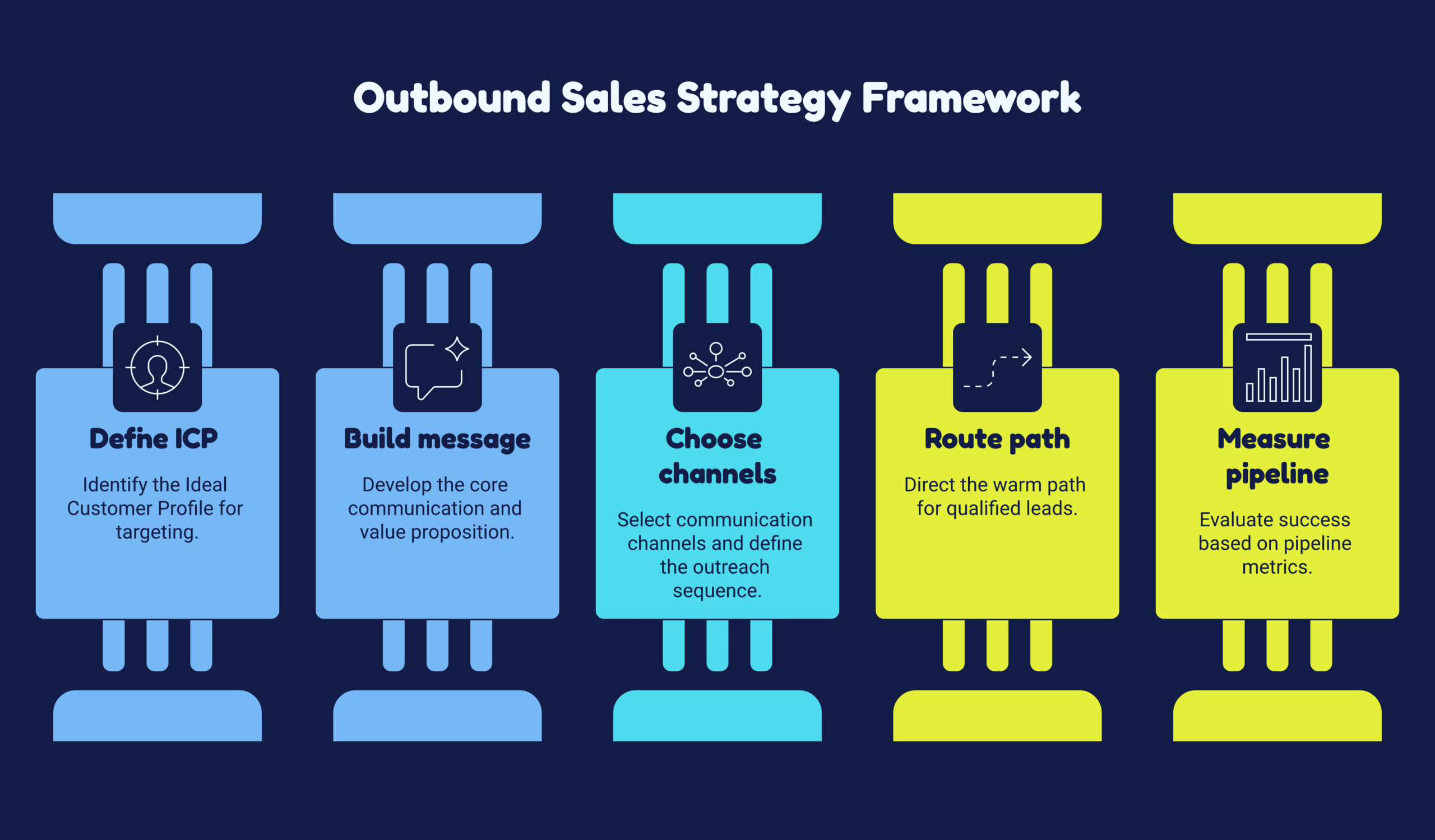
- Define the ICP: name the accounts worth pursuing by real fit, not by a title filter on a list, because every later choice inherits this one. Targeting is the strategy’s foundation.
- Build the message: ground the outreach in a problem the account actually has and a reason to act now, so relevance earns the reply in a filtered inbox. The message is the test of whether you understand the buyer.
- Choose channels and sequence: decide how email, calls, and social combine over a defined window, because the coordinated sequence breaks through where a single channel cannot. The sequence is the delivery system for the message.
- Route the warm path: check each target account for a partner relationship and send the warm ones through an introduction, because a trusted partner beats the best cold touch. This is the channel most strategies leave out.
- Measure by pipeline: judge the strategy on qualified pipeline and conversion by source, not on sends or meetings, so you invest in what closes. The measure is what keeps the strategy honest over time.
The through-line is that strategy is a sequence of constraints, each narrowing the next. Choose the accounts, earn the reply, deliver through the right channels, route the warm ones, and measure what closes.
Common pitfalls
- No real ICP: targeting by job title on a purchased list instead of genuine fit, so reps work hard against accounts that were never going to buy.
- Generic message at scale: sending the same value proposition to everyone, which gets filtered and trains buyers to ignore the sender.
- Single-channel strategy: betting the whole motion on email or calls alone, when the account that ignores one answers the other.
- Measuring activity, not pipeline: tracking sends and meetings as the scorecard, so the strategy optimizes for motion instead of revenue.
- Ignoring the warm path: running cold outbound into accounts where a partner already has a relationship, which skips the warmest route to the exact accounts the strategy targets.
What this looks like in practice
A worked example shows strategy beating effort. Two teams target the same market. The first writes a strong sequence and runs it hard against a broad purchased list, measuring sends and meetings. The second defines a tight ICP, writes a message around a real trigger, sequences email and calls, and routes every account with a partner relationship through a warm introduction, measuring qualified pipeline by source. The first team books more meetings and closes fewer. The second generates less raw activity and far more pipeline, because the warm-routed accounts convert several times better than the cold ones. The strategy, not the work rate, produced the difference.
The takeaway is that outbound is won at the planning stage. The choices about who, why, how, and what counts decide the result before the first email sends.
Forecastable’s POV
A good outbound sales strategy is mostly a series of disciplined nos: no to the accounts that do not fit, no to the generic message, no to measuring activity instead of pipeline. The teams that make those choices produce more pipeline from less motion, which is the opposite of the volume reflex most outbound runs on.
The choice that compounds hardest is building the warm path in. Partner-sourced introductions convert far better than cold outreach because the account already trusts the partner, and they are usually the lowest cost per customer in the mix. At Forecastable we are a partnerships operating platform that connects partner conversations and actions to CRM pipeline and revenue, so your outbound strategy can see which target accounts a partner can open and route those through an introduction instead of a cold sequence. Our Co-Sell Alignment Specialist is delivered as part of the service and uses the platform to run those partner plays and track them to closed revenue.
My bet: the teams that treat the warm partner path as a core part of the outbound strategy, not an afterthought, are the ones whose outbound keeps producing while competitors burn their domains on volume.
Forecastable is an independent third-party. Any tools, vendors, or third-party figures referenced here are described from public information for the reader’s own evaluation, not as paid placements.
Frequently asked questions
What makes a good outbound sales strategy? Deliberate choices about which accounts you target, the problem that makes them care, the channels and sequence you use, and measuring qualified pipeline rather than activity. Strategy concentrates effort where it converts instead of spreading it thin.
How is outbound strategy different from outbound tactics? Strategy decides who, why, and what counts as success; tactics are the emails, calls, and sequences that execute it. Good tactics cannot rescue a bad strategy, because the targeting and measurement choices happen before any outreach.
How do I choose the right target accounts for outbound? Define an ideal customer profile by genuine fit, buying signals, problem, and timing, not just a job title on a list. Then tier the accounts so your best effort goes to the ones most likely to buy.
How should I measure outbound sales strategy? By qualified pipeline and conversion by source, not by sends or meetings booked. Activity metrics reward motion; pipeline and conversion metrics reward the outcomes that pay the quarter.
Where does partner-sourced pipeline fit in an outbound strategy? As a core channel, not an afterthought. Checking target accounts for partner relationships and routing the warm ones through an introduction converts far better than cold outreach into the same accounts.
Why do outbound strategies fail? Usually a weak ICP, a generic message, and measuring activity instead of pipeline. The motion looks busy and produces little, because the strategic choices that decide the outcome were never made deliberately.
Next step
If your outbound is busy but thin, fix the strategy before the sequences. Define a real ICP, ground the message in a true problem, and measure qualified pipeline by source instead of meetings.
Then build in the warm path most strategies skip. Start your growth journey with Forecastable and we will show you which target accounts a partner can open for you. Our outbound sales guide covers the execution, and the partner-sourced pipeline guide shows why a warm introduction beats a cold sequence.
Uncover Your Growth Potential
Schedule a Discovery Call