Outbound Sales Outsourcing: A 2026 Buyer’s Guide

Short answer
Short answer: Outbound sales outsourcing is the practice of paying an outside firm to run some or all of your prospecting, from list building and sequencing to booking qualified meetings. It works when the motion is already proven and you need capacity, and it fails when you hand over a motion you have never made work yourself.
Here is the position. You can outsource the execution of outbound, but you cannot outsource owning the message, the list, and the definition of a good meeting, and the providers that pretend otherwise are the ones that disappoint.
What is outbound sales outsourcing?
Outbound sales outsourcing moves the top-of-funnel motion, cold prospecting into booked meetings, to an external provider. The provider supplies the reps, the tooling, and the process, and you supply the offer, the target market, and the definition of a qualified meeting. The arrangement ranges from a fully managed service that owns the whole motion to a staffing model where you rent trained reps and direct them yourself.
The reason the category exists is speed and capacity. Building an in-house outbound team means hiring, ramping, and managing SDRs for months before a single meeting lands. An outside team can be sending in weeks. What you gain in speed you trade in control, and the buying decision turns on how much control you can give up.
Why outbound sales outsourcing matters in 2026
Cold outbound got harder and more expensive at the same time. Inboxes are saturated, deliverability is tighter, and the generic sequence that worked three years ago now gets filtered before a human reads it. That pushes teams toward specialists who do nothing but outbound, and it also raises the risk of buying volume that produces noise instead of pipeline.
Here is the trap. The cheapest providers sell meetings by the unit, and paying per meeting guarantees you get meetings, not qualified pipeline. The incentive is to book anyone who will take a call, and your sales team absorbs the cost of the bad ones. In my work with revenue teams, the quarter where outsourced meeting volume went up and win rate went down is a familiar pattern, and it almost always traces to a per-meeting contract.
The teams that use outsourcing well treat the provider as execution capacity on a motion they already own. They bring the proven message and the real target list, and they hold the provider to qualified pipeline, not raw meetings. The ones that get burned hand over a motion they never made work and expect the vendor to invent demand that was not there.
How outbound sales outsourcing actually works
A sound outsourcing engagement works as a four-part decision, and skipping any part is how the engagement goes wrong.
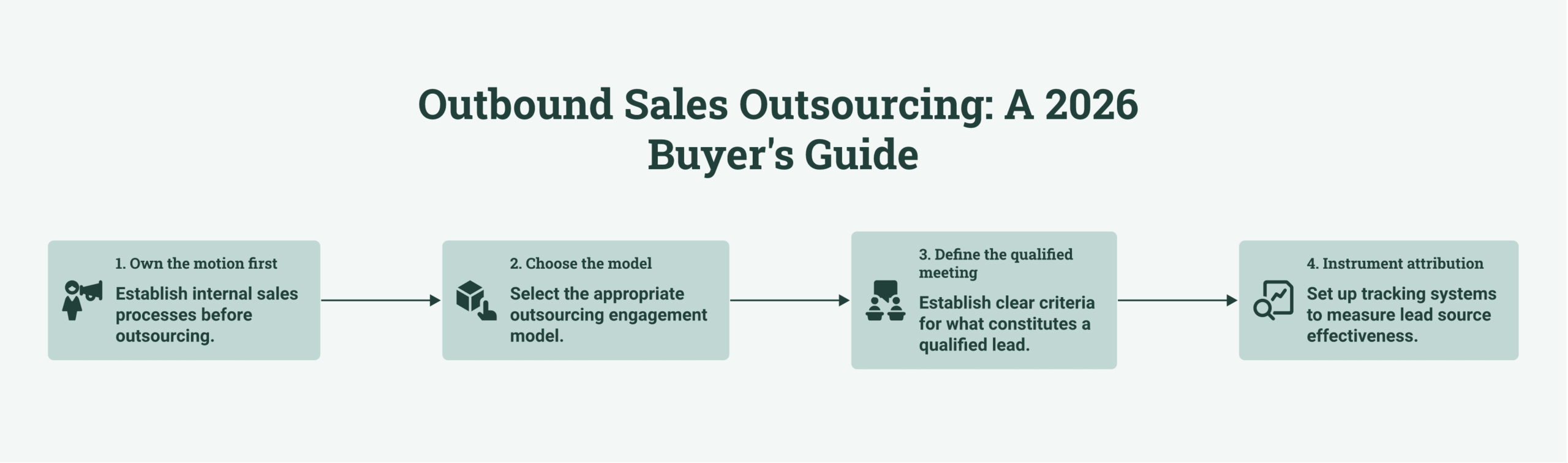
- Own the motion first: prove the message and the target market convert before you outsource anything, because a provider amplifies the motion you give them and cannot fix one that does not work. Proof comes before scale.
- Choose the model: decide between a fully managed service, a pay-per-meeting shop, and a rented-rep staffing model, because each trades a different amount of control for a different amount of speed. The model sets the incentive.
- Define the qualified meeting: write down what a meeting must contain to count, so you pay for pipeline and not for anyone who answers the phone. A shared definition is the single most important line in the contract.
- Instrument attribution: track every outsourced meeting through to qualified opportunity and closed revenue, so you can see cost per customer and not just cost per meeting. Revenue is the only number that settles whether it worked.
The through-line is that outsourcing scales a working motion; it does not create one. Own the message and the definition of success, then rent the capacity to run it.
Tools and examples
Outbound outsourcing is best evaluated by provider model, not brand, because the model decides the incentive you are buying.
| Provider model | What you pay for | What to check |
|---|---|---|
| Fully managed service | A team that owns list, sequencing, and booking end to end | Whether they will work your message and target list, or push a generic one |
| Pay-per-meeting shop | A fixed price per booked meeting | How “qualified” is defined, since the incentive is volume over fit |
| Rented-rep staffing | Trained SDRs you direct yourself | Whether you have the management capacity to run them day to day |
| In-house build | Hiring and ramping your own SDRs | Whether you can wait the months it takes to see pipeline |
A short worked example shows the choice. A company buys a pay-per-meeting contract to hit a number fast. Meetings arrive, and three months later the sales team reports that most had no budget and no timeline. The cost per meeting looked cheap; the cost per closed customer was enormous. The team switches to a managed provider, hands over its proven message and target list, and holds the provider to qualified opportunities. Volume drops, win rate rises, and cost per customer finally makes sense. The model, not the effort, was the problem.
Forecastable’s POV
Outbound outsourcing is a capacity decision, not a strategy decision, and teams get it wrong when they treat it as the latter. If outbound already works, a provider lets you do more of it. If it does not, a provider lets you fail faster and more expensively. The message, the list, and the definition of a qualified meeting stay yours no matter who does the sending.
There is a warmer motion most teams underuse before they ever outsource cold. Partner-sourced introductions convert several times better than cold outbound because the account already trusts the partner who made the introduction, and they are usually the lowest cost per customer in the whole mix. At Forecastable we are a partnerships operating platform that connects partner conversations and actions to CRM pipeline and revenue, so the partner channel gets run and measured with the same rigor a good outbound provider brings to cold. Our Co-Sell Alignment Specialist is delivered as part of the service and uses the platform to run those partner plays and track them to closed revenue.
My bet: the teams that instrument the warm partner channel before they scale cold outsourcing are the ones who stop paying premium prices for meetings that never close.
Forecastable is an independent third-party. Any tools, vendors, or third-party figures referenced here are described from public information for the reader’s own evaluation, not as paid placements.
Frequently asked questions
What does outbound sales outsourcing include? Typically list building, email and call sequencing, and booking qualified meetings, delivered by an outside team. You supply the offer, the target market, and the definition of a qualified meeting; the provider supplies the reps, tooling, and process.
How much does outbound sales outsourcing cost? It varies by model: managed services charge a monthly retainer, pay-per-meeting shops charge per booked meeting, and staffing models charge per rep. The cheapest headline price often hides the highest cost per customer.
Is outsourcing outbound better than building an in-house team? It depends on whether your motion is proven and how fast you need pipeline. Outsourcing buys speed and capacity on a working motion; building in-house buys control but costs months of ramp before the first meeting lands.
Why do outsourced meetings often convert poorly? Usually because the contract pays per meeting, which rewards volume over fit. The provider books anyone who will take a call, and your sales team absorbs the unqualified ones. Defining the qualified meeting and paying for pipeline fixes most of it.
When should I not outsource outbound? When you have never made the motion work yourself. A provider amplifies the message and list you give them; they cannot invent demand. Prove the motion first, then outsource the capacity to scale it.
How does partner-sourced pipeline compare to outsourced outbound? Partner introductions convert far better than cold outbound because the account already trusts the partner, and they usually carry the lowest cost per customer. Most teams underuse the partner channel before paying to scale the colder one.
Next step
If you are shopping for an outbound provider, write the definition of a qualified meeting before you take a single demo, and insist the contract pays against it. That one document decides whether you buy pipeline or noise.
If the warmer channel you have not instrumented is partner-sourced pipeline, that is what we run. Start your growth journey with Forecastable and we will put the partner channel to work beside your outbound. Our outbound sales guide covers the cold motion, and the co-sell guide shows why a partner introduction closes warmer than a cold meeting.
Uncover Your Growth Potential
Schedule a Discovery Call