How to Calculate Cost Per Lead (With Formula)

Short answer
Short answer: How to calculate cost per lead comes down to one division: total spend on a channel over a period, divided by the number of leads that channel produced in the same period. It is a simple formula that most teams get wrong by leaving costs out and by stopping at the lead instead of carrying the math to revenue.
Here is the position. The calculation is easy; the honest version, with every cost counted and the number read next to conversion, is the part that matters.
What is cost per lead?
Cost per lead, often shortened to CPL, measures what one lead from a given channel costs to generate. You total what the channel cost and divide by the leads it produced. If a campaign cost 20,000 dollars and produced 200 leads, the cost per lead is 100 dollars.
The metric exists so you can compare channels on a common basis: for this channel, what did one lead cost? It does not tell you whether that lead was any good, which is why the calculation has to be extended before it means much.
Why calculating cost per lead correctly matters in 2026
Budgets are tighter and every channel is under review, so cost per lead is back in every marketing report. Calculated loosely, it misleads: leave out agency fees or tooling and a channel looks cheaper than it is, and stop at the lead and you reward the channel that produces the most leads whether or not any of them close.
The honest version pairs the number with conversion. A lead that costs three times more but converts five times better is the best buy in the mix. In my work with revenue teams, the most common error is a falling cost per lead celebrated right up to the moment win rate falls with it.
How to calculate cost per lead
Calculating cost per lead correctly works as a four-step process that only becomes useful when you extend it past the lead.
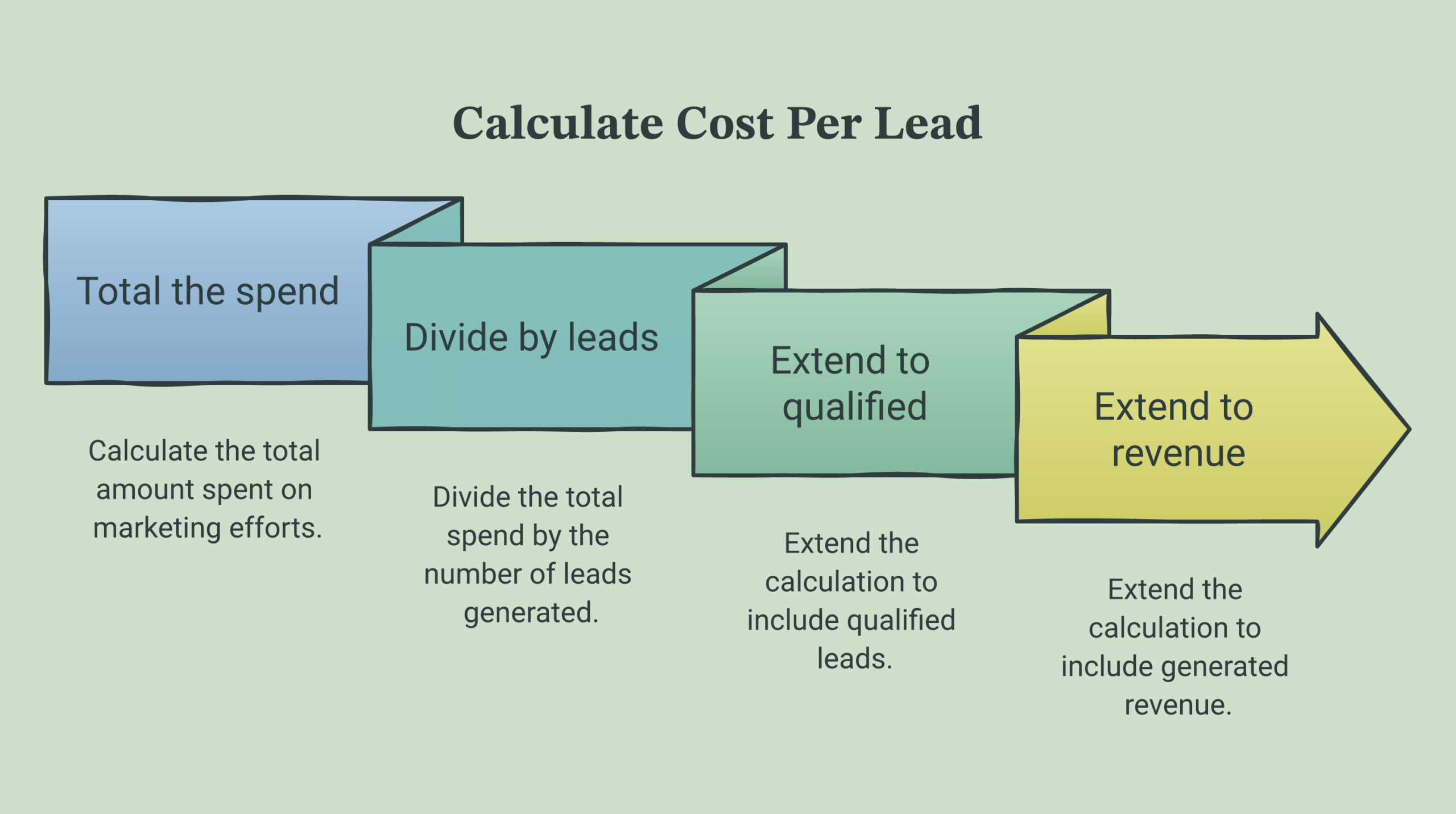
- Total the spend: add every cost tied to the channel, media, agency, tooling, and content, not just the ad bill, because a half-counted cost makes the channel look more efficient than it is. Honest inputs come first.
- Divide by leads: divide that total by the leads the channel produced in the same window, using one agreed definition of a lead so channels compare fairly. A shared definition keeps the comparison honest.
- Extend to qualified: multiply through the qualification rate to get cost per qualified lead, because a cheap lead that never qualifies costs more than an expensive one that does. This is where real analysis starts.
- Extend to revenue: carry the number through close rate and deal size to cost per customer, so you compare channels on revenue, not leads. Revenue is the number that should set the budget.
The through-line is that cost per lead is the first step of a calculation, not the whole one. Stop at the lead and you optimize for volume; carry it to revenue and you optimize for pipeline that closes.
Common pitfalls
- Half-counting the spend: dividing by media cost alone and leaving out agency, tooling, and content, which flatters the channels with hidden costs.
- Loose lead definition: letting each channel count leads its own way, so a form-fill and a hand-raise count the same.
- Stopping at the lead: never extending to cost per qualified lead or cost per customer, which rewards volume over conversion.
- Leaving out the warm channel: treating partner-sourced introductions as unmeasurable, so the lowest cost per customer never enters the calculation.
What this looks like in practice
A quick example shows why the extension matters. Paid social produces leads at 60 dollars each; partner introductions cost 180 dollars each once you count the program, so on cost per lead alone they look like the loser. Extend the math, though: paid social qualifies at 8 percent and closes at 10 percent, while partner introductions qualify at 45 percent and close at 35 percent, because the account already trusts the partner. Run it to cost per customer and the expensive channel is far cheaper per closed deal. The team watching only cost per lead would have cut the better channel.
Forecastable’s POV
Cost per lead became a vanity metric the moment teams managed to it directly. The cheapest lead is almost never the best lead, and a number calculated without conversion steers you toward worse pipeline every quarter. Calculate it, then extend it to cost per customer before you decide anything.
The channel that wins the extended calculation and gets left out of it is partner-sourced pipeline. It carries a higher cost per lead and the lowest cost per customer, because the introduction starts from trust. At Forecastable we are a partnerships operating platform that connects partner conversations and actions to CRM pipeline and revenue, so the partner channel shows up in the same efficiency math as paid and content. Our Co-Sell Alignment Specialist is delivered as part of the service and uses the platform to track that pipeline from introduction to closed revenue.
My bet: the teams that calculate cost per customer by channel, not just cost per lead, are the ones who stop buying cheap pipeline that never closes.
Forecastable is an independent third-party. Any tools, vendors, or third-party figures referenced here are described from public information for the reader’s own evaluation, not as paid placements.
Frequently asked questions
What is the cost per lead formula? Cost per lead equals total channel spend in a period divided by the leads that channel produced in the same period. Include media, agency fees, tooling, and content, not just the ad bill, so the number reflects the real cost.
What costs should be included in cost per lead? Every cost tied to the channel: media or ad spend, agency and freelancer fees, tooling, and content production. Leaving any out flatters the channels with hidden costs and distorts the comparison.
What is a good cost per lead in B2B? There is no single good number; it varies by channel and deal size. A better test is cost per qualified lead and cost per customer, since a higher cost per lead that closes well beats a cheap lead that does neither.
How is cost per lead different from customer acquisition cost? Cost per lead measures the cost of generating one lead. Customer acquisition cost measures the cost of winning one customer across every channel and the sales effort, so cost per lead is one input into it, not a substitute.
Should I include partner-sourced leads in the calculation? Yes. Partner introductions carry a higher cost per lead once you count the program but a much lower cost per customer, because the account already trusts the partner. Leaving them out hides your most efficient channel.
Next step
Calculate cost per lead with every cost counted, then do the step most teams skip: carry it through qualification and close rate to cost per customer, and rank your channels on that instead.
If the channel that wins on cost per customer is partner-sourced pipeline, that is what we build. Start your growth journey with Forecastable and we will put the partner channel in the same efficiency math as the rest. Our cost per lead guide covers the metric in full, and the partner-sourced pipeline guide shows why a partner introduction closes warmer than a cold lead.
Uncover Your Growth Potential
Schedule a Discovery Call