B2B Outbound Sales: What Works in 2026

Short answer
Short answer: B2B outbound sales is the motion of proactively reaching target accounts that have not raised their hand, through cold email, calls, and social, to create pipeline that inbound alone would never produce. It still works in 2026, but only for teams that trade volume for precision and relevance.
Here is the position. Outbound did not stop working; spray-and-pray stopped working, and the teams blaming the channel are usually running the version that deserved to die.
What is b2b outbound sales?
B2B outbound sales is demand creation rather than demand capture. Instead of waiting for a buyer to fill in a form, a rep identifies accounts that fit the profile, finds the right people inside them, and reaches out with a reason to care. The channels are familiar: cold email, cold calls, LinkedIn, and increasingly a coordinated mix of all three against the same account.
The distinction from inbound is the direction of the first move. Inbound sales responds to interest a buyer already signaled. Outbound manufactures the first conversation where no interest was visible yet. That makes outbound harder and also more controllable, because you choose the accounts instead of taking whoever shows up.
The reason teams run outbound at all is that the best-fit accounts rarely raise their hand on your timeline. If you only sell to inbound, you sell to the slice of the market already looking, and you cede the rest to whoever reached out first. Outbound is how you reach the accounts you want before they are shopping.
Why b2b outbound sales matters in 2026
The channel got harder in a way that rewards good teams and punishes lazy ones. Inboxes are saturated, deliverability rules tightened, and buyers learned to ignore the generic sequence on sight. The high-volume motion that sent ten thousand identical emails and booked a few meetings now gets filtered before a human reads it.
Here is why that is good news for disciplined teams. When volume stops working, relevance becomes the moat, and relevance is hard to copy. A rep who understands the account, names a real problem, and references something specific will get a reply in a market where generic outreach is invisible. The bar went up, which means the teams willing to clear it face less noise on the other side.
The second shift is that outbound no longer stands alone. The teams that win in 2026 sequence outbound with warmer signals: product usage, intent data, and above all partner relationships. In my work with revenue teams, the single most underused outbound accelerant is a partner who already sells to the account, because a warm introduction converts several times better than the best cold email. Most teams run cold outbound hard and leave the warm partner path untouched.
How b2b outbound sales actually works
A modern outbound motion works as a five-part system, and the teams that skip the early parts pay for it in the later ones.
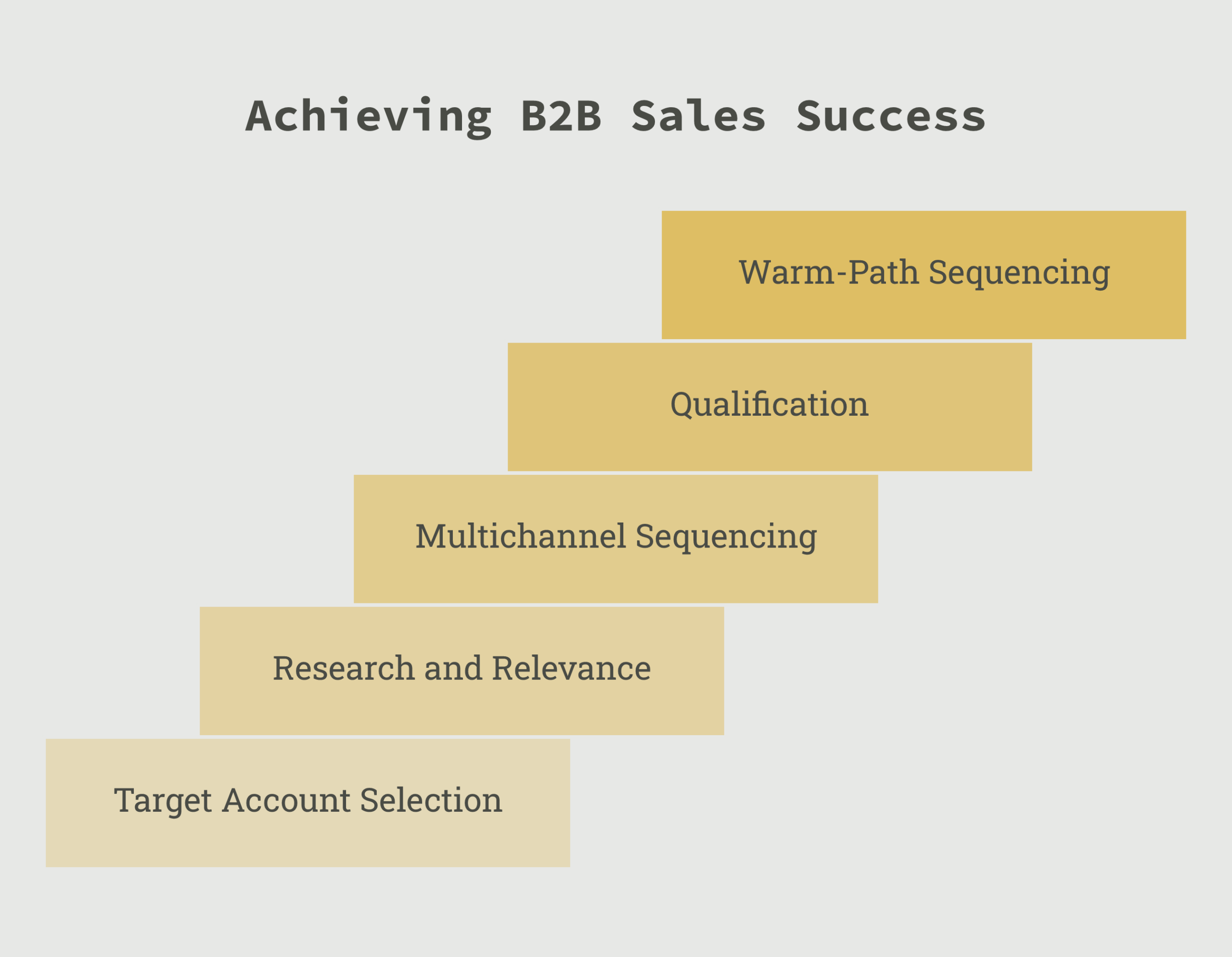
- Target account selection: define the accounts worth pursuing by fit, not by whoever is on a purchased list, because precision at this step saves every step after it. The list decides the ceiling.
- Research and relevance: find the real problem and the real trigger before writing a word, so the outreach names something true about the account instead of a generic pain. Relevance is what earns the reply.
- Multichannel sequencing: coordinate email, calls, and social against the same contacts over a defined window, because one channel alone rarely breaks through now. The sequence is the unit, not the single email.
- Qualification: hold every booked meeting to a shared definition of qualified, so the motion produces pipeline and not a calendar full of dead ends. A meeting is not the goal; a qualified opportunity is.
- Warm-path sequencing: check every target account against partner relationships and route the warm ones through an introduction, because a partner the account already trusts beats the best cold sequence. This is the step most teams never build.
The through-line is that outbound rewards precision at the top and discipline at the bottom. Choose the right accounts, earn the reply with relevance, and always ask whether a partner can turn a cold touch into a warm one.
Common pitfalls
- Volume over relevance: sending the same sequence to thousands of contacts, which trains buyers and spam filters to ignore you and burns the domain in the process.
- Buying the list, skipping the fit: prospecting a purchased list that matches a title but not the actual profile, so reps work hard against accounts that were never going to buy.
- One channel only: running email alone or calls alone, when the account that ignores an email answers a call, and the reverse.
- Counting meetings, not pipeline: celebrating booked meetings without a qualification bar, so the motion looks productive while the pipeline stays thin.
- Ignoring the warm path: running cold outbound into accounts where a partner already has a relationship, which wastes the warmest route to the exact accounts you want.
What this looks like in practice
A worked example shows the difference precision makes. Two teams target the same two hundred accounts. The first runs a high-volume sequence, personalizes the first line, and books meetings at a low single-digit rate, most of which go nowhere. The second cuts the list to the hundred best-fit accounts, researches a real trigger for each, sequences email and calls together, and checks every account against its partner relationships first. For the forty accounts where a partner already sells, the second team asks for an introduction instead of sending cold. Those forty convert to pipeline at several times the rate of the cold sixty. Same market, same quarter, and the team that built the warm path produced most of the pipeline from a fraction of the volume.
That is the shape of outbound that works now. Fewer accounts, more relevance, and a warm partner path wherever one exists.
Forecastable’s POV
Outbound is not dead; the lazy version is, and good riddance. The teams declaring the channel over are usually the ones who ran it on volume and never invested in relevance or the warm path. Precision at the top of the funnel and a real qualification bar at the bottom still produce pipeline no inbound motion would have found.
The part almost everyone underbuilds is the warm path. Partner-sourced introductions convert several times better than cold outbound because the account already trusts the partner, and they are usually the lowest cost per customer in the mix. At Forecastable we are a partnerships operating platform that connects partner conversations and actions to CRM pipeline and revenue, so your outbound team can see which target accounts a partner can open and route those through an introduction instead of a cold sequence. Our Co-Sell Alignment Specialist is delivered as part of the service and uses the platform to run those partner plays and track them to closed revenue.
My bet: the teams that pair precise cold outbound with a built-out warm partner path are the ones who keep producing pipeline while their competitors conclude outbound is dead.
Forecastable is an independent third-party. Any tools, vendors, or third-party figures referenced here are described from public information for the reader’s own evaluation, not as paid placements.
Frequently asked questions
Does B2B outbound sales still work in 2026? Yes, for teams that trade volume for precision. The high-volume generic sequence gets filtered now, but targeted, relevant outreach into well-chosen accounts still produces pipeline that inbound alone would never reach.
What is the difference between outbound and inbound sales? Outbound reaches accounts that have not signaled interest; inbound responds to interest a buyer already showed. Outbound is harder and more controllable, because you choose the accounts rather than taking whoever fills in a form.
What channels work best for B2B outbound? A coordinated mix of email, calls, and social against the same accounts outperforms any single channel. The unit of work is the multichannel sequence over a defined window, not the one-off email.
How do I make cold outbound more effective? Shrink the list to best-fit accounts, research a real trigger for each, and name something true about the account. Relevance is the moat now that volume is filtered, and a smaller precise list beats a large generic one.
What is the most underused outbound channel? The warm partner path. Checking target accounts against partner relationships and routing the warm ones through an introduction converts several times better than cold outreach, yet most teams run cold outbound and never build it.
How do you measure outbound sales performance? Measure qualified pipeline and cost per customer, not booked meetings. A meeting count without a qualification bar makes the motion look productive while the pipeline stays thin and the sales team drowns in dead ends.
Next step
If outbound is underperforming, do not add volume, add precision. Cut the list to best-fit accounts, research a real trigger for each, and hold every meeting to a qualification bar.
Then build the warm path you are probably missing. Start your growth journey with Forecastable and we will show you which target accounts a partner can open for you. Our outbound sales guide covers the cold motion, and the partner-sourced pipeline guide shows why a warm introduction converts better than any sequence.
Uncover Your Growth Potential
Schedule a Discovery Call