What Is Revenue Operations? Definition and How It Works

Short answer
Short answer: What is revenue operations starts with one idea: it is the function that runs sales, marketing, and customer success as a single revenue engine instead of three teams with three systems and three versions of the number. It aligns the process, the data, and the tooling so the whole go-to-market motion forecasts and reports off one source of truth.
Here is the position. RevOps is not a reporting team you bolt on at the end. It is the operating layer that decides whether your pipeline number means anything.
What is revenue operations?
Revenue operations is the discipline of unifying the people, process, data, and systems behind sales, marketing, and customer success so they run as one motion. Instead of each team optimizing its own funnel and its own dashboard, RevOps owns the handoffs between them, the definitions everyone reports against, and the CRM hygiene that makes any of it trustworthy.
The job breaks into a few concrete responsibilities: own the data model in the CRM, standardize stage definitions and conversion math, run the forecast, and keep the tool stack from fragmenting into islands. The point is a single accountable owner for how revenue is measured end to end, not a committee that meets about it.
The common misread is that RevOps is sales operations with a wider title. It is broader than that. Sales ops optimizes the sales team; revenue operations optimizes the connection between every team that touches the customer, which is where most pipeline actually leaks.
Why revenue operations matters in 2026
Most companies do not have a demand problem. They have a measurement problem. When marketing reports sourced pipeline, sales reports its own number, and success reports retention on a separate system, leadership gets three stories and no truth. RevOps exists to collapse that into one defensible number.
This matters more as go-to-market gets more complex. Partner-sourced and partner-influenced deals, product-led signups, and outbound all feed the same pipeline, and without one owner for how they are credited, the fastest-growing sources are the ones that get measured worst. In my work with revenue teams, the account nobody can forecast is almost always the account where the data handoff broke, not where the demand dried up.
How revenue operations actually works
Revenue operations works as a four-part operating system that turns scattered team data into one trustworthy revenue picture.
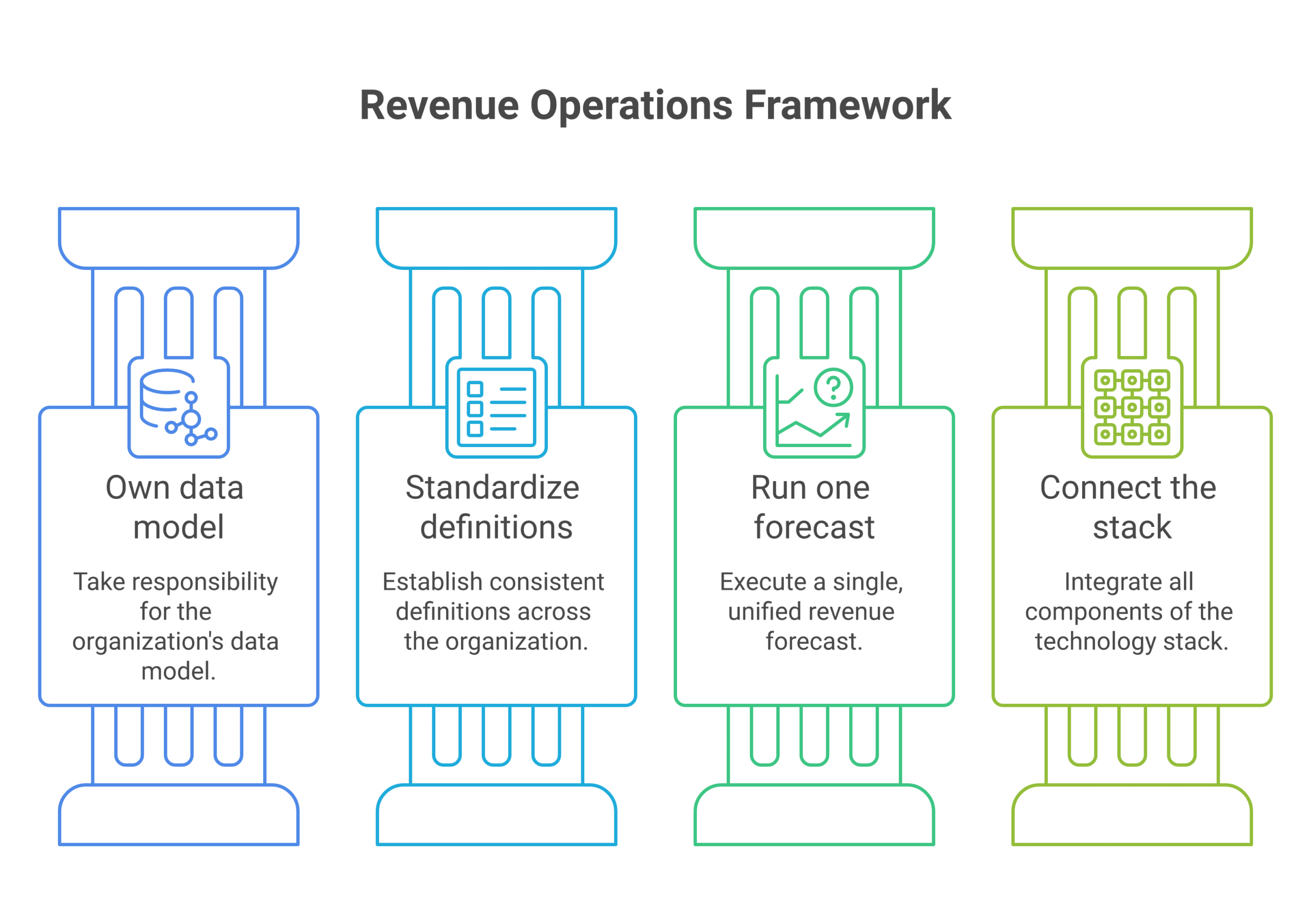
- Own the data model: put every team on one CRM schema with clean, enforced fields, because a forecast is only as honest as the data under it. Hygiene is the foundation, not the afterthought.
- Standardize the definitions: agree on what a stage, a qualified lead, and a sourced deal actually mean, so the same word means the same thing in every team’s report. Shared definitions are what make one number possible.
- Run one forecast: roll sales, marketing, and success signals into a single forecast leadership inspects, instead of three parallel ones. The forecast is the product RevOps ships.
- Connect the stack: wire the tools so data flows between them automatically rather than through spreadsheets and copy-paste. Connected systems are what let the motion scale without adding headcount.
The through-line is that RevOps earns its keep at the handoffs. Fix the data model and the definitions, and the forecast stops being an argument.
What this looks like in practice
A quick example makes the definition concrete. A company reports strong marketing-sourced pipeline and a healthy sales forecast, yet the board number keeps missing. RevOps traces it to the handoff: marketing counts a lead as sourced, sales re-sources the same deal when it converts, and partner-influenced accounts are credited to whichever rep logged the last activity. Nobody is lying. The definitions never agreed. Once the stage math and the sourcing rules are written down and enforced in the CRM, the three numbers reconcile into one the board can trust. The fix was never more pipeline; it was one owner for how pipeline is counted.
Forecastable’s POV
RevOps gets treated as plumbing, so it gets underfunded until the forecast misses badly enough to scare someone. That is backwards. The data model and the definitions are the product, because every number leadership trusts is built on them.
At Forecastable we see this most sharply in partner-sourced revenue, which is usually the worst-instrumented line in the whole model. We are a partnerships operating platform that connects partner conversations and actions to CRM pipeline and revenue, so the partner contribution shows up in the same forecast as everything else instead of in a separate deck nobody reconciles. Our Co-Sell Alignment Specialist is delivered as part of the service and uses the platform to keep that attribution clean where it normally breaks.
My bet: the teams that treat revenue operations as the owner of one number, not as reporting support, are the ones whose forecasts stop surprising them.
Forecastable is an independent third-party. Any tools, vendors, or third-party figures referenced here are described from public information for the reader’s own evaluation, not as paid placements.
Frequently asked questions
What is revenue operations in simple terms? It is the function that runs sales, marketing, and customer success as one revenue engine, with one owner for the data, the definitions, and the forecast. Instead of three teams reporting three numbers, RevOps produces one that leadership can defend.
What is the difference between revenue operations and sales operations? Sales operations optimizes the sales team. Revenue operations optimizes the connection between every team that touches revenue, including marketing and customer success, which is where most pipeline leaks. RevOps is the broader discipline, and sales ops often sits inside it.
What does a revenue operations team do? It owns the CRM data model, standardizes stage and sourcing definitions, runs the forecast, and keeps the tool stack connected. The output is a single, trustworthy revenue picture rather than competing dashboards.
Why do companies need revenue operations? Because most forecast misses are measurement failures, not demand failures. When each team reports on its own system with its own definitions, leadership cannot trust the number. RevOps collapses that into one source of truth.
Is revenue operations the same as RevOps? Yes. RevOps is the common shorthand for revenue operations, and the two terms are used interchangeably.
Next step
If your teams report three different pipeline numbers, your problem is not demand, it is ownership. Start by writing down what a sourced deal actually means and enforcing it in the CRM.
If the worst-measured line in your model is partner-sourced revenue, that is exactly what we fix. Start your growth journey with Forecastable and we will fold partner pipeline into the same forecast as the rest. Our revenue operations guide covers the full operating model, and the co-sell guide shows how partner-sourced deals get credited cleanly.
Uncover Your Growth Potential
Schedule a Discovery Call