Partner Relationship Management Market: A 2026 Guide

Short answer
Short answer: The partner relationship management market is the set of software vendors that sell systems of record for managing partner programs, portals, deal registration, tiers, and reporting, and in 2026 it is splitting into two camps: mature enterprise PRMs and a newer wave of CRM-native, AI-native entrants. The market is growing because more revenue runs through partners, but buyers keep making the same mistake, treating a PRM purchase as a substitute for a partner motion.
Here is the position. The interesting story in the PRM market is not the size number; it is the split. The old enterprise PRMs and the new CRM-native tools are built on different assumptions about how partner teams work, and picking the wrong camp is more consequential than picking the wrong vendor.
What is the partner relationship management market?
The partner relationship management market is the category of software that vendors buy to run their partner programs. A PRM is a system of record for partners the way a CRM is a system of record for customers. The core capabilities are consistent: a partner portal, deal registration and lead distribution, tier and program management, content and enablement hosting, market development fund tracking, and partner-facing reporting.
The market exists because running a channel by spreadsheet breaks down past a certain number of partners and deals. A PRM reduces the administrative drag of onboarding partners, keeping deal registration clean, and giving partners somewhere to self-serve. That is real value once a channel has volume.
Define the boundary clearly, because the PRM market is routinely conflated with the account-mapping and ecosystem market. Crossbeam, Pocus, and Common Room are account-mapping and ecosystem platforms; they find shared accounts between partners. They are not PRMs and do not belong in the same buying decision. Blurring the two is the most common category error buyers make, and it leads to buying the wrong tool for the job.
Why the partner relationship management market matters in 2026
The market matters more now because more revenue is partner-influenced than ever. Industry analysts put the share of technology deals involving a partner at roughly 96 percent, per work widely cited from Jay McBain. As partner motions become central rather than peripheral, more vendors reach the point where managing the channel by hand no longer scales, which expands the buyer pool for PRM software.
The second force shaping the market is CRM gravity. The newer entrants are built to live inside the CRM, so partner data, deal registration, and reporting sit where the revenue team already works, rather than in a separate portal the internal team ignores. This is a genuine shift, because the biggest failure mode of the old PRM generation was internal teams not using the tool, and CRM-native design attacks that directly.
The catch, and it is the through-line of everything I see in this market, is that no PRM produces partner revenue. The market sells systems of record, and a system of record organizes activity that a motion generates. Buyers who shop the PRM market to fix a channel that produces nothing are shopping for the wrong thing.
How the partner relationship management market is structured
The market sorts into a few recognizable groups. Understanding the groups matters more than memorizing vendors.
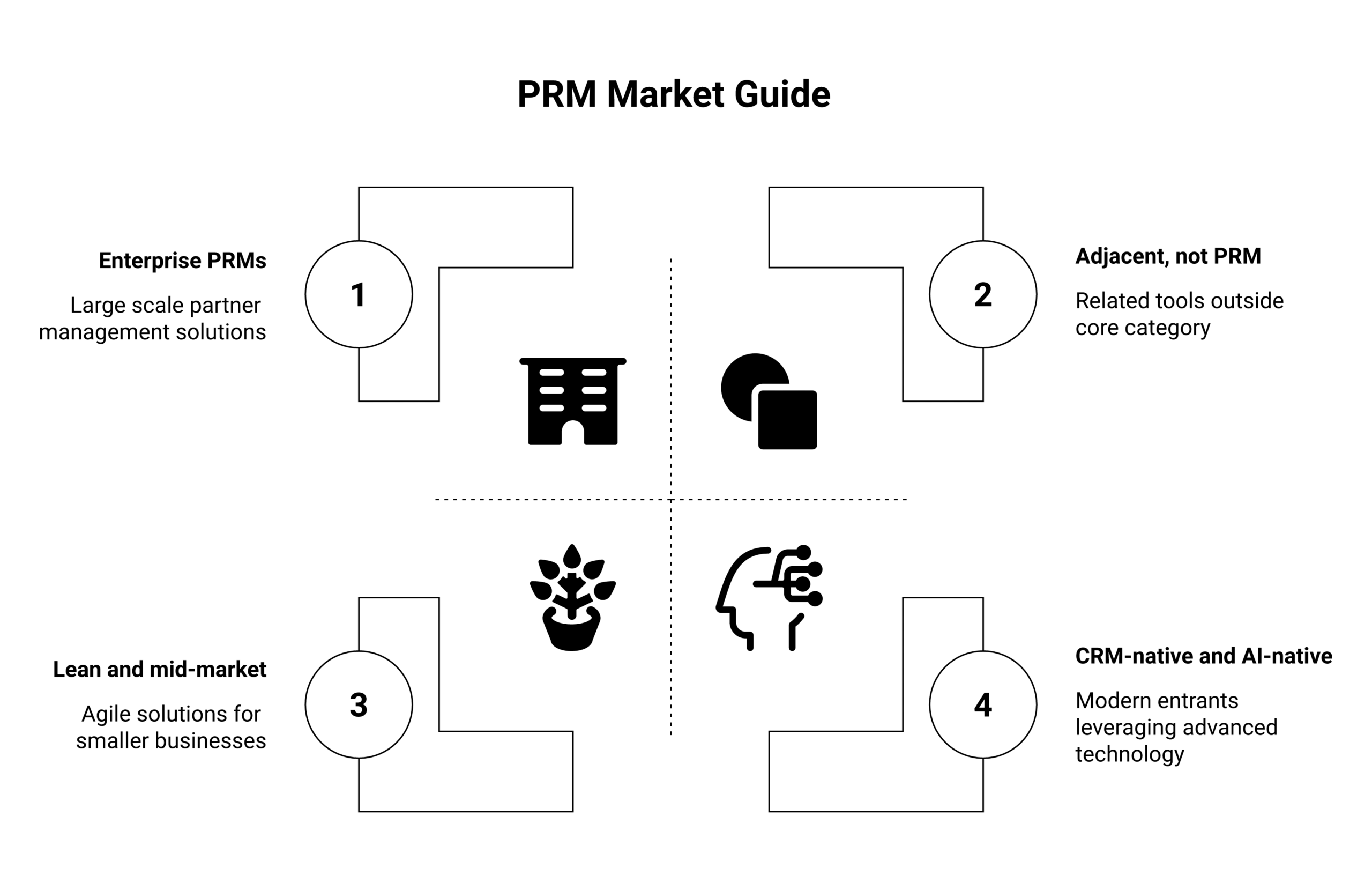
- Enterprise PRMs: mature, feature-deep platforms built for large reselling channels, with strong portals, tiering, and deal-registration hygiene. Impartner and PartnerStack anchor this group, with PartnerStack especially strong for high-volume SaaS partner and affiliate programs. These fit teams with large channels and the staff to administer them.
- CRM-native and AI-native entrants: newer tools like Introw and Euler that sit on top of the CRM and lean on automation to cut the admin burden. They target teams that want partner data where the revenue team already works and refuse to maintain a heavy portal. This is the fastest-moving part of the market.
- Lean and mid-market PRMs: options like Allbound, Zinfi, Magentrix, and Kiflo that serve mid-market channels wanting faster setup and lower cost than the enterprise tier without going fully CRM-native. Fit depends on channel size and budget.
- Adjacent, not PRM: account-mapping and ecosystem platforms (Crossbeam, Pocus, Common Room) that are frequently mistaken for PRMs. They solve overlap and signals, not program management, and belong in a separate decision.
The through-line is that the market is defined by fit to motion and team, not by feature count. An enterprise PRM is the right buy for a large administered channel and the wrong buy for a lean team that will never staff it, and the reverse is equally true.
Common pitfalls
- Conflating PRM with account mapping: treating Crossbeam, Pocus, or Common Room as PRM options and buying overlap tooling when program management was the need, or the reverse.
- Buying enterprise for a lean team: purchasing a feature-deep enterprise PRM a small team cannot administer, so it becomes expensive shelfware.
- Shopping the market to fix production: buying any PRM to fix a channel that produces nothing, when the missing piece is a motion, not a system of record.
- Feature-grid comparison: comparing vendors on feature counts instead of fit to your channel’s size and your team’s willingness to maintain the tool.
- Ignoring the CRM-native shift: defaulting to a legacy portal-first tool when a CRM-native option would actually get the internal team to use it.
What this looks like in practice
A worked example shows how the market split plays out in a real decision. In my work with partnerships teams, the recurring scene is a lean team evaluating enterprise PRMs because those are the names they recognize, then stalling because the tools are heavier than the team can run. The right move is usually the opposite of the instinct: for a small, high-touch channel, a CRM-native tool that keeps partner data where the team already works beats a feature-deep enterprise platform that needs a dedicated admin.
But the tool decision is downstream of a bigger one. Before shopping the market at all, the question is whether there is a partner motion worth systematizing. In the cases where a team buys well, they first proved a joint motion produced with a few partners, which told them exactly what they needed the PRM to organize. That order, motion first, market second, is what separates a PRM that earns its cost from one that organizes a channel that still does not sell.
The lesson is that the partner relationship management market gives you a system of record, and a system of record is only worth buying once you have a motion generating something worth recording.
Forecastable’s POV
The partner relationship management market is healthy and getting more interesting, but most buyer disappointment in it comes from a single confusion: expecting a system of record to be a production engine. The market sells tools to organize a channel. It does not sell tools that make partners sell. Buy into the market to fix a channel that produces nothing and you will own a well-organized channel that still produces nothing.
We are not a PRM and do not compete in this market; your PRM holds the tiers, the portal, and the deal registration. Forecastable operates at the activation layer. We are a partnerships operating platform focused on connecting partner conversations and actions to CRM pipeline and revenue, the flywheel from conversations to actions to pipeline to revenue. Our Co-Sell Alignment Specialist is delivered as part of the service and uses the platform to run the joint motion that gets partners producing, and to attribute what they source, on top of whichever PRM you choose.
My read of the market: the CRM-native shift is real and good, because it attacks the oldest failure mode, internal non-use. But no camp of the market solves production. Prove the motion, then buy the tool that fits your channel and team, and let the market split guide you to the right camp. Order of operations matters: motion first, market second.
Forecastable is an independent third-party. Any tools, vendors, or third-party figures referenced here are described from public information for the reader’s own evaluation, not as paid placements.
Frequently asked questions
What is the partner relationship management market? The partner relationship management market is the category of software vendors that sell systems of record for managing partner programs, including partner portals, deal registration, tier management, and reporting. In 2026 it splits into mature enterprise PRMs and a newer wave of CRM-native, AI-native entrants.
Who are the main PRM vendors? Established enterprise PRMs include Impartner and PartnerStack, with mid-market options like Allbound, Zinfi, Magentrix, and Kiflo. Newer CRM-native and AI-native entrants include Introw and Euler. Account-mapping platforms like Crossbeam, Pocus, and Common Room are a separate, adjacent category, not PRMs.
Is the PRM market growing? Yes. As more revenue becomes partner-influenced and more vendors outgrow managing channels by spreadsheet, the buyer pool for PRM software expands. The most notable recent shift is toward CRM-native tools that reduce the internal non-use that plagued earlier portal-first platforms.
What is the difference between a PRM and an account-mapping platform? A PRM manages a partner program: portal, deal registration, tiers, reporting. An account-mapping platform like Crossbeam finds shared accounts between partners. They solve different problems and belong in separate buying decisions; conflating them is a common category error.
How do you choose in the PRM market? Match the tool to your channel size, your motion, and your team’s willingness to maintain it, not to feature counts. A large administered channel fits an enterprise PRM; a lean team fits a CRM-native tool. And prove a partner motion produces before buying, because a PRM organizes production, it does not create it.
Next step
Before you shop the partner relationship management market, ask whether you have a partner motion worth systematizing or a channel that has never produced. The market sells organization; it cannot sell production.
If you want to prove the motion first and then choose the right camp of the market, that is what we do. Start your growth journey with Forecastable and we will run the partner motion on top of whatever PRM you select. Our PRM and partner tech guide covers the category, and the best PRM software guide and partner program guide go deeper on choosing a tool and building the motion it is meant to scale.
Uncover Your Growth Potential
Schedule a Discovery Call