


Account Mapping for Sales: What It Is and How to Run It

Short answer
Short answer: Account mapping in sales is the practice of comparing your customer and prospect list with a partner’s to find the accounts you share, so the two sales teams can trade warm introductions and co-sell into them. It matters because a shared account with a partner already inside it is the warmest path most reps will ever get to a target.
Here is the part almost everyone gets wrong. The overlap data is not the work. I tell teams plainly that account mapping is a commitment-and-cadence exercise, not a data exercise, and the ones who treat it as a data exercise get a tidy spreadsheet and no pipeline.
What is account mapping in sales?
Account mapping is the act of overlaying two companies’ account lists to see where they intersect: shared customers, shared prospects, and the accounts where one side is a customer and the other is chasing the deal. In a sales context, that overlap is a set of warm paths. If my partner already sells to an account I am trying to break into, an introduction from them is worth more than a hundred cold touches.
The mechanics are simple. You and a partner each bring your accounts, a tool or a spreadsheet compares them, and you get four buckets: accounts you both already serve, accounts you serve that they are pursuing, accounts they serve that you are pursuing, and net-new accounts neither of you has. Each bucket implies a different play, from a joint expansion motion to a straight warm intro.
The confusion I run into is that people think the comparison is the deliverable. It is not. The comparison tells you where a conversation is possible. Whether that conversation happens, and whether it produces a deal, depends entirely on what you do after the lists line up. As one partner leader put it to me, you can walk into a partner’s office, hold up two lists, and say “let’s work together,” and then just stare at each other. The overlap created the room. It did not fill it.
Why account mapping matters in 2026
Account mapping matters because partner-surrounded selling is now the default, not the exception. Analyst Jay McBain has estimated that roughly 96% of technology deals involve partners somewhere in the cycle, and account mapping is how you find those partners inside your own pipeline before the deal is decided. Crossbeam has reported that partner-involved deals win at higher rates and run larger than solo deals, and the overlap is what makes that involvement possible in the first place.
The second reason is efficiency. Every rep has a finite number of hours and an infinite target list. Account mapping tells a rep which of their targets a trusted partner can open this quarter, so the effort goes where a warm path already exists instead of into another cold sequence. In a market where everyone is being asked to do more with a smaller team, that prioritization is worth more than another list of names.
The catch is that the value only shows up when someone acts on the overlap. A shared account that nobody introduces is identical, in the pipeline, to an account you never mapped. The data creates potential energy. The motion converts it.
How account mapping actually works
A producing account-mapping motion runs on five components. The overlap pull is only the first, and the last three are where most programs quietly stop.
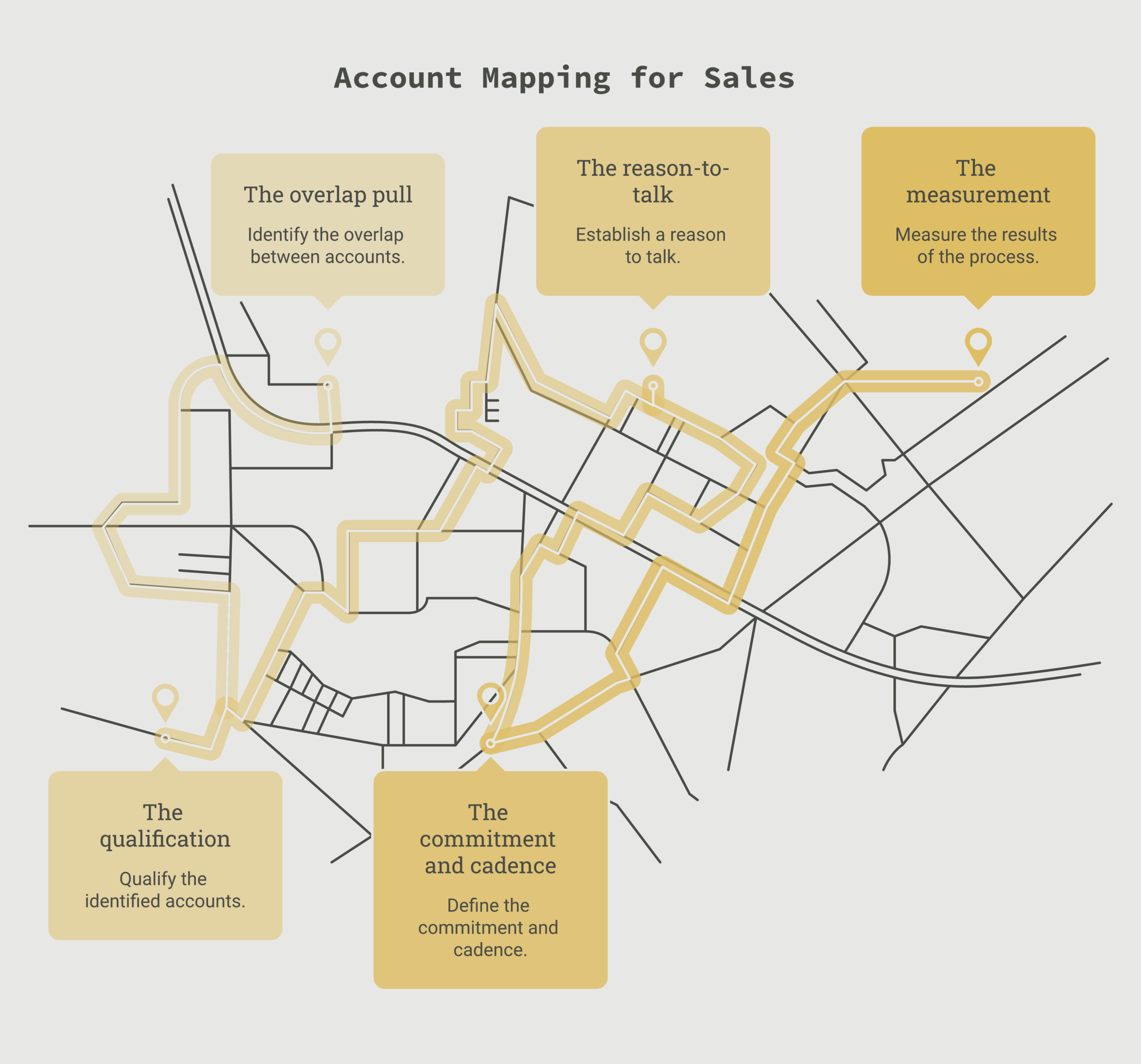
- The overlap pull: the comparison of your accounts against the partner’s, usually through an ecosystem-data tool, producing the shared-customer and shared-prospect buckets. This is the data step, and it is the easy part.
- The qualification: deciding which overlaps are actually worth a conversation. Not every shared account is a real opportunity, and a mapping session that treats all overlap equally drowns the reps in noise.
- The reason-to-talk: giving the partner’s rep a concrete hook for their customer, usually a case study matched by industry or problem, so they have something specific to open with. Without this layer, the mapping is a list comparison that produces no action.
- The commitment and cadence: agreeing, partner by partner, exactly what the two sides will do together, at what rhythm, and putting it in writing. A monthly session, how you monitor the data between sessions, how you ping each other when something moves. The commitment is the actual product of the exercise.
- The measurement: tracking how many mapped overlaps were actioned, what came of them, and how much sourced pipeline resulted per partner. This is what you carry into the next review instead of a vague sense that mapping is happening.
The through-line is that the tool produces the overlap and the humans produce the revenue. I have watched teams stand up beautiful overlap reports and generate nothing, because they treated the report as the finish line. The teams that produce treat the report as the start of a documented, cadenced motion.
Common pitfalls
- Account mapping as a data exercise: buying the overlap tool, loading the lists, and assuming reps will know what to do. If you throw data in front of reps with no play, they will not magically act on it.
- The list-comparison stare: walking into a partner session with two lists and no reason-to-talk, so both sides agree there is overlap and neither side moves.
- No written commitment: leaving a mapping session with warm feelings and no documented per-partner agreement on cadence and ownership. Nothing scheduled means nothing happens.
- Treating overlap as the symptom instead of the cause: solving the immediate account-mapping request without asking what the reps are actually failing to do, which is act on warm paths in a disciplined way.
- Measuring the map, not the motion: reporting how many accounts overlapped instead of how many overlaps were worked and what they sourced.
Tools and examples
The overlap data itself comes from ecosystem and account-mapping platforms. These tools compare account lists securely across companies and surface the shared records; they are the data layer described above, not the motion.
| Tool | What it does | Best for |
|---|---|---|
| Crossbeam | Secure account mapping and overlap data across a partner network, with alerts when overlap changes | The broadest partner network and the default overlap layer for most programs |
| Pocus | Blends product and ecosystem signals to prioritize accounts and surface warm paths | Teams that want overlap fused with usage and intent signals for prioritization |
| Common Room | Aggregates ecosystem, community, and intent signals into person and account views | Teams already running signal-based prioritization who want overlap in the same place |
A worked example makes the difference concrete. Say a partner leader runs a Crossbeam rollout across a dozen partners. The wrong version trains everyone on the tool, turns on the data, and calls it done. The right version, the one I coach, does something narrower: it picks each partner, documents what the two sides have agreed to do together, sets a monthly account-mapping session, decides how the data gets monitored between sessions, and memorializes all of it in writing per partner. Then a small operations layer, part manual on each side and part automated, keeps the cadence honest. The tool did not change. The commitment did, and that is what produced pipeline.
Forecastable’s POV
Account mapping is the clearest example in all of partnerships of a symptom being mistaken for the cause. A team feels the pain of not knowing where their accounts overlap, buys a tool that shows the overlap, and assumes the problem is solved. It is not. The overlap was never the problem. The problem was that no disciplined motion existed to act on warm paths, and the tool does not supply one.
The win in account mapping is not the data flowing. It is getting each partner to commit to regular sessions and then running them. The most valuable thing a program can do is document, partner by partner, what both sides have agreed to do together, memorialize it in writing, and stand up the operations around it. That is a cadence and an accountability problem, and it is human work supported by software, not software that runs itself.
At Forecastable we build for exactly that. We are a partnerships operating platform focused on connecting partner conversations and actions to CRM pipeline and revenue, the flywheel that runs from conversations to actions to pipeline to revenue. The overlap tools tell you where to act. The work we deliver as part of the service is turning that overlap into documented commitments, a run cadence, and sourced pipeline you can defend. The specialist runs that motion; the platform is the software they run it on.
My bet: the programs that win with account mapping will be the ones that stop shopping for a better overlap report and start measuring how many overlaps they actually worked.
Forecastable is an independent third-party. Any tools or vendors named here are described from public information for the reader’s own evaluation, not as paid placements, and Forecastable does not resell them.
Frequently asked questions
What is account mapping in sales? Account mapping in sales is comparing your account list with a partner’s to find shared customers and prospects, so the two teams can trade warm introductions and co-sell into the overlap. It turns a partner relationship into a set of specific, warm paths into named accounts.
How do you run an account mapping session? Bring both account lists, pull the overlap through a tool or spreadsheet, qualify which shared accounts are worth a conversation, give each side a concrete reason-to-talk such as a matched case study, and leave with a written, per-partner agreement on cadence and ownership. The written commitment is the real output.
What is the difference between account mapping and co-selling? Account mapping finds the shared accounts. Co-selling is the motion you run in them: the introductions, joint calls, and shared pursuit. Mapping tells you where a co-sell is possible; co-selling is the acting on it.
What tools do you use for account mapping? Ecosystem-data platforms such as Crossbeam, Pocus, and Common Room compare account lists securely and surface the overlap. They supply the data layer. They do not supply the motion, which is where the revenue is won or lost.
Why does account mapping fail to produce pipeline? Almost always because it is run as a data exercise. Teams load the overlap and expect reps to act without a play, a reason-to-talk, or a documented cadence. The data creates potential; only a committed, measured motion converts it.
How do you measure account mapping? Measure how many mapped overlaps were actioned, what resulted, and how much sourced pipeline came from each partner, not how many accounts overlapped. The map is an input; the worked overlaps are the outcome.
Next step
Take your single most important partner and ask two questions: which of your accounts do you actually share, and what did the two of you agree, in writing, to do about it this month? If the answer is a spreadsheet and a shrug, you have the data problem solved and the motion problem untouched.
If you want your account mapping run as a documented, cadenced motion that sources pipeline instead of reports, that is exactly what we do. Start your growth journey with Forecastable and we will turn the overlap into commitments and a number. Our account mapping guide covers how it fits the wider attribution picture.
Uncover Your Growth Potential
Schedule a Discovery Call


