Technology Partner Program: What It Is and How to Run It

Short answer
Short answer: A technology partner program is the structure a company uses to recruit, integrate, enable, and co-sell with software companies whose products complement its own. It matters because integrated technology partners make a product stickier and open warm access to shared customers, but a program measured by integration count produces a marketplace, not revenue.
The mistake is optimizing for breadth. A technology partner program that chases integration count builds a long directory and activates almost none of it. The revenue is in the handful you co-sell with, not the hundred you list.
What is a technology partner program?
A technology partner program is the operating framework for working with other software companies whose products integrate with or complement yours. It governs how you recruit them, how integrations get built and listed, how partners are tiered, and how the two companies go to market together. It is the program layer above individual technology partner relationships.
The structure exists because integrations do not sell themselves. A company can accumulate hundreds of technical connections and generate no shared pipeline, because the integration is a feature and the revenue comes from a go-to-market motion built on top of it. The program is what turns a directory of integrations into a set of producing partnerships.
The distinction worth holding is between an integration marketplace and a technology partner program. A marketplace lists connections and lets customers find them. A program decides which of those partners get co-sell investment, runs account mapping with them, and measures what they source. The marketplace is the catalog; the program is the motion, and companies routinely build the first and call it the second.
Why a technology partner program matters in 2026
A technology partner program matters because buyers assemble stacks, and the vendors whose products work together own more of the workflow. Analyst Jay McBain has estimated that roughly 96% of technology deals are partner-surrounded, and integrated technology partners are a large part of that surrounding activity. A program is how you engage those partners deliberately instead of hoping the integrations pay off on their own.
The strategic value is warm access and expansion. Technology and integration partners often open more expansion opportunity than resellers, because an embedded integration gives customers ongoing reasons to stay and buy more. A program that activates its strongest technology partners captures that expansion; a directory that merely lists them does not.
The recurring failure is running the program as a scoreboard for integration count. I have watched teams celebrate crossing a hundred integrations while three partners sourced all the pipeline. Signing an integration is a technical milestone. Producing revenue with a technology partner is an operating commitment, and a program that confuses the two ends up investing evenly across partners that produce nothing and partners that could produce a lot.
How a technology partner program actually works
A technology partner program that produces runs on five components. Recruitment and integration are the first two, and the three that follow decide whether the partners you sign ever source revenue.
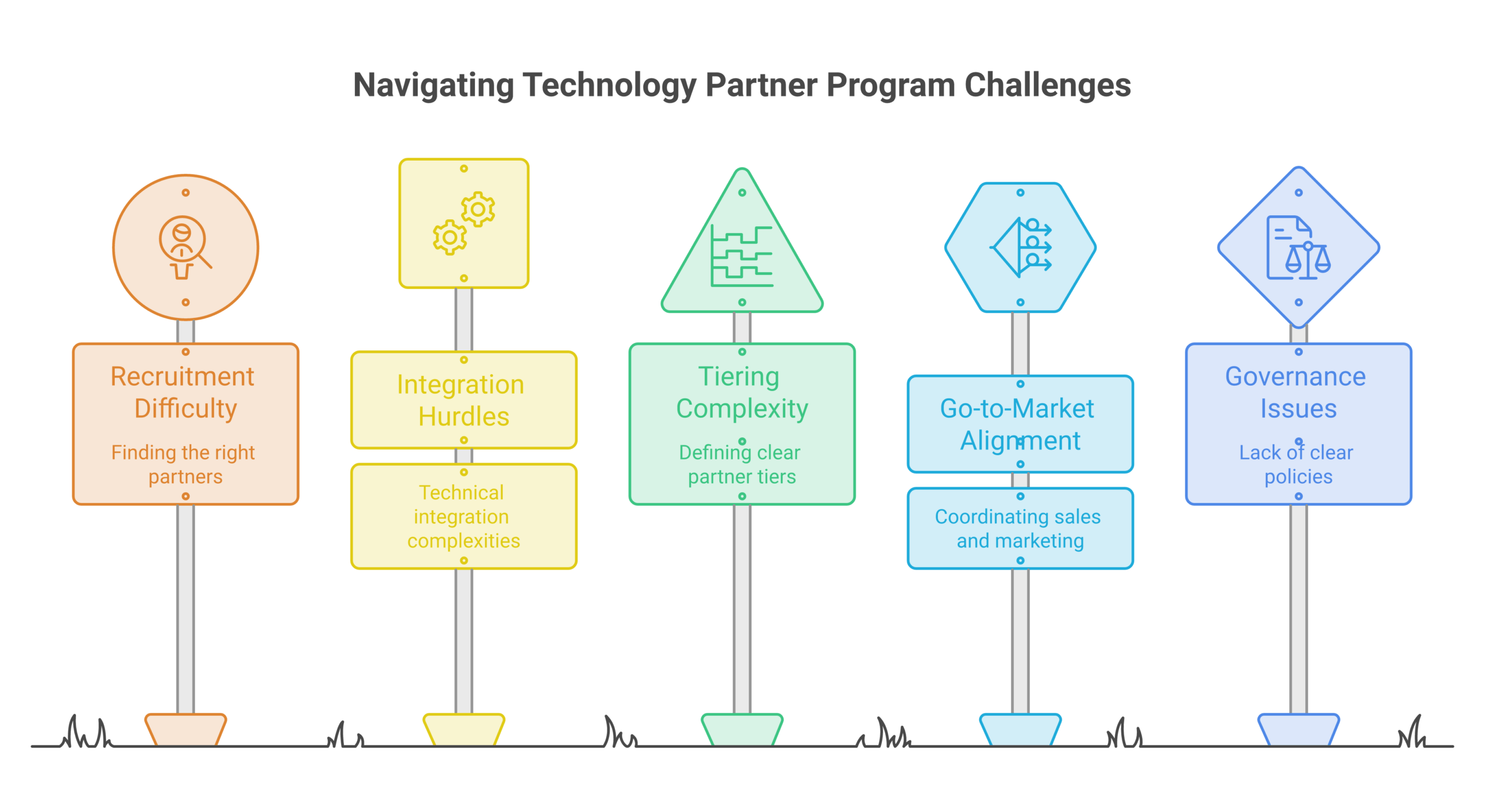
- Recruitment and ideal partner profile: decide which technology partners you actually want based on product fit and customer overlap, not on who is willing to integrate. Recruiting on availability fills the directory with weak matches.
- Integration and marketplace enablement: make it straightforward for partners to build, certify, and list an integration, so the technical work is not the bottleneck. The listing is necessary and not sufficient.
- Tiering and structure: sort partners into levels of investment so your strongest few get co-sell attention and the rest stay warm. Equal effort across unequal partners is how programs dilute themselves.
- Joint go-to-market and co-sell: build the joint value proposition, map shared accounts, and run warm introductions with your priority partners. This is where an integration becomes pipeline.
- Governance and measurement: assign owners, run a cadence, and track sourced pipeline per partner. A program that measures integration count instead of sourced revenue is optimizing the wrong number.
The through-line is that a technology partner program is a concentration exercise disguised as a breadth exercise. The integrations tempt you to count, and the revenue comes from the few you co-sell with. Programs that run all five components activate the strongest partners; programs that stop at recruitment and integration get a marketplace and a quiet pipeline.
Common pitfalls
- Measuring integration count: reporting the number of integrations as program health. A hundred listings with three producing partners is a directory, not a channel.
- Recruiting on availability: signing any company willing to integrate rather than the ones that fit. Weak matches absorb enablement effort and never co-sell.
- Marketplace as the finish line: treating a published integration as the win. The listing is the start of the go-to-market work, not the end.
- Equal effort across partners: spreading co-sell attention evenly instead of concentrating it on the strongest few. The best partners get too little and the rest get more than they return.
- No measurement: never tracking which technology partners source pipeline, so investment stays flat across producers and dormant partners alike.
What this looks like in practice
The version that works concentrates on the few. Take a program I would model this on that split its technology partners into deliberate motions rather than one flat track: systems integrators went into a co-sell and expansion motion because they carry deals, while complementary platforms went into an integration and warm-access motion because the win there is embedded workflow. Inside each motion, the team picked the three or four partners with the strongest fit and the most account overlap, mapped shared accounts, and ran an actual co-sell cadence with named plays and owners. The other partners stayed warm on a lighter touch.
That concentration is the whole point. Equal effort across unequal technology partners is how a program spreads itself into irrelevance, so the program invested where the overlap and the fit were strongest and accepted that most listings would stay dormant. The measure of the program was sourced pipeline per partner, not the size of the integration directory.
The contrast is the company that runs its technology partner program as a marketplace scoreboard. It recruits widely, celebrates the integration count, and measures success by how full the ecosystem page looks, while a tiny number of partners quietly source everything. The lesson repeats: a technology partner program rewards depth on the few, and the teams that win activate and measure their strongest integrations instead of counting all of them.
Forecastable’s POV
A technology partner program is the clearest place where counting integrations substitutes for producing revenue. The marketplace is easy to grow and satisfying to report. The co-sell motion that turns a few integrations into pipeline is harder, less visible, and the only part that produces. A program measured by directory size is measuring its own effort, not the market’s response.
At Forecastable we build for the co-sell layer of a technology partner program. We are a partnerships operating platform focused on connecting partner conversations and actions to CRM pipeline and revenue, the flywheel that runs from conversations to actions to pipeline to revenue. The integration and the listing answer “who are our technology partners.” The work we deliver as part of the service answers “which of them are producing, and what are we running this week to make more produce,” on the Forecastable platform.
My bet: the programs that win will report technology partners by sourced revenue and run a smaller, more activated ecosystem. The teams measuring integration count are optimizing the size of a catalog no one is co-selling from.
Forecastable is an independent third-party. Any tools or vendors named here are described from public information for the reader’s own evaluation, not as paid placements, and Forecastable does not resell them.
Frequently asked questions
What is a technology partner program? A technology partner program is the framework a company uses to recruit, integrate, tier, enable, and co-sell with software companies whose products complement its own. It is the program layer above individual technology partner relationships, and its purpose is to turn integrations into sourced pipeline.
What is the difference between a technology partner program and an integration marketplace? A marketplace lists integrations so customers can find them. A technology partner program decides which partners get co-sell investment, runs account mapping with them, and measures what they source. The marketplace is a catalog; the program is a go-to-market motion built on top of it.
How do you recruit technology partners? Recruit on product fit and customer overlap, not on willingness to integrate. Decide which partners genuinely complement your product and serve the accounts you want, then prioritize those. Recruiting anyone willing to build a connector fills the directory with weak matches that never co-sell.
How do you measure a technology partner program? Track sourced and influenced pipeline per partner, tied to your CRM, and watch how many partners are actively co-selling. Integration count and marketplace size are vanity metrics. The number that matters is how much pipeline your technology partners actually source.
How many technology partners should a program actively work? Fewer than it lists. The revenue concentrates in the handful with the strongest fit and account overlap, so a program should co-sell deeply with a few and keep the rest warm. Equal effort across every integration dilutes the partners that could produce.
Why do technology partner programs fail? Usually because they measure integration count instead of sourced revenue, recruit on availability, and treat a marketplace listing as the finish line. The result is a full directory that sources little pipeline, because the go-to-market motion was never built on top of the integrations.
Next step
Rank your technology partners by the pipeline they sourced last quarter, not by when they integrated. If a few produce everything and the rest are dormant, your program is measuring the wrong number, and the fix is concentration, not more integrations.
If you want your strongest technology partners activated and measured on sourced revenue, that is exactly what we do. Start your growth journey with Forecastable and we will build the co-sell motion the marketplace only hints at. Our partner program guide covers how a technology partner program fits the wider strategy.
Uncover Your Growth Potential
Schedule a Discovery Call