OEM Partners: What They Are and How to Work With Them

Short answer
Short answer: OEM partners are companies that embed your product into their own and sell the combination under their brand, so your technology reaches their customers without your logo on the box. They matter because a single OEM relationship can put your product into thousands of end customers at once, but the model concentrates risk and demands depth, not breadth.
The mistake is treating OEM like any other partner type. An OEM deal is closer to a supply relationship than a referral, and it rewards one deep, well-run partnership far more than a directory of shallow ones.
What is an OEM partner?
An OEM partner, from the term original equipment manufacturer, is a company that incorporates your product into its own offering and brings it to market as part of what it sells. In software this usually means your technology is embedded in their platform or resold under their name; in hardware it means your component ships inside their device. Either way, the end customer buys from the OEM and often does not know your company is involved.
The model sits apart from the more familiar partner types. A reseller sells your product as your product, with your brand intact, for a margin. A technology or integration partner connects two separately branded products for shared customers. An OEM partner absorbs your product into theirs, so the value moves through their brand and their customer relationship. That single difference, whose brand carries the value, changes everything about how the relationship is run.
The distinction worth holding onto is depth versus breadth. Most partner types reward a portfolio: sign many, activate the best. OEM rewards concentration. Because your product is embedded in the partner’s offering and tied to their roadmap and their customers, a strong OEM relationship is worth more than a long list of weak ones, and the failure modes are different too.
Why OEM partners matter in 2026
OEM partners matter because they offer reach and embedding that no other model matches. When your product is built into a partner’s platform, you inherit their distribution, their customer base, and a level of stickiness a standalone sale rarely achieves. One OEM relationship with a large platform can represent more end customers than a year of direct selling, which is why these deals command executive attention.
The strategic value is entrenchment. An embedded product is hard to remove, because ripping it out means re-architecting the partner’s offering. That durability cuts both ways, and it is exactly why the relationship deserves more governance than a lighter partnership, not less. The upside is large and the switching cost, once you are in, is high for both sides.
The recurring failure is spreading OEM effort thin. I watched a device company chase a wide roster of manufacturers and get shallow traction everywhere, until the strategy shifted to deepening a single primary OEM relationship rather than onboarding more. That refocus is usually the right call. A related lesson from the same work: if you do not involve the OEM partner upfront, the resellers underneath will not believe the message, so channel sequencing matters as much as the deal itself.
How OEM partnerships actually work
An OEM relationship that produces runs on five components. The embedding is only the first one, and the commercial and channel design around it decides whether the deal is worth having.
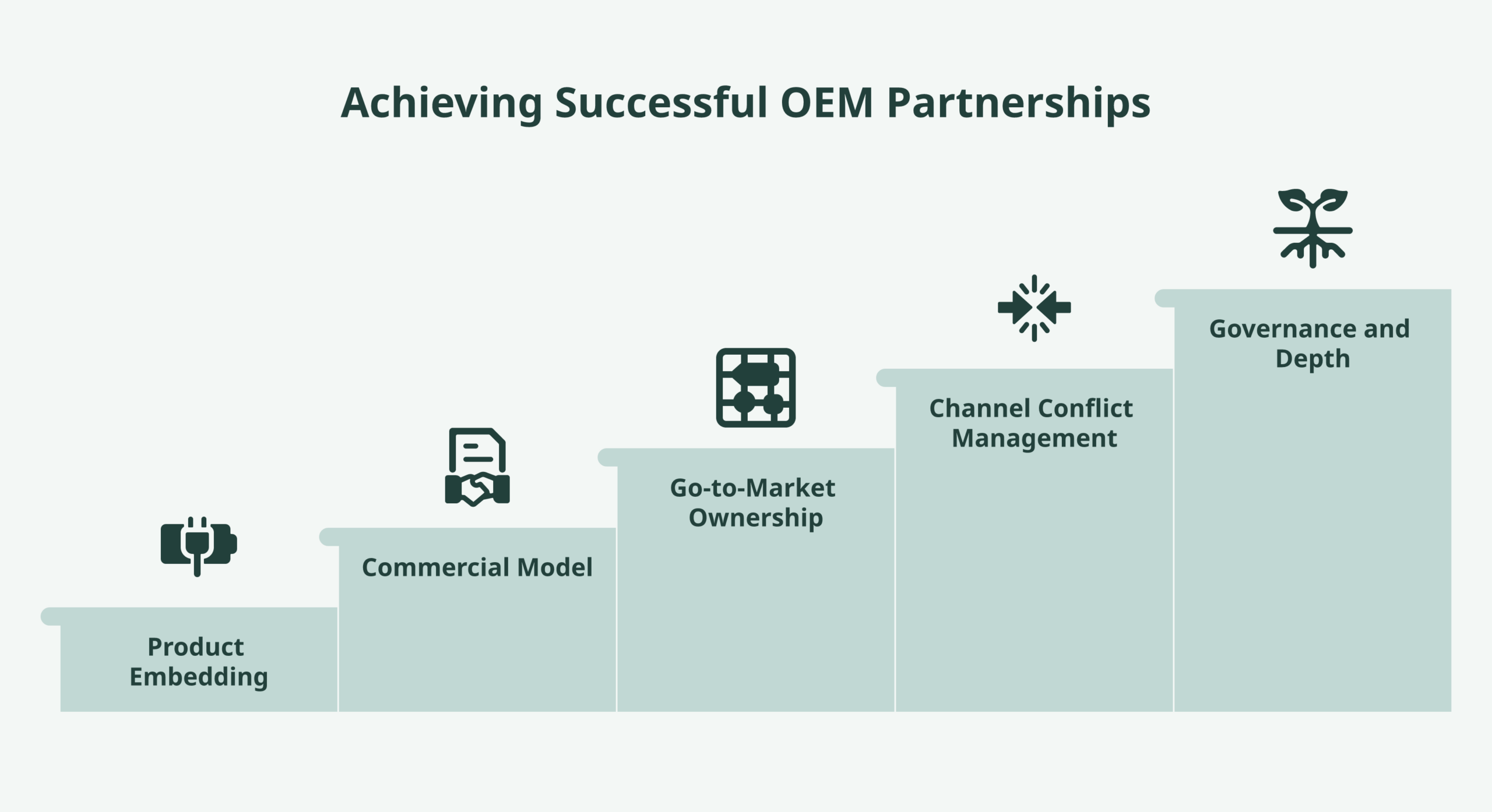
- Product embedding: the technical work of integrating your product into the partner’s offering so it functions as one. This is the substance of the deal and usually the longest lead time, because the partner is betting their product experience on yours.
- The commercial model: how you get paid, through royalties, revenue share, or wholesale pricing per unit or seat. Because your brand disappears into theirs, the economics have to work at their scale, and the model is negotiated, not listed.
- Go-to-market ownership: the OEM owns the customer relationship and the brand, so you are enabling their sales motion, not running your own. Your job shifts from selling to making their team able to sell the combined product.
- Channel conflict management: an embedded product can collide with your direct sales and with resellers carrying your standalone offering. You have to define who owns which accounts and sequence the message so the channel underneath believes it.
- Governance and depth: because the relationship is concentrated and entrenched, it needs senior ownership, a real cadence, and joint planning. An OEM deal signed and then left to run itself decays quietly and expensively.
The through-line is that OEM trades breadth for depth. The embedding creates the dependency, and the commercial, channel, and governance work decides whether that dependency pays off. Companies that treat an OEM like a logo on a partner page miss that the whole model rewards concentration and punishes neglect.
Common pitfalls
- Chasing breadth: signing many OEM partners and going shallow with all of them, when the model rewards deepening one or two strong relationships. A wide OEM roster usually means none of them are producing.
- Underpricing the embed: agreeing to royalty or wholesale terms that look fine at pilot volume and hurt at scale. Because your brand is gone, the economics are the whole return, and they have to survive the partner’s growth.
- Ignoring channel conflict: letting the embedded product collide with your direct sales or your resellers without defining boundaries. Unmanaged conflict turns your own channel against the deal.
- Skipping the upstream buy-in: rolling out an OEM message without involving the OEM partner early, so the resellers underneath do not believe it. Sequence matters, and the OEM has to be visibly in front.
- No senior owner: leaving a concentrated, entrenched relationship to run on autopilot. An OEM deal without executive governance and a cadence drifts, and the switching cost that protected you also traps you in a stale arrangement.
What this looks like in practice
The version that works concentrates. Take a hardware and platform relationship I would model this on: rather than onboarding more manufacturers to show a broad ecosystem, the team shifted its energy to deepening a single strategic OEM, building the org chart, identifying the right contacts across sales and marketing, and running an actual engagement plan against that one relationship. Same partnerships headcount, aimed at depth instead of spread, and the pipeline followed the focus.
The channel sequencing was part of it. The team understood that resellers sitting below the OEM would not carry a combined message unless the OEM was visibly committed first, so they secured upstream buy-in before pushing the message down. Get that order wrong and the reseller layer treats the whole thing as vendor noise; get it right and the OEM’s endorsement does the persuading for you.
The contrast is the company that treats OEM like any other partner tier, signs several, and measures success by how many appear on the page. None of them embed deeply, none of them are governed, and the concentrated value the model is built to capture never shows up. The lesson repeats: OEM is a depth game, and the teams that win it pick the relationships worth entrenching and run those relationships hard.
Forecastable’s POV
OEM partnerships are the clearest case of why partner count is the wrong metric. Every other partner type at least tempts you to build a portfolio; OEM openly punishes it. The value is in one or two deeply embedded, well-governed relationships, and a roster of shallow OEM deals is a sign the strategy has lost the plot.
At Forecastable we treat OEM the way the model demands, as a small number of high-stakes relationships that need real operating discipline. We are a partnerships operating platform focused on connecting partner conversations and actions to CRM pipeline and revenue, the flywheel that runs from conversations to actions to pipeline to revenue. An OEM contract answers “is the product embedded.” The work we deliver as part of the service answers “is the relationship being governed and is it producing,” run on the Forecastable platform. Concentration without governance is just exposure.
My bet: the programs that win with OEM will run fewer, deeper relationships and staff them senior, and will treat channel sequencing as part of the deal. The teams counting OEM logos are measuring the exact wrong thing about the exact partner type where breadth hurts most.
Forecastable is an independent third-party. Any tools or vendors named here are described from public information for the reader’s own evaluation, not as paid placements, and Forecastable does not resell them.
Frequently asked questions
What is an OEM partner? An OEM partner is a company that embeds your product into its own offering and sells the combination under its brand. The end customer buys from the OEM, often without knowing your product is inside. The term comes from original equipment manufacturer.
What is the difference between an OEM partner and a reseller? A reseller sells your product as your product, with your brand intact, for a margin. An OEM partner absorbs your product into theirs and sells it under their own brand. The reseller carries your logo; the OEM makes your product part of theirs.
How do OEM partners make money for both sides? The OEM sells more capable products to its own customers and keeps the customer relationship. You earn through royalties, revenue share, or wholesale pricing per unit or seat. Because your brand is not on the product, the commercial terms are the entire return, so they have to work at the partner’s scale.
How many OEM partners should a company have? Usually few. The model rewards depth, because your product is embedded in the partner’s offering and tied to their roadmap and customers. One or two well-governed OEM relationships typically produce far more than a broad roster of shallow ones.
What is channel conflict in an OEM deal? Channel conflict happens when your embedded product collides with your own direct sales or with resellers carrying your standalone product. Managing it means defining who owns which accounts and sequencing the message so the channel underneath the OEM believes and carries it.
Why do OEM partnerships fail? Usually because the company spreads effort across too many OEMs and goes shallow, underprices the embed so the economics break at scale, or leaves a concentrated relationship without senior governance. All three waste a model built to reward depth and discipline.
Next step
Look at your OEM relationships and ask whether you are running a portfolio or a focused set. If effort is spread across several shallow deals, the fix is concentration: pick the one or two worth entrenching and staff them seriously.
If you want a concentrated OEM relationship governed and measured like the high-stakes deal it is, that is the operating work we do. Start your growth journey with Forecastable and we will build the cadence and the plan behind the deal. Our partner program guide covers how OEM fits alongside your other partner types.
Uncover Your Growth Potential
Schedule a Discovery Call