B2B SaaS Marketing Partner: What It Is and How

What is a b2b saas marketing partner?
Short answer: A b2b saas marketing partner is a company you run joint marketing with, co-branded campaigns, joint webinars, shared content, and co-marketing to each other’s audiences, to create demand neither of you would generate alone. It can be a technology partner you integrate with, a channel partner who resells you, or an agency that markets on your behalf, but the defining trait is that marketing happens together, aimed at a shared audience, with leads routed to a real follow-up.
The word “partner” hides three very different arrangements. Getting value starts with being clear which kind you mean, because the motion for each is not the same.
Why a b2b saas marketing partner matters in 2026
The reason a b2b saas marketing partner matters in 2026 is that customer acquisition costs keep climbing and a partner’s audience is the one channel where you borrow trust instead of buying attention. When a partner your target buyer already trusts co-markets with you, the introduction carries credibility a cold ad never will. That borrowed trust is why joint demand converts better than the same message delivered alone, and why partner marketing has moved from a nice-to-have to a real acquisition line.
That matters more now because buyers tune out vendor marketing but still listen to companies they already use. A joint webinar with a trusted partner reaches an audience that would skip your standalone event. The partner’s endorsement, implicit in showing up together, does work your own brand cannot do by itself.
The reframe is that a b2b saas marketing partner is a demand relationship, not a logo swap. The value is not that two brands appear on a slide; it is that a shared audience hears a combined message from a source they trust, and the resulting leads get followed up. Co-marketing that stops at the co-branded asset produces awareness nobody acts on.
How a b2b saas marketing partner relationship actually works
A b2b saas marketing partner relationship works by picking a shared audience, building a joint offer, running it together, and routing the leads to real follow-up. Each step is where these programs usually break, so naming them is how you run one that produces pipeline. The parts below are the components to build.
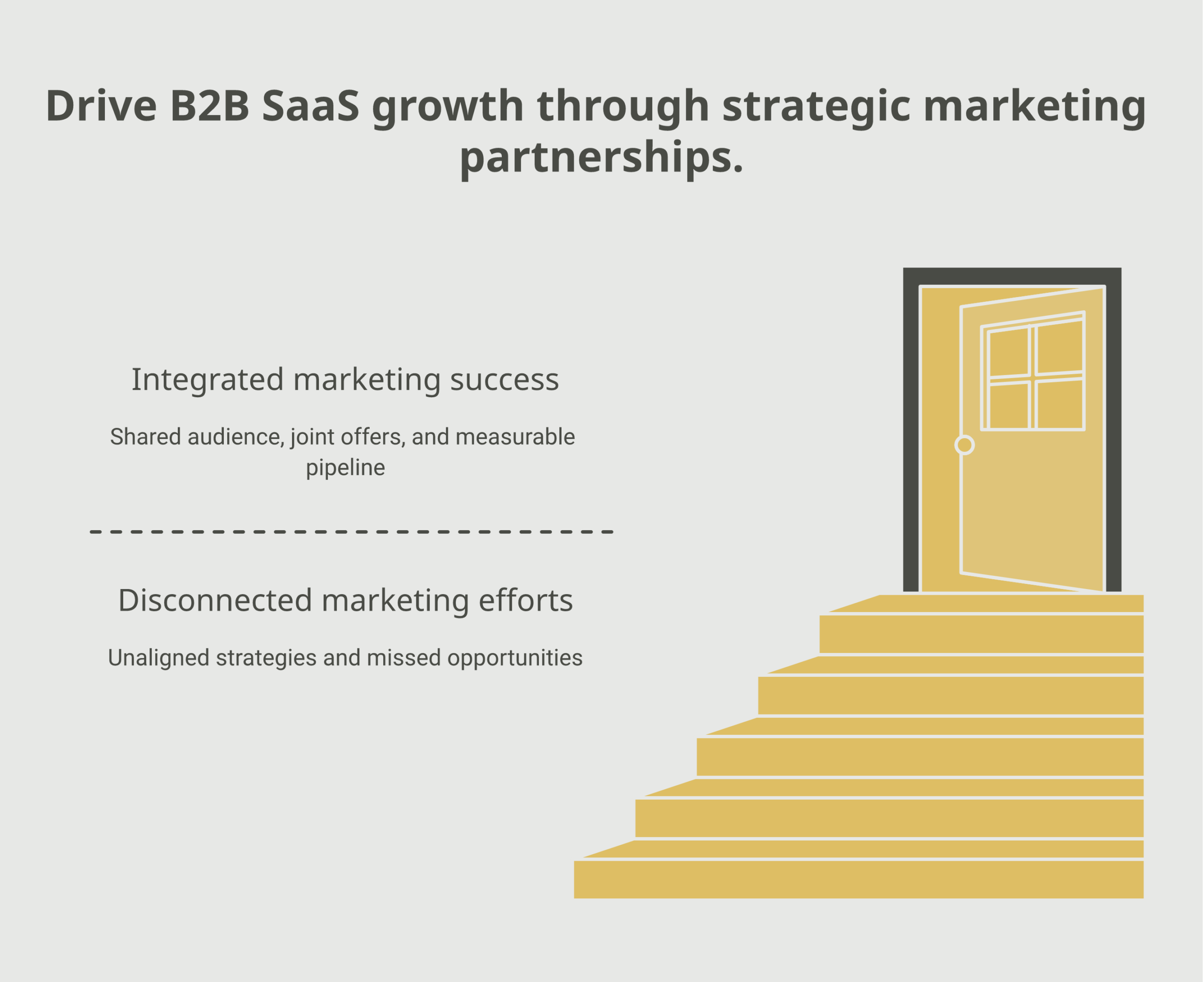
- Define the shared audience: Identify the overlap where both companies want to reach the same buyer. Co-marketing only works when both audiences genuinely benefit, so the shared segment comes first, before any campaign idea.
- Build a joint offer: Create something worth showing up for, a webinar, a research piece, a template, that combines both companies’ value. The offer has to serve the audience, not just promote the partnership, or nobody engages.
- Split the promotion: Agree who promotes to which list and how, so both audiences actually see it. A joint asset that only one side distributes reaches half the intended audience and underdelivers.
- Route and follow up the leads: Decide upfront who owns which leads and how they enter each CRM for follow-up. This is where most partner marketing dies, because the campaign runs and the leads sit unworked.
- Measure the pipeline, not the impressions: Track the leads and pipeline the joint motion produced, tied back to the CRM. Awareness metrics feel good and prove nothing, so the scorecard has to reach pipeline.
Common pitfalls when working with a b2b saas marketing partner
- Logo-swap partnerships: Two brands on a landing page with no campaign behind it produces nothing. If the relationship stops at co-branding and never runs a joint offer to a shared audience, it is a press release, not a marketing partner.
- An offer that serves neither audience: A webinar built to promote both products rather than help the buyer gets no attendance. Build the offer around the audience’s problem, and let the partnership be the mechanism, not the topic.
- Uneven promotion: If only one side actually pushes the campaign to its list, the reach is lopsided and the results disappoint the side that did the work. Agree on promotion commitments before you build the asset.
- Leads that go nowhere: The most common failure is a successful campaign whose leads are never routed or followed up. Decide lead ownership and CRM routing before launch, or the pipeline never materializes.
- Measuring awareness only: Impressions and registrations feel like success and predict nothing. If the joint motion is not tracked to leads and pipeline in the CRM, it will be cut the moment budgets tighten.
What this looks like in practice
A worked example: a SaaS company signed a marketing partnership with a complementary vendor, announced it, put both logos on a co-branded landing page, and considered the partnership live. Six months later it had produced no measurable pipeline. The relationship existed on paper, but no joint demand had ever run, because nobody had built an actual campaign or agreed who would follow up on anything it generated.
The two teams restarted with a motion instead of an announcement. They identified the specific buyer segment both companies wanted, built a joint webinar around a problem that audience actually had, and agreed that each side would promote it to its own list with a set number of sends. Most importantly, they decided before launch that registrants would be split by which list they came from, routed into each company’s CRM, and worked by a named owner on each side with a follow-up sequence. The webinar drew an audience neither would have reached alone, the leads landed in both CRMs instead of a shared spreadsheet, and the follow-up turned registrations into real conversations. The partnership finally produced pipeline, because it ran a demand motion with follow-through instead of publishing a co-branded page.
Forecastable’s POV on the b2b saas marketing partner
Our position is that most b2b saas marketing partnerships fail at the least glamorous step: lead follow-up. Teams get excited about the co-branded asset and the joint webinar, run a genuinely good campaign, and then let the leads sit because nobody agreed who owned them. The marketing was fine; the motion had no back half. Joint demand is only worth running if the leads it creates get routed and worked.
The way we would run it is to build the follow-up before the campaign. Name the shared audience, build an offer that serves them, commit both sides to promotion, and, before anything launches, decide exactly how leads get split, routed into each CRM, and worked by a named owner. Then measure to pipeline, not to registrations. A marketing partner is a demand relationship, and a demand relationship is judged by the pipeline that reaches the CRM, not by the impressions the campaign earned.
Forecastable is a partnerships operating platform that connects partner conversations and actions to CRM pipeline and revenue, the flywheel of Conversations to Actions to Pipeline to Revenue. We are a category authority on running partner-led growth, so we care that joint marketing is measured by the leads and pipeline it puts into the CRM, because co-marketing that stops at awareness produces activity no one can attribute or defend.
Any tools or frameworks referenced here are independent third-party context, and mentioning them is not an endorsement. Shape any joint marketing motion around your own audience, partners, and CRM routing before launching it.
Frequently asked questions
What is a b2b saas marketing partner? A b2b saas marketing partner is a company you run joint marketing with, co-branded campaigns, joint webinars, and shared content, aimed at a shared audience to create demand neither would alone. It can be a technology partner, a channel partner, or an agency, but the defining trait is marketing done together.
How is a marketing partner different from a channel partner? A channel partner resells or refers your product and is measured on sourced revenue. A marketing partner runs joint demand generation with you and is measured on the leads and pipeline the co-marketing produces. A single partner can be both, but the motions and metrics differ.
Why do co-branded campaigns usually stall? Because they stop at the co-branded asset. A landing page with two logos and no joint offer, uneven promotion, or no lead follow-up produces awareness nobody acts on. The campaigns that work run a real offer to a shared audience and route the leads to named owners.
Who follows up on the leads from joint marketing? That has to be decided before launch. Leads are typically split by which partner’s list they came from, routed into each company’s CRM, and worked by a named owner with a follow-up sequence. Skipping this step is the most common reason partner marketing produces no pipeline.
How do you measure a b2b saas marketing partner? By the leads and pipeline the joint motion produced, tied back to the CRM, not by impressions or registrations. Awareness metrics feel like success and predict nothing, so the scorecard has to reach pipeline to prove the partnership worked.
What makes a good joint offer? One that serves the shared audience’s problem rather than promoting both products. A webinar, research piece, or template built around the buyer’s need draws attendance and engagement, while an offer built to advertise the partnership gets ignored.
Next step
If your marketing partnership is a co-branded page that has never produced pipeline, the fix is to run a real joint offer and, above all, decide lead follow-up before you launch. Start your growth journey now to turn co-marketing into pipeline that reaches the CRM. The partner program hub frames how partner marketing fits the wider program.
Uncover Your Growth Potential
Schedule a Discovery Call