Behavioral Incentives for Partners: A Guide

What are behavioral incentives for partners?
Short answer: Behavioral incentives for partners are rewards tied to the specific actions that lead to revenue, such as completing certification, registering deals, or bringing a qualified opportunity, rather than only to a closed sale. They exist because the closed deal is a lagging result, and it pays partners for the habits that produce pipeline before the revenue shows up.
The idea is to reward the leading indicators. A partner who registers deals, gets trained, and sources qualified opportunities will produce revenue, so paying for those behaviors pulls production forward instead of waiting for it.
The useful question is not whether to use behavioral incentives, it is which behaviors actually predict revenue in your motion, because rewarding the wrong ones just buys activity.
Why behavioral incentives for partners matter in 2026
The reason behavioral incentives matter in 2026 is that partner programs are being measured on partner-sourced pipeline, and pipeline is built by behaviors that happen long before a deal closes. If you only reward the close, you give partners no reason to do the early work, registering, training, sourcing, that makes the close possible. Rewarding behavior connects the incentive to the part of the funnel the partner actually controls.
That matters more now because programs have too many partners and too little time to nurture each one personally. A well-designed behavioral incentive scales the nudge: it tells every partner, without a call, which actions the program values and pays for. Done well, it steers a large partner base toward productive habits. Done badly, it pays for box-checking that never converts.
The reframe is that a behavioral incentive is a signal about what you believe drives revenue. If you reward a behavior that does not predict production, you have not motivated your partners, you have taught them to farm the reward. The design is only as good as the link between the behavior and the money.
How behavioral incentives for partners actually work
Behavioral incentives work by identifying the actions that predict revenue, attaching a reward to each, and measuring both the behavior and whether it actually converts. The discipline is in choosing behaviors that lead to money and checking that the link holds. The parts below are the model to run.
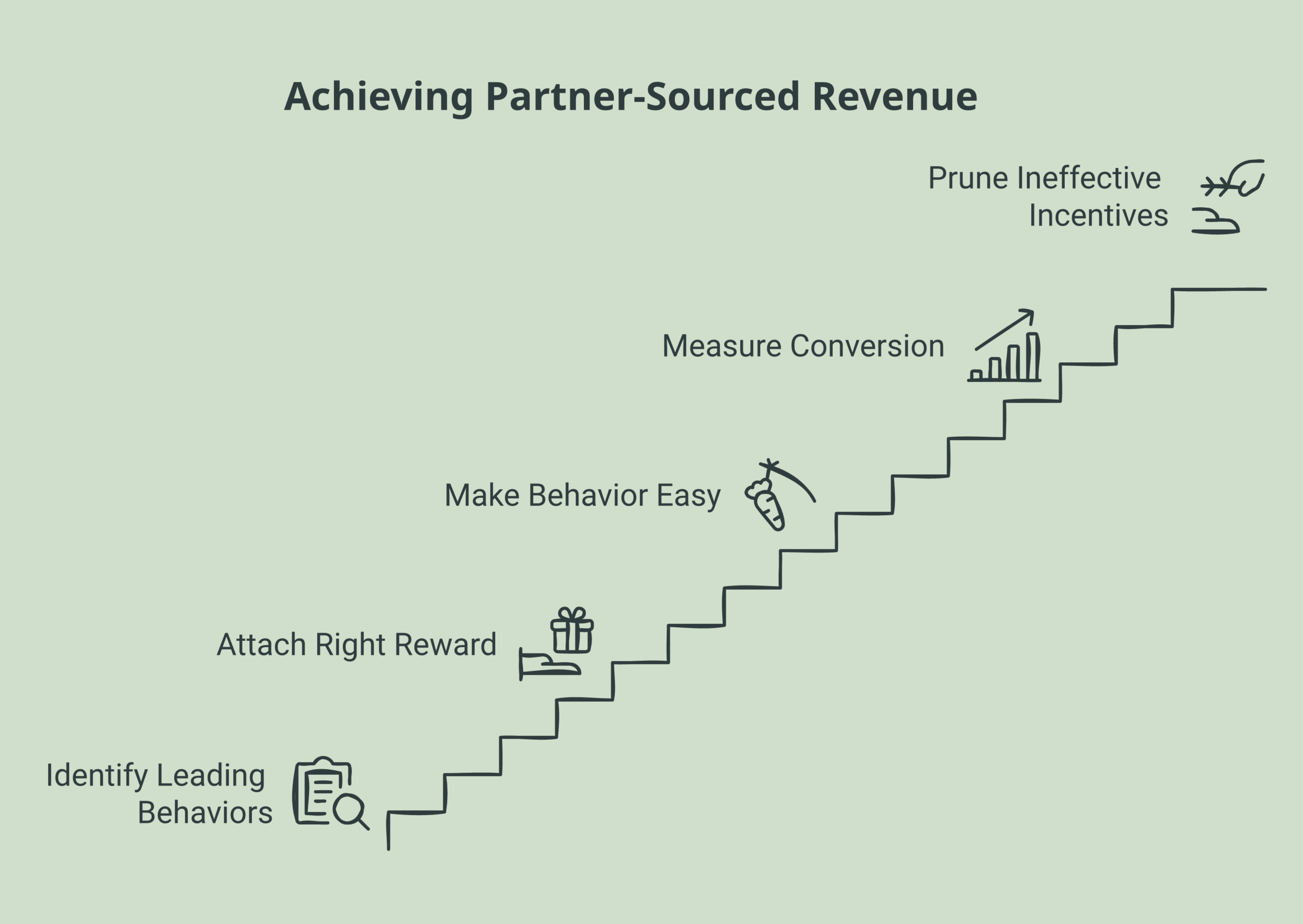
- Identify the leading behaviors: Find the actions that reliably precede partner-sourced revenue in your motion, such as certification, deal registration, or sourcing a qualified opportunity. These are the behaviors worth paying for, because they predict the outcome you want.
- Attach the right reward: Match each behavior to an incentive that fits its value, from recognition and tier progress to spiffs or margin. The reward should be proportional to how much the behavior actually moves revenue, not uniform across everything.
- Make the behavior easy to do and to prove: Reduce the friction of the action and the friction of claiming the reward. If registering a deal or logging a certification is painful, the incentive fights the process instead of reinforcing it.
- Measure conversion, not just completion: Track whether the rewarded behavior converts to pipeline and revenue, not just whether partners did it. This is the check that separates a real incentive from a reward partners farm without producing.
- Prune what does not convert: Retire incentives for behaviors that turn out not to predict revenue, and double down on the ones that do. An incentive scheme that never gets pruned drifts into paying for activity.
Common pitfalls with behavioral incentives for partners
- Rewarding activity that does not convert: The central failure is paying for a behavior that feels productive but does not lead to revenue. Portal logins, content downloads, and webinar attendance are easy to reward and easy to farm, so check the conversion before you pay for them.
- Making the reward the goal: If the incentive is large enough and the behavior easy enough, partners optimize for the reward, not the outcome. Register junk deals, claim the spiff, move on. Design so gaming the behavior is not worth more than producing.
- Uniform rewards for unequal behaviors: Paying the same for a low-value action and a high-value one distorts effort. Weight the reward to the revenue impact, or partners chase the easiest reward regardless of its worth.
- Too much friction to claim: An incentive nobody can be bothered to claim changes no behavior. If proving the action is harder than doing it, the scheme dies quietly.
- Never revisiting the scheme: Behaviors that once predicted revenue can stop predicting it as the motion changes. An incentive program that is set and forgotten slowly pays for the wrong things.
What this looks like in practice
A partnerships team measured on partner-sourced pipeline noticed that partners who registered deals early produced far more revenue than partners who did not, but most partners registered late or not at all. Instead of adding another close-based bonus, it built a behavioral incentive: tier progress and a modest spiff for registering a qualified deal within a set window, with the reward paid only when the registration met a real qualification bar. It made registration a two-click action and the reward automatic once the bar was met.
The team then watched conversion, not just registrations. Early registrations climbed, and because the qualification bar was real, the registered deals converted at the rate the data had predicted. When one add-on incentive for attending enablement webinars showed no lift in production, the team retired it rather than keep paying for attendance. The behavioral incentive worked because every reward was tied to an action that the data showed led to revenue, and because the team kept checking that the link held.
Forecastable’s POV on behavioral incentives for partners
Our position is that behavioral incentives are powerful and dangerous for the same reason: they get partners to do exactly what you pay them to do. If you pay for behaviors that predict revenue, you pull production forward and scale a nudge across a large base. If you pay for behaviors that merely look productive, you fund box-checking and call it engagement. The design is the whole game, and the design lives or dies on whether the rewarded behavior actually converts.
That is the frame we would apply to any partner incentive. Start from the revenue and work backward to the behaviors that reliably precede it, reward those in proportion to their impact, make them easy to do and to prove, and then measure conversion relentlessly. Prune anything that does not convert. The goal is not more partner activity; it is more partner-sourced revenue, and a behavioral incentive only earns its cost when it produces the second, not just the first.
Behavioral incentives are one lever inside a program that has to be measured end to end. Forecastable is a partnerships operating platform that connects partner conversations and actions to CRM pipeline and revenue, the flywheel of Conversations to Actions to Pipeline to Revenue, so the actions you incentivize are the same actions you can trace to production. That is what keeps an incentive scheme honest: you can see whether the behavior you paid for turned into pipeline, and stop paying when it does not.
Any third-party tools, firms, or benchmarks referenced here are independent and mentioned for context, not as endorsements. Evaluate any incentive design against your own partner base and motion before rolling it out.
Frequently asked questions
What are behavioral incentives for partners? Behavioral incentives for partners are rewards tied to the actions that lead to revenue, such as certification, deal registration, or sourcing a qualified opportunity, rather than only to a closed sale. They pay for the leading indicators of production so partners are motivated to do the early work that builds pipeline.
How are they different from a standard partner commission? A commission rewards the closed deal, which is a lagging result. Behavioral incentives reward the earlier actions the partner controls and that predict the close. The two work together: behavior incentives pull production forward, and the commission rewards the outcome.
Which behaviors are worth incentivizing? Only the ones that reliably precede partner-sourced revenue in your motion, typically certification, timely deal registration, and sourcing qualified opportunities. Avoid rewarding easy-to-farm activity like logins or downloads unless you can show it converts.
How do you keep partners from gaming the incentive? Attach the reward to a real qualification bar, weight it to the behavior’s actual revenue impact, and measure conversion rather than completion. If producing is worth more than gaming, and the bar is genuine, farming the reward stops being profitable.
How often should you revisit an incentive scheme? Regularly, because behaviors that once predicted revenue can stop predicting it as the motion changes. Track conversion continuously and prune incentives that no longer lead to production so the scheme keeps paying for the right things.
Do behavioral incentives work for small programs? Yes, and they can matter more, because a small team cannot nurture every partner personally. A simple behavioral incentive scales the nudge toward productive habits, as long as the rewarded behaviors genuinely convert and the scheme stays easy to claim.
Next step
If your partner incentives reward the close but not the behaviors that build pipeline, you are leaving the early work unmotivated and paying only for results you can already see. Start from the revenue, reward the behaviors that predict it, and measure whether they convert. Start your growth journey now to build a partner motion where the actions you reward are the actions you can trace to revenue. The partner program hub frames how incentives fit the broader program.
Uncover Your Growth Potential
Schedule a Discovery Call