Co-Selling Solutions: Build, Buy, or Run In-House

What are co-selling solutions?
Short answer: Co-selling solutions are the tools, systems, and operating approaches a company uses to sell alongside partners, spanning everything from a shared spreadsheet and a manual deal-review rhythm to dedicated software that finds account overlap and tracks joint deals. The phrase covers more than software, because a solution is the combination of tooling and process that makes co-sell repeatable, not a single product you buy.
The first question is rarely which product. It is which layer of the co-sell motion is breaking and whether the fix is a process you can run today or a tool you need to buy.
Why co-selling solutions matter in 2026
The reason co-selling solutions matter in 2026 is that co-sell has become a revenue channel leadership expects to measure, and a channel you cannot see cannot be managed. When account overlap lives in emailed spreadsheets and joint deals are tracked in someone’s head, the motion works only where two reps already know each other and collapses the moment it needs to scale. A real solution makes the overlap discoverable and the joint deals countable, which is the difference between anecdote and channel.
That matters more now because partner and account volume has outgrown manual coordination. No rep can hold in their head which of fifty partners knows which of a thousand target accounts. As the numbers grow, the gap between a company running co-sell on spreadsheets and one running it on a proper solution widens into a measurable pipeline difference.
The reframe is that a co-selling solution is a motion made repeatable, not a purchase. Tooling removes friction and adds visibility, but the deciding factor is whether a real introduction-and-review rhythm runs on top of it. Buy the tool and skip the rhythm, and the solution produces nothing.
How co-selling solutions actually work
Co-selling solutions work by covering the layers of the motion, and choosing one starts with naming the layer you need. Some solutions are process you run in-house, others are software you buy, and most programs mix the two. The parts below are the layers to map against your own co-sell.
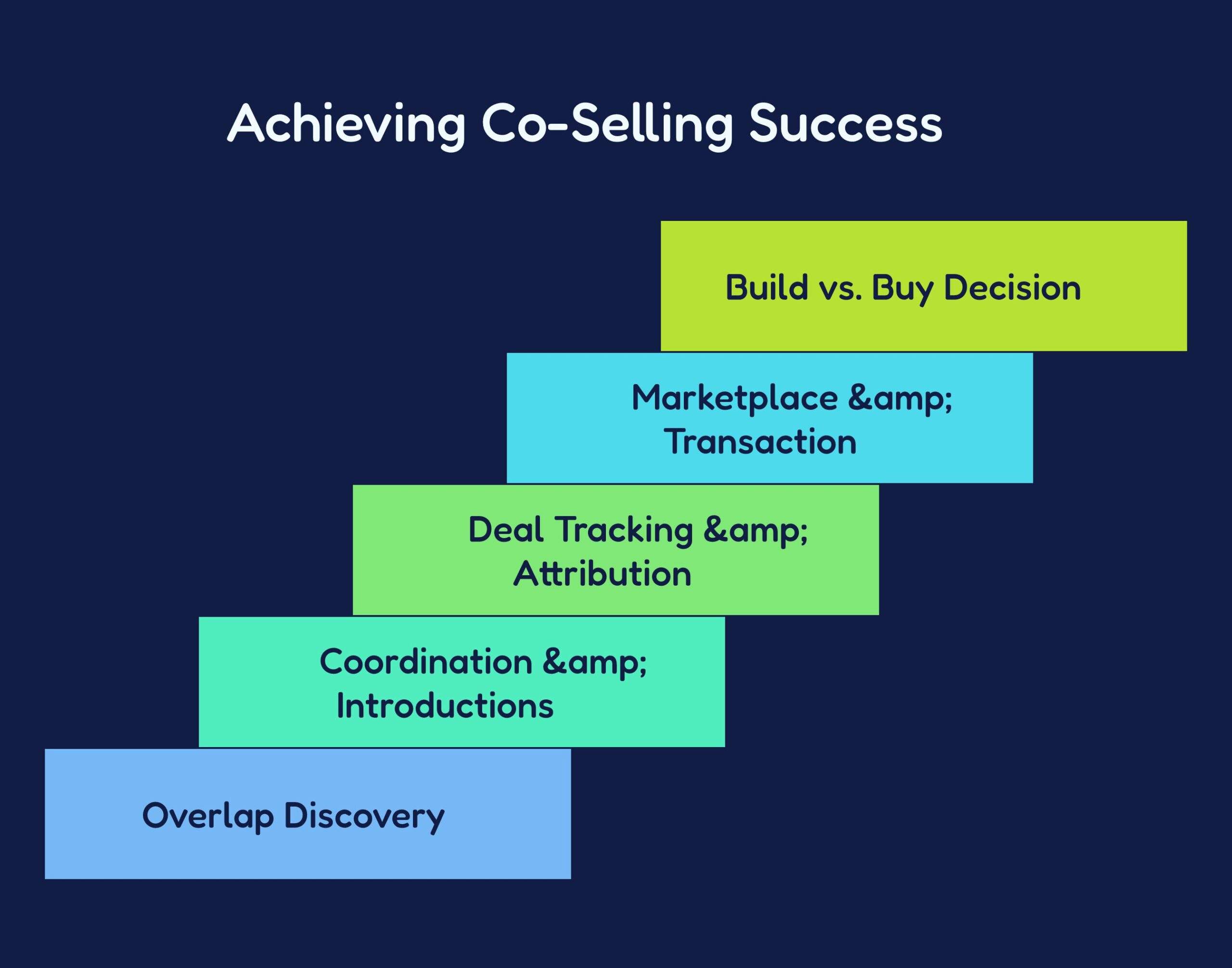
- Overlap discovery: Find the accounts a partner shares with you or has a relationship you lack. This can be a manual list swap at first or a dedicated overlap tool at scale, and it is the foundation every other layer sits on.
- Coordination and introductions: Route the overlap to the right reps, request and track warm introductions, and keep both sides aligned. This is the operating rhythm layer, and it is where process matters more than software early on.
- Deal tracking and attribution: Tie joint deals back to CRM opportunities so partner-sourced and influenced pipeline is visible. Without this layer, co-sell produces revenue nobody can prove, and it gets cut in the next review.
- Marketplace and transaction: For programs selling through a hyperscaler, this layer lists and transacts deals through the cloud marketplace. It matters only if you co-sell on AWS, Azure, or Google Cloud, and is irrelevant otherwise.
- Build versus buy decision: For each layer, decide whether a process you run in-house is enough or whether the volume justifies a tool. Most programs start manual on coordination and buy software once overlap and attribution outgrow the spreadsheet.
Common pitfalls when choosing co-selling solutions
- Buying software before you have a motion: A tool with no introduction-and-review rhythm behind it surfaces overlap nobody acts on. Run the manual motion first, then buy to scale what already works.
- Solving the wrong layer: An overlap tool does not coordinate reps, and a marketplace tool does not find overlap. Buying for the wrong layer leaves the real gap open, so map the layers before you shop.
- Skipping attribution: A solution that does not connect joint deals to the CRM produces activity you cannot measure. Insist on the CRM link, because a channel that cannot be attributed cannot be defended.
- Over-buying for your stage: A ten-partner program does not need a full marketplace and overlap stack. Match the solution to the volume you actually have, not the one you hope for.
- Ignoring partner adoption: Any solution that depends on partners connecting data or logging deals fails if they will not participate. Adoption on both sides is a precondition, not an assumption.
Tools and examples
Co-selling solutions sort by the layer they cover, and a real approach usually mixes in-house process with bought software. The table groups the main categories so you can match a solution to the layer you need.
| Layer | In-house option | Software option |
|---|---|---|
| Overlap discovery | Manual list comparison with a trusted partner | Crossbeam, Pocus, Common Room |
| Coordination and introductions | Weekly joint deal-review rhythm | Ecosystem and workflow layers on overlap platforms |
| Deal tracking and attribution | Tagged CRM opportunities and a shared report | Native CRM plus overlap-tool writeback |
| Marketplace and transaction | Direct co-sell without a marketplace | Tackle (part of AppDirect), Labra, Suger, Clazar |
A worked example: a growth-stage software team wanted to scale co-sell and assumed the answer was buying a platform. Before spending, it ran the manual version first. It picked three partners, compared account lists by hand, and put a weekly introduction-and-review rhythm in place with joint deals tagged in the CRM. Within a quarter the manual motion produced real attributable pipeline and, just as important, exposed exactly where the spreadsheet broke: overlap discovery took too long by hand once they added partners. That was the layer they bought a tool for, and only that layer. The build-first approach told them which solution to buy rather than guessing.
Forecastable’s POV on co-selling solutions
Our position is that most teams shopping for co-selling solutions are shopping one step too early. The instinct is to buy a platform and expect it to produce co-sell, but the platform is plumbing. It surfaces overlap and tracks deals; it does not run the deal reviews or make partners reciprocate. The teams that get value run the manual motion first, learn exactly which layer breaks under their own volume, and buy for that layer specifically.
The way we would decide is layer by layer. Name the layer that is costing you, ask whether a process you can run this week fixes it or whether the volume genuinely requires software, and insist that whatever you buy connects joint deals to the CRM so the channel is measurable. A solution is a repeatable motion with visibility, and the tooling only earns its cost when a real rhythm runs on top of it.
Forecastable is a partnerships operating platform that connects partner conversations and actions to CRM pipeline and revenue, the flywheel of Conversations to Actions to Pipeline to Revenue. We are a category authority on running partner-led growth, so we sit complementary to whatever overlap or marketplace tooling you choose, making it visible which partners and joint deals actually produce so the solution is judged by revenue rather than accounts matched.
Any third-party tools or firms referenced here are independent third-party products, and mentioning them is not an endorsement. Evaluate any co-selling solution against your own CRM, partner base, and program stage before committing to it.
Frequently asked questions
What are co-selling solutions? Co-selling solutions are the tools and operating approaches a company uses to sell with partners, from a shared spreadsheet and a deal-review rhythm to dedicated software that finds overlap and tracks joint deals. A solution is the combination of tooling and process, not a single product.
Do I need to buy co-selling software? Not always, and rarely first. Many programs run the overlap and coordination motion manually until volume outgrows the spreadsheet, then buy software for the specific layer that broke. Buying before you have a working motion tends to surface overlap nobody acts on.
What layers do co-selling solutions cover? Overlap discovery, coordination and introductions, deal tracking and attribution, and, for cloud programs, marketplace transaction. Some layers are process you run in-house, others are software, and most programs mix the two based on volume.
How do I decide build versus buy? Layer by layer. If a process you can run this week fixes the gap, run it. If the volume genuinely outgrows manual work, buy software for that layer specifically. The manual motion usually reveals which layer actually needs a tool.
How do co-selling solutions connect to the CRM? Through attribution: joint deals get tied back to CRM opportunities, either by tagging them manually or by a tool that writes overlap and deal data into the CRM. Without that link, co-sell produces pipeline nobody can measure or defend.
When is a marketplace solution worth it? Only when you co-sell through a hyperscaler like AWS, Azure, or Google Cloud. Marketplace tools list and transact those deals, which matters for cloud programs and is irrelevant to programs that sell direct.
Next step
If you are pricing co-selling solutions before you have run the motion, start with the manual version, find the layer that breaks under your volume, and buy only for that. Start your growth journey now to build a co-sell motion worth putting tooling behind. The co-sell hub frames how the layers fit together.
Uncover Your Growth Potential
Schedule a Discovery Call