Co-Sell Messaging: How to Build a Joint Pitch

What is co-sell messaging?
Short answer: Co-sell messaging is the shared story two partnered companies tell a single buyer about why their combined solution solves a problem neither one solves as well alone. It names the customer’s problem, states how the two products work together, and gives both sales teams the same words to use in front of the account. It is not two pitches stapled together, it is one narrative built around the customer.
The test is simple. If a rep from either company can tell the joint story in two sentences without naming a feature, the messaging works. If they default to their own product pitch, it does not.
Why co-sell messaging matters in 2026
The reason co-sell messaging matters in 2026 is that co-sell has become a measured revenue channel, and a channel with no shared story produces two sales teams talking past each other in the same account. When both partners walk into a customer meeting with their own pitch, the buyer hears two vendors, not one solution, and the joint motion collapses into a warm introduction that goes nowhere. Shared messaging is what makes the meeting feel like a solution rather than a handoff.
That matters more now because buyers expect the partners in front of them to have done the integration thinking already. A customer does not want to assemble the value of two products in their head during a sales call. If the partners cannot articulate the combined value crisply, the buyer assumes it does not exist, and the deal stays single-vendor.
The reframe is that co-sell messaging is a customer story, not a partnership announcement. The point is not that two companies are working together, the point is what the customer gets because they are. Messaging that leads with the partnership loses the buyer; messaging that leads with the customer problem keeps them.
How co-sell messaging actually works
Co-sell messaging works by building one narrative both teams can carry, anchored on the customer rather than either product. It starts from a shared problem, states the combined value, and arms both sales teams with the same language. The parts below are the components to build, in order.
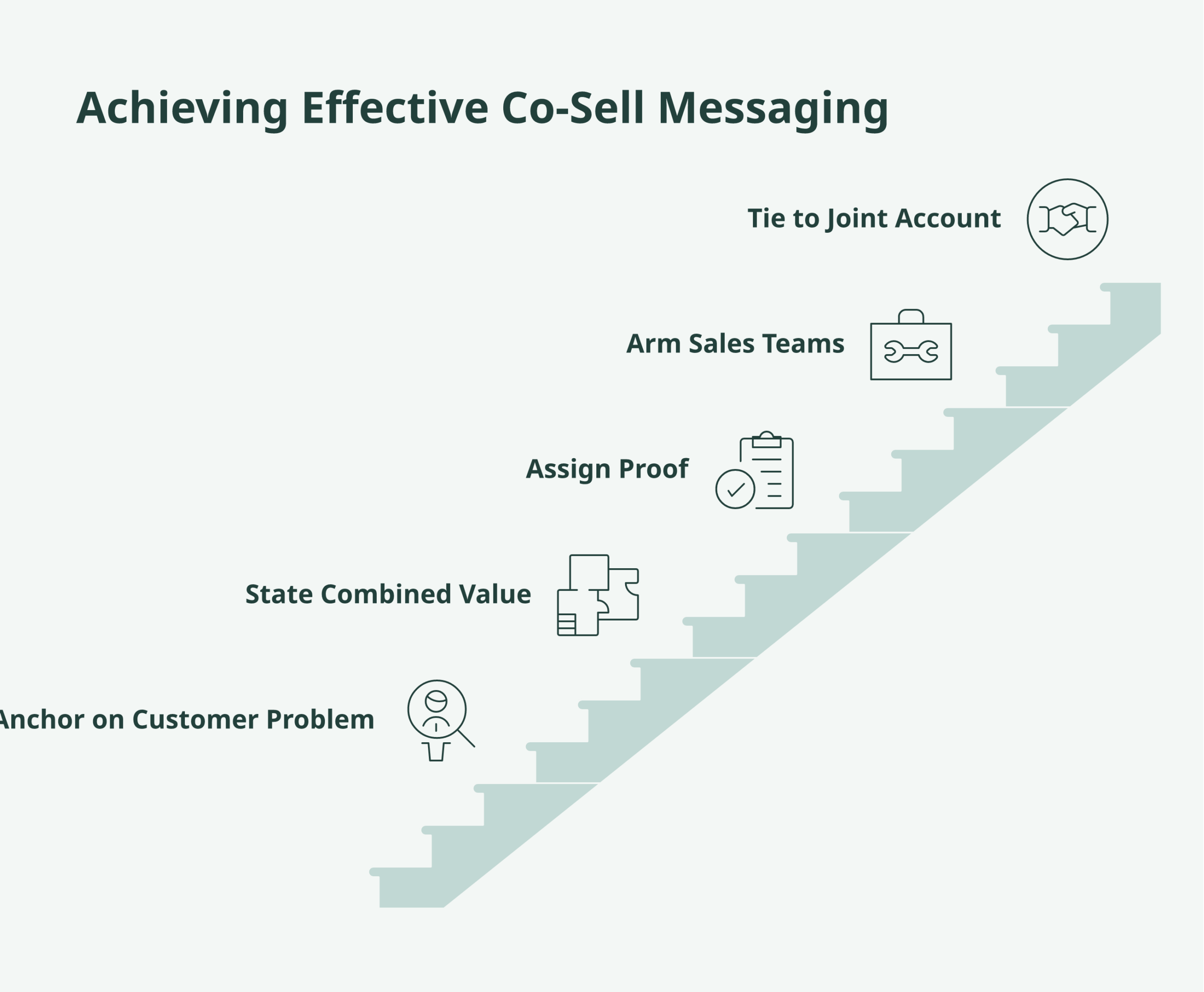
- Anchor on the customer problem: Start with a problem the shared target account actually has, stated in the customer’s words. The joint story only works if it opens on the buyer’s pain, not on either company’s product, so the problem statement comes first.
- State the combined value: Say what the two products do together that neither does alone, in one sentence a buyer would repeat. This is the core of the message, and it should describe an outcome, not a feature list from each side.
- Assign the proof: Decide which partner proves which part of the claim, so the story has evidence. One company may own the integration proof, the other the outcome proof, and the messaging should make clear who says what.
- Arm both sales teams: Give reps on both sides the same two-sentence version, the same discovery questions, and the same objection answers. Messaging that lives in a deck nobody reads is not messaging; it has to reach the reps in usable form.
- Tie it to the joint account: Connect the message to the specific accounts the partners are working together, so it is used in real deals and not just at launch. The story earns its keep in a live co-sell review, not in a marketing asset.
Common pitfalls when building co-sell messaging
- Leading with the partnership: “Company A and Company B are excited to partner” tells the buyer nothing they care about. Lead with the customer problem and the combined outcome; the partnership is the mechanism, not the message.
- Stapling two pitches together: A joint story is not each company’s slides back to back. If the message is two product pitches in sequence, the buyer hears two vendors and assembles nothing. Build one narrative anchored on the customer.
- Feature soup: Listing every capability of both products drowns the combined value. Pick the one outcome the partnership creates and cut the rest, because a buyer remembers one clear claim and forgets ten features.
- Messaging that never reaches reps: A joint value deck that sits in a shared drive changes nothing. If the two sentences, discovery questions, and objection answers do not reach the sellers, the messaging exists on paper only.
- No owner for the story: If neither partner owns keeping the message current, it drifts as products change. Assign one owner on each side so the joint narrative stays accurate as both offerings evolve.
What this looks like in practice
A worked example: two software companies with a real integration kept losing joint deals because their sales teams pitched separately. The first company’s rep would demo their product, then hand off to the partner’s rep, who demoed theirs. Buyers left the meetings understanding two tools and no combined reason to buy both. The partnership had produced introductions but almost no closed revenue.
The two partnerships teams sat down and built one story. They opened on a specific operational problem their shared customers had, stated in the customer’s language, then wrote a single sentence describing what the combined solution did about it. They decided which company proved the integration and which proved the business outcome, and they wrote a two-sentence version, three discovery questions, and answers to the four objections that always came up. Then they ran it into a live co-sell deal review and coached both sales teams to use it. The next joint meetings felt like one solution. Reps from either company could open the same way, ask the same discovery questions, and the buyer heard a single combined value instead of two product tours. The messaging did not change the products; it changed whether the buyer could see why the two belonged together.
Forecastable’s POV on co-sell messaging
Our position is that co-sell messaging is the most underbuilt part of most co-sell programs. Teams invest in overlap data and deal registration, then send two sales forces into shared accounts with no shared story, and wonder why the introductions do not convert. The overlap tells you where to sell together; the messaging is what you actually say when you get there, and skipping it wastes the overlap.
The way we would build it is customer-first and rep-usable. Start on the buyer’s problem, state the one combined outcome, assign the proof, and get the two-sentence version into the reps’ hands, then pressure-test it in a live joint deal rather than a launch email. A joint message is only real when a seller from either company uses it in front of a customer and the buyer hears one solution. Everything before that is a document.
Forecastable is a partnerships operating platform that connects partner conversations and actions to CRM pipeline and revenue, the flywheel of Conversations to Actions to Pipeline to Revenue. We are a category authority on running partner-led growth, so we care that a joint message actually shows up in the conversations reps have and the deals they log, because messaging that never reaches a live account produces no measurable co-sell.
Any tools or frameworks referenced here are independent third-party context, and mentioning them is not an endorsement. Build any joint message around your own products, partners, and shared accounts before taking it to a customer.
Frequently asked questions
What is co-sell messaging? Co-sell messaging is the shared story two partnered companies tell a single buyer about why their combined solution solves a problem better than either alone. It anchors on the customer’s problem, states the combined value in one sentence, and gives both sales teams the same words to use in the account.
How is co-sell messaging different from a partner announcement? A partner announcement says two companies are working together. Co-sell messaging says what the customer gets because they are. The announcement is about the partnership; the messaging is about the buyer’s outcome, which is the only part a customer cares about.
Why do joint pitches usually fail? Because they are two product pitches stapled together instead of one narrative. When each rep pitches their own product in sequence, the buyer hears two vendors and assembles no combined reason to buy. A single story anchored on the customer problem fixes it.
Who owns co-sell messaging? Both partnerships teams build it together, and each side names one owner to keep it current as products change. The sales teams on both sides use it, but without a named owner on each side the message drifts and goes stale.
How do you know co-sell messaging is working? When a rep from either company can tell the joint story in two sentences without naming a feature, and when joint meetings feel like one solution rather than two demos. The clearest signal is joint pipeline that converts rather than introductions that stall.
Where should co-sell messaging live? In the reps’ hands and in the live deal review, not only in a launch deck. The two-sentence version, discovery questions, and objection answers have to reach the sellers in usable form, or the messaging exists on paper and changes nothing in real accounts.
Next step
If your co-sell produces introductions that stall because both teams pitch separately, the missing piece is a shared story anchored on the customer, not more overlap data. Start your growth journey now to turn joint messaging into co-sell pipeline that converts. The co-sell hub frames how messaging fits the broader motion.
Uncover Your Growth Potential
Schedule a Discovery Call