Design Partner Program: What It Is and How to Run

What is a design partner program?
Short answer: A design partner program is a structured arrangement where a company recruits a small set of early customers to help shape a product in exchange for early access, influence over the roadmap, and favorable terms. It is how a product gets built with real users instead of guesses, and its value is a tight feedback loop with committed customers who have a genuine stake in the outcome rather than a casual free trial.
The commitment is the point. A design partner agrees to engage deeply, give honest feedback, and put the product to real use; in return they get influence and access they could not buy later. It is a two-way commitment, not a giveaway.
The useful question is not how many design partners to sign, it is whether each one will actually commit, because a design partner who does not engage is worse than no design partner at all.
Why a design partner program matters in 2026
The reason a design partner program matters in 2026 is that building the wrong thing is the most expensive mistake a product team can make, and design partners are the cheapest insurance against it. A handful of committed early customers, used well, tell you what to build, what to cut, and what nobody actually needs, before you have spent a year and a launch on the wrong bet. That feedback loop is worth far more than the revenue the design partners themselves represent.
That matters more now because markets move fast and a product built in isolation ships stale. Design partners keep the build anchored to real use as it changes. They also become the first proof points, the reference customers and case studies that make the eventual launch credible, if the program is run so they succeed rather than just sign.
The reframe is that a design partner program is a commitment mechanism, not a discount mechanism. The value comes from the depth of engagement, not the number of logos. A program that trades access for real involvement produces a better product and durable advocates; one that trades access for nothing produces a list of names that never engaged.
How a design partner program actually works
A design partner program works by selecting the right early customers, setting a clear mutual commitment, running a tight feedback loop, and converting engaged partners into references and paying customers. The discipline is in the selection and the commitment, because the rest fails without them. The parts below are the model to run.
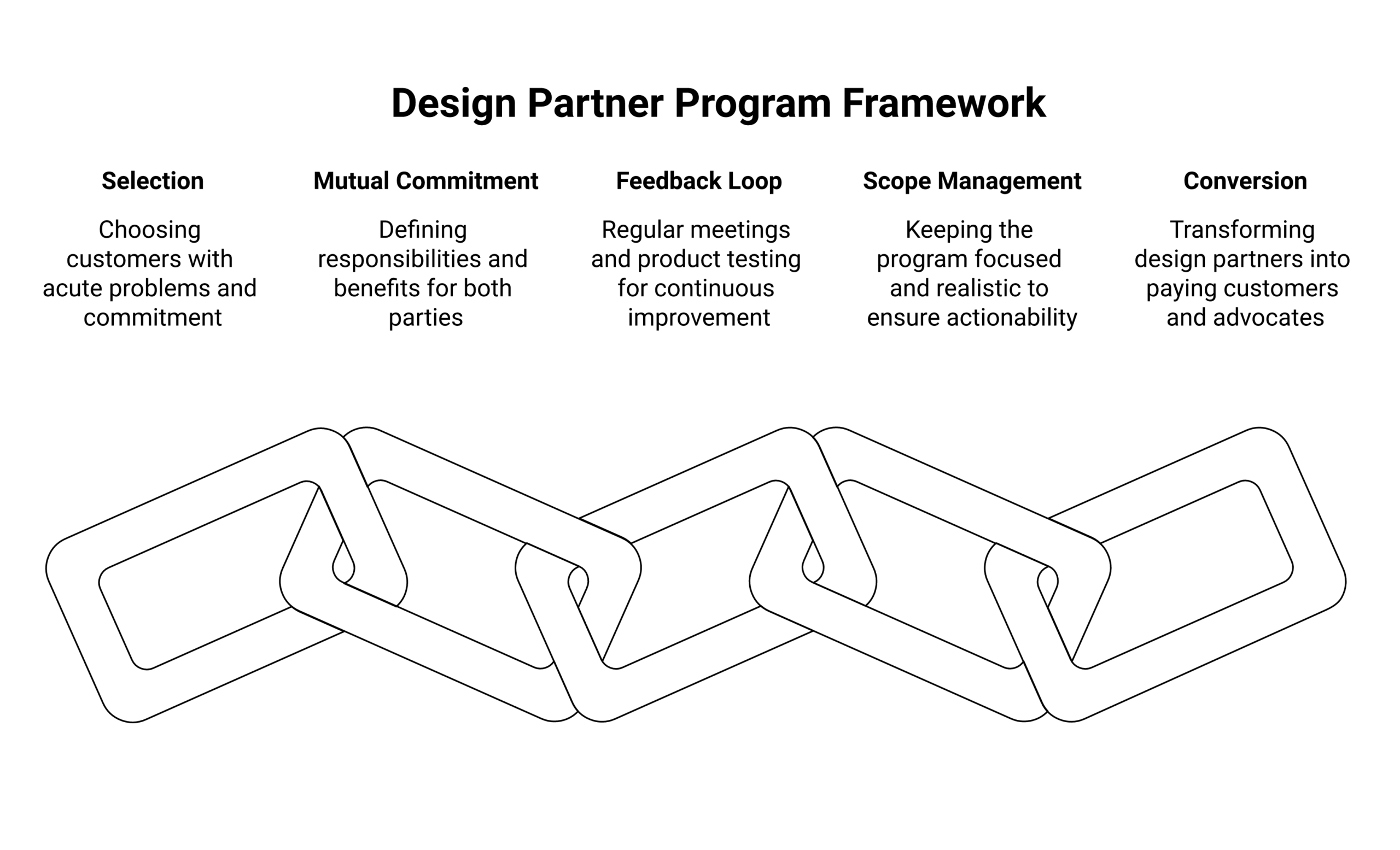
- Select for fit and commitment: Choose a small number of customers who have the problem acutely, will actually use the product, and will give honest feedback. Selection is the whole game, because an unengaged design partner consumes attention and returns nothing.
- Set a mutual commitment: Agree explicitly on what each side gives: the customer commits to real usage and regular feedback, the company commits to access, influence, and terms. A clear two-way commitment is what separates a design partner from a free trial.
- Run a tight feedback loop: Meet on a regular cadence, put the product in front of real workflows, and turn feedback into visible roadmap decisions. The loop only works if partners see their input change the product, which is what keeps them engaged.
- Manage scope and expectations: Keep the group small and the roadmap honest, so you can actually act on the feedback and partners are not promised things you will not build. Overcommitting on scope or count breaks the loop and the trust.
- Convert to references and revenue: As the product matures, turn engaged design partners into paying customers, case studies, and references. This is the payoff of running the program so partners succeed, and it only happens if the earlier steps built real advocates.
Common pitfalls in a design partner program
- Selecting for logos over commitment: The most common failure is signing recognizable names that never engage. A famous customer who does not use the product or give feedback is worse than an unknown one who does, because it costs attention and delivers nothing.
- Treating it as a free pilot: If the arrangement is just early access with no mutual commitment, partners behave like trial users. The commitment is what makes the feedback real, so a program without it produces the surface engagement of a trial.
- Signing too many: A large design partner group cannot be served well, and you cannot act on everyone’s feedback. Keeping the group small is what lets you run a tight loop and actually change the product in response.
- Feedback that goes nowhere: If partners give input and never see it affect the roadmap, they disengage. The loop dies the moment partners conclude their feedback is being collected and ignored.
- No conversion plan: A program that never turns engaged partners into references and paying customers wastes the advantage it built. Plan the conversion from the start, or the goodwill and the proof points evaporate at launch.
What this looks like in practice
A product team launching a new module signed eight design partners, most of them chosen because they were well-known names the team wanted on a slide. Only two engaged; the rest took the early access, used the product lightly, and gave little feedback. The team spent its attention chasing the six who did not care and shipped a module shaped mostly by the two who did, which was lucky rather than designed.
On the next module the team ran it differently. It picked four customers who had the problem badly and would commit to weekly sessions and honest feedback, and it wrote down the mutual commitment so expectations were explicit. It ran a tight cadence, showed each partner how their feedback changed the roadmap, and kept the group small enough to act on everything. All four engaged, the module shipped closer to what users actually needed, and three converted into paying reference customers with case studies at launch. The difference was not the product team; it was selecting for commitment and running a real loop instead of collecting logos.
Forecastable’s POV on the design partner program
Our position is that a design partner program is a commitment, not a free pilot, and every failure traces back to forgetting that. The value is not the early revenue or the recognizable names; it is the depth of engagement from customers who have a genuine stake in the product being right. Trade access for real involvement and you get a better product and durable advocates. Trade access for nothing and you get a list of names that never engaged and a roadmap shaped by whoever happened to show up.
That is the frame we would apply to any early-customer program. Select ruthlessly for commitment, write the mutual commitment down, keep the group small enough to serve, close the feedback loop so partners see their influence, and plan the conversion to references and revenue from the start. The program is a mechanism for building the right thing with committed people, and it works exactly to the degree that the commitment is real.
Design partners are the front end of a relationship that continues as a customer and often a partner. Forecastable is a partnerships operating platform that connects partner conversations and actions to CRM pipeline and revenue, the flywheel of Conversations to Actions to Pipeline to Revenue, so the engagement you build in a design partner program can be tracked as those relationships mature into pipeline. That continuity is what keeps the early commitment from being a one-time event.
Any third-party tools, firms, or benchmarks referenced here are independent and mentioned for context, not as endorsements. Adapt any program design to your own product, market, and stage before running it.
Frequently asked questions
What is a design partner program? A design partner program recruits a small set of early customers to help shape a product in exchange for early access, roadmap influence, and favorable terms. It is a two-way commitment: the customer engages deeply and gives honest feedback, and the company gives access and influence they could not buy later.
How is a design partner different from a beta tester or a free trial? A design partner commits to real usage and regular feedback and gets influence in return, while a beta tester or trial user engages casually with no mutual commitment. The commitment is what makes design partner feedback deep and reliable rather than surface-level.
How many design partners should you have? Few. A small group is what lets you serve each partner well, run a tight feedback loop, and actually act on the input. Signing too many produces feedback you cannot act on and partners you cannot serve, which breaks the program.
How do you choose design partners? Select for fit and commitment: customers who have the problem acutely, will genuinely use the product, and will give honest feedback. Resist choosing for recognizable names alone, because a famous logo that never engages costs attention and returns nothing.
How do you keep design partners engaged? Run a regular cadence and, crucially, show partners how their feedback changes the roadmap. Engagement dies when partners conclude their input is collected and ignored, so a visible, acted-on feedback loop is what keeps them involved.
How do design partner programs pay off? Through a better product built on real use, and through converting engaged partners into paying customers, case studies, and references at launch. The payoff depends on running the program so partners succeed, which is why selection and the feedback loop matter more than the count.
Next step
If your early-access customers sign up and never engage, you are running a free pilot, not a design partner program, and the feedback loop that justifies the whole effort is missing. Select for commitment, write it down, and close the loop. Start your growth journey now to build partner relationships that produce as they mature. The partner program hub frames how design partners fit the broader program.
Uncover Your Growth Potential
Schedule a Discovery Call